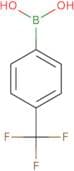
CAS 128796-39-4
:Acide 4-(trifluorométhyl)phénylboronique
Description :
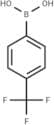
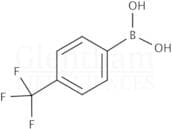
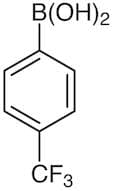
Acide 4-(trifluorométhyl)phénylboronique est un composé organoboré caractérisé par la présence d'un groupe fonctionnel acide borique attaché à un cycle phénylique qui possède un substituant trifluorométhyle. Ce composé présente généralement une apparence cristalline blanche à blanc cassé et est soluble dans des solvants organiques polaires. Le groupe trifluorométhyle améliore la lipophilie du composé et peut influencer sa réactivité et son interaction avec les systèmes biologiques. En tant qu'acide borique, il peut participer à diverses réactions chimiques, y compris le couplage de Suzuki, qui est significatif dans la synthèse organique pour former des liaisons carbone-carbone. De plus, il peut agir comme un acide de Lewis, se coordonnant avec des bases et jouant un rôle dans la catalyse. La présence du groupe trifluorométhyle peut également conférer des propriétés électroniques uniques, le rendant utile dans le développement de produits pharmaceutiques et d'agrochimiques. Dans l'ensemble, Acide 4-(trifluorométhyl)phénylboronique est un composé polyvalent avec des applications en chimie synthétique et en science des matériaux.
Formule :C7H6BF3O2
InChI :InChI=1S/C7H6BF3O2/c9-7(10,11)5-1-3-6(4-2-5)8(12)13/h1-4,12-13H
Code InChI :InChIKey=ALMFIOZYDASRRC-UHFFFAOYSA-N
SMILES :C(F)(F)(F)C1=CC=C(B(O)O)C=C1
Synonymes :- 4-(Trifluoromethyl)Benzeneboronic Acid
- 4-(Trifluoromethyl)Phenylboronic Acid
- 4-[(Trifluoromethyl)-Phenyl]-Boronic Acid
- B-[4-(Trifluoromethyl)phenyl]boronic acid
- Boronic acid, B-[4-(trifluoromethyl)phenyl]-
- Boronic acid, [4-(trifluoromethyl)phenyl]-
- [p-(Trifluoromethyl)phenyl]boronic acid
- p-(Trifluoromethyl) phenylboronic acid
- α,α,α-Trifluoro-p-tolylboronic acid
Trier par
Degré de pureté (%)
0
100
|
0
|
50
|
90
|
95
|
100
9 produits concernés.
4-(Trifluoromethyl)benzeneboronic acid, 98%
CAS :4-(Trifluoromethyl)benzeneboronic acid is used of this drug is to N-arylate imidazoles and amines with copper-exchanged fluorapatite, as well as used in microwave-promoted cross-coupling with acid chlorides leading to aryl ketones. This Thermo Scientific Chemicals brand product was originally part oFormule :C7H6BF3O2Degré de pureté :98%Couleur et forme :White to pale cream, PowderMasse moléculaire :189.93Boronic acid, B-[4-(trifluoromethyl)phenyl]-
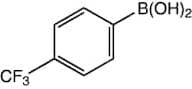
CAS :Formule :C7H6BF3O2Degré de pureté :98%Couleur et forme :SolidMasse moléculaire :189.9275Ref: IN-DA000YEL
1g26,00€5g30,00€10g34,00€1kgÀ demander25g60,00€2kgÀ demander50g85,00€5kgÀ demander100g116,00€500g543,00€4-(Trifluoromethyl)phenylboronic acid
CAS :4-(Trifluoromethyl)benzeneboronic acid: N-arylating agent for imidazoles/amines, aids in microwave-assisted cross-coupling to aryl ketones.Formule :C7H6BF3O2Degré de pureté :98%Couleur et forme :White PowderMasse moléculaire :189.934-(Trifluoromethyl)benzeneboronic acid
CAS :4-(Trifluoromethyl)benzeneboronic acidFormule :C7H6BF3O2Degré de pureté :98%Couleur et forme : white solidMasse moléculaire :189.93g/mol4-(Trifluoromethyl)phenylboronic Acid (contains varying amounts of Anhydride)
CAS :Formule :C7H6BF3O2Degré de pureté :97.0 to 111.0 %Couleur et forme :White to Light yellow powder to crystalMasse moléculaire :189.934-(Trifluoromethyl)phenylboronic acid
CAS :Formule :C7H6BF3O2Degré de pureté :99.0%Couleur et forme :SolidMasse moléculaire :189.934-(Trifluoromethyl)phenylboronic acid
CAS :4-(Trifluoromethyl)phenylboronic acid is a boronic acid that has been used as a model system to study the cross-coupling reaction. This compound is synthetically challenging and has shown high resistance to degradation by natural compounds, such as dopamine. 4-(Trifluoromethyl)phenylboronic acid can also be used for o-glycosylation, a reversible covalent process in which an alcohol reacts with an unprotected carbohydrate. The compound has been shown to react with uridine and hydrogen bond with the carbonyl group of sugars, giving it the potential to serve as a fluorescent probe for detection of carbohydrates in urine samples or other biological fluids.Formule :C7H6BF3O2Degré de pureté :Min. 95%Masse moléculaire :189.93 g/mol

![Boronic acid, B-[4-(trifluoromethyl)phenyl]-](/_next/image/?url=https%3A%2Fstatic.cymitquimica.com%2Fproducts%2FIN%2Fthumb%2FDA000YEL.jpg&w=3840&q=75)