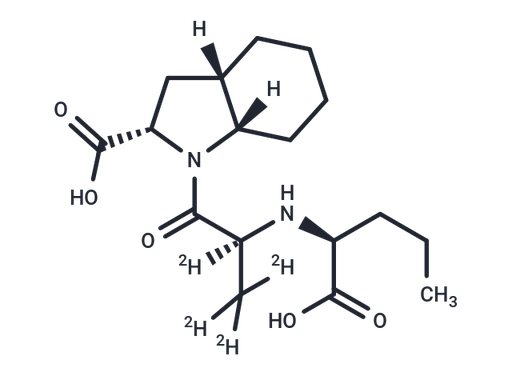
CAS 1356841-18-3
:Formule :C17H28N2O5
InChI :InChI=1S/C17H28N2O5/c1-3-6-12(16(21)22)18-10(2)15(20)19-13-8-5-4-7-11(13)9-14(19)17(23)24/h10-14,18H,3-9H2,1-2H3,(H,21,22)(H,23,24)/t10-,11-,12-,13-,14-/m0/s1/i2D3,10D
Code InChI :ODAIHABQVKJNIY-NREMRFMJSA-N
SMILES :[2H][C@@](C(=O)N1[C@H]2CCCC[C@H]2C[C@H]1C(=O)O)(C([2H])([2H])[2H])N[C@@H](CCC)C(=O)O
Filtrer par
Pourcentage de pureté
0
100
|
0
|
50
|
90
|
95
|
100
8 produits trouvés.
- Tri par prix ascendant
- Tri par prix descendant
- Puretés inférieures
- Puretés supérieures
- Livraison estimée la plus rapide
Perindopril EP Impurity B-d4 (Perindopril USP Related Compound B-d4 (Free Hydrate), Perindoprilat-d4)
CAS :Formule :C17H24D4N2O5Couleur et forme :White To Off-White SolidMasse moléculaire :344.44Perindoprilat-d4 (Mixture of Diastereomers)
CAS :Produit contrôléApplications Perindoprilat-d4 is the isotope labelled analog of Perindoprilat (P287531); an angiotensin-converting enzyme (ACE) inhibitor and antihypertensive.
References Pascard, C., et al.: J. Med. Chem., 34, 663 (1991)Formule :C17H24D4N2O5Couleur et forme :NeatMasse moléculaire :344.44Perindoprilat-D4
CAS :Perindoprilat-D4 is a deuterated compound of Perindoprilat. Perindoprilat (T1484) has a CAS number of 95153-31-4. Perindoprilat (T1484) is an angiotensin-converting enzyme inhibitor.Formule :C17H24D4N2O5Masse moléculaire :344.44Perindoprilat-d4
CAS :Perindoprilat-d4 is a medicinal compound that has been extensively studied for its potential use in cancer treatment. It has been shown to induce apoptosis, or programmed cell death, in a variety of cancer cell lines. Perindoprilat-d4 also inhibits the activity of certain kinases, which are enzymes that play a key role in regulating the cell cycle and promoting cell growth. This inhibition leads to a disruption of the normal cell cycle and ultimately results in cell death. In addition to its anti-cancer properties, Perindoprilat-d4 has also been shown to have potential therapeutic applications in other diseases where kinase inhibitors may be beneficial, such as autoimmune disorders or inflammatory conditions. Its effectiveness has been demonstrated in both human and Chinese hamster ovary cells, making it a promising candidate for further research into novel cancer treatments.Formule :C17H28N2O5Degré de pureté :Min. 95%Masse moléculaire :344.4 g/mol