CAS 14371-10-9
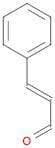
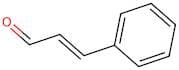
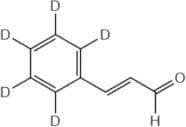
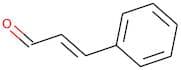
:cinnamaldéhyde
Description :
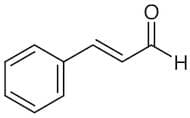
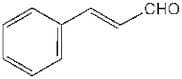
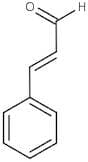
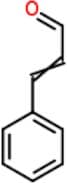
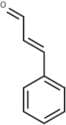
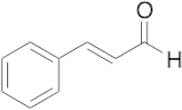
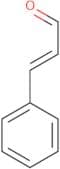
cinnamaldéhyde, avec le numéro CAS 14371-10-9, est un composé organique qui sert de composant principal de l'huile de cannelle, contribuant à sa saveur et son arôme caractéristiques. Il est classé comme un aldéhyde, spécifiquement un phénylpropanoïde, et a la formule moléculaire C9H8O. cinnamaldéhyde est un liquide incolore à jaune pâle à température ambiante, présentant un parfum doux et épicé rappelant la cannelle. Il est soluble dans des solvants organiques tels que l'éthanol et l'éther, mais a une solubilité limitée dans l'eau. Le composé est connu pour ses propriétés antimicrobiennes et antifongiques, ce qui le rend utile dans la conservation des aliments et comme agent aromatisant naturel. De plus, cinnamaldéhyde a été étudié pour ses potentiels bienfaits pour la santé, y compris des effets anti-inflammatoires et antioxydants. Cependant, il peut être irritant pour la peau et les muqueuses, nécessitant des précautions lors de la manipulation. Dans l'ensemble, cinnamaldéhyde est un composé polyvalent avec des applications dans l'alimentation, les cosmétiques et les produits pharmaceutiques, reflétant son importance tant dans l'industrie que dans la recherche.
Formule :C9H8O
InChI :InChI=1/C9H8O/c10-8-4-7-9-5-2-1-3-6-9/h1-8H/b7-4-
Code InChI :InChIKey=KJPRLNWUNMBNBZ-QPJJXVBHSA-N
SMILES :C(=C/C=O)\C1=CC=CC=C1
Synonymes :- (2E)-3-Phenyl-2-propenal
- (2E)-3-phenylprop-2-enal
- (2Z)-3-phenylprop-2-enal
- (E)-3-Phenylacrolein
- (E)-3-Phenylprop-2-en-1-al
- (E)-3-Phenylprop-2-enal
- (E)-3-Phenylprop-2-enone
- (E)-3-Phenylpropenal
- (E)-Cinnamaldehyde
- 2-Phenylprop-2-Enal
- 2-Propenal, 3-phenyl-, (2E)-
- 2-Propenal, 3-phenyl-, (E)-
- 3-Phenyl-2-propenal
- 3-Phenylprop-2-Enal
- Cinnam Aldehyde
- Cinnamaldehyde, (E)-
- Cinnamic aldehyde
- Cinnamyl Aldehyde
- E-Cinnamyl aldehyde
- Natural Cinnamyl Aldehyde
- Zimtaldehyd
- trans-3-Phenyl-2-propenal
- trans-3-Phenylpropenal
- trans-Benzenepropenal
- trans-Cinnamaldehyde
- trans-Cinnamic aldehyde
- trans-Cinnamylaldehyde
- Synthetic Cinnamaldehyde
- STYRONE
- TRANS-PHENYLACRYLALDEHYDE
- LABOTEST-BB LT00939010
- 3-PHENYLPROPENAL
- TRANS-ALPHA CINNAMALDEHYDE
- (e)-2-propena
- AKOS B004060
- TRANS-3-PHENYL-2-PROPEN-1-AL
- CINNAMALDEHYDE, TRANS-
- AKOS BBS-00003207
- FEMA 2286
- TRANS-PHENYLACROLEIN
- TRANS-CINNAMAL
- Voir plus de synonymes
Trier par
Degré de pureté (%)
0
100
|
0
|
50
|
90
|
95
|
100
14 produits concernés.
trans-Cinnamaldehyde
CAS :Formule :C9H8ODegré de pureté :>98.0%(GC)Couleur et forme :Colorless to Light orange to Yellow clear liquidMasse moléculaire :132.16trans-Cinnamaldehyde, 98+%
CAS :trans-Cinnamaldehyde is used in the flavor and perfume industry. It is also used in medicine. It reacts with glutathione to get an adduct 1'-(glutathion-S-yl)-dihydrocinnamaldehyde. It is used to prepare cinnamylidene-bisacetamide by reacting with acetamide. Further, it inhibits xanthine oxidase. ThFormule :C9H8ODegré de pureté :98+%Couleur et forme :Clear colorless to yellow, LiquidMasse moléculaire :132.16trans-Cinnamaldehyde
CAS :trans-Cinnamaldehyde analytical standard provided with chromatographic purity, to be used as reference material for qualitative determination.Formule :C9H8ODegré de pureté :(GC) ≥95%Couleur et forme :LiquidMasse moléculaire :132.16Cinnamaldehyde
CAS :Cyclic aldehydes without other oxygen function not elsewhere specified or includedFormule :C9H8OCouleur et forme :Yellow Light Yellow LiquidMasse moléculaire :132.057512-Propenal, 3-phenyl-, (2E)-
CAS :Formule :C9H8ODegré de pureté :96%Couleur et forme :LiquidMasse moléculaire :132.1592trans-Cinnamaldehyde
CAS :Formule :C9H8ODegré de pureté :95%Couleur et forme :Liquid, ClearMasse moléculaire :132.162trans-Cinnamaldehyde
CAS :Trans-Cinnamaldehyde (Phenylacrolein) exhibits anti-inflammatory activities and antidepressant-like effects in stressed mid-aged rats as a COX-2 inhibitor.Formule :C9H8ODegré de pureté :98.07%Masse moléculaire :132.16trans-Cinnamaldehyde
CAS :Applications trans-Cinnamaldehyde is an aromatic aldehyde that is derived from Cinnamomi cortex, the dried bark of the Cinnamomum cassia tree. trans-Cinnamaldehyde is a known cause of allergic contact dermatitis (ACD) in humans and is a major component of cinnamon oil. trans-Cinnamaldehyde also exhibits cytotoxic effects on human leukemia cells.
References Hayashi, K., et al.: Antivir. Res., 74, 1 (2007); He, Z., et al.: J. Agr. Food Chem., 53, 2424 (2005); Peters, M. & Caldwell, J.: Food Chem. Toxicol., 32, 869 (1994); Smith, C., et al.: Toxicol. Appl. Pharm., 168, 189 (2000); Zhang, J., et al.: Acta. Pharm. Sinic., 31, 861 (2010)Formule :C9H8OCouleur et forme :NeatMasse moléculaire :132.16trans-Cinnamaldehyde
CAS :Cinnamaldehyde is a natural compound that has shown to have antiviral and antimicrobial properties. It has been shown to inhibit the toll-like receptor, which is a protein on the surface of cells that detects bacteria and other microorganisms. Cinnamaldehyde is also able to inhibit c. glabrata growth in vitro at concentrations between 10 and 100 μM, as well as copper-mediated cell death in hl-60 cells. Cinnamaldehyde has been shown to cause neuronal death by interfering with cellular physiology. This compound can be used in the treatment of infectious diseases because it inhibits bacterial dna gyrase, dna topoisomerase, and rna synthesis.Formule :C9H8ODegré de pureté :Min. 95%Couleur et forme :PowderMasse moléculaire :132.16 g/mol