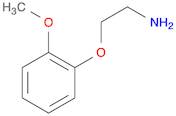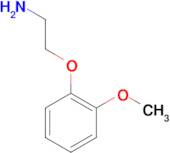
CAS 1836-62-0
:2-(2-Méthoxyphénoxy)éthanamine
- 2-(2-Methoxyphenoxy)Ethanaminium
- 2-(2-Methoxyphenoxy)ethan-1-amine
- 2-(2-Methoxyphenoxy)ethanamine
- 2-(o-Methoxyphenoxy)ethylamine
- Ethanamine, 2-(2-methoxyphenoxy)-
- Ethylamine, 2-(o-methoxyphenoxy)-
- Guaiacoxyethylamine
- N-(2-pyridin-2-ylethyl)propan-1-amine
- o-Methoxy Phenoxy Ethamine
- 2-(2-Methoxyphenoxy)ethylamine
- Tri par prix ascendant
- Tri par prix descendant
- Puretés inférieures
- Puretés supérieures
- Livraison estimée la plus rapide
2-(2-Methoxyphenoxy)ethylamine
CAS :Formule :C9H13NO2Degré de pureté :>95.0%(GC)(T)Couleur et forme :Light yellow to Brown clear liquidMasse moléculaire :167.212-(2-Aminoethoxy)anisole
CAS :2-(2-Aminoethoxy)anisoleFormule :C9H13NO2Degré de pureté :>98%Couleur et forme :LiquidMasse moléculaire :167.20502Carvedilol USP Related Compound E
CAS :Formule :C9H13NO2Couleur et forme :Yellowish-Brown LiquidMasse moléculaire :167.212-(2-Methoxyphenoxy)ethanamine
CAS :Formule :C9H13NO2Degré de pureté :98%Couleur et forme :LiquidMasse moléculaire :167.20502-(2-Aminoethoxy)anisole
CAS :Produit contrôléApplications 2-(2-Aminoethoxy)anisole is used as an additive to vinylphosphonic acid esters and acrylonitrile forming compounds displaying hypotensive activity. An impurity from the process of Carvedilol (C184625)
References Reznik, V. et al.: Russ. Chem. Bull., 48, 979, (1999); Hirohashi, M., et al.: Arzneim.-Forsch., 40, 735 (1990), Packer, M., et al.: N. Engl. J. Med., 334, 1349 (1996),Formule :C9H13NO2Couleur et forme :NeatMasse moléculaire :167.22-(2-Methoxyphenoxy)ethylamine
CAS :2-(2-Methoxyphenoxy)ethylamineFormule :C9H13NO2Degré de pureté :98%Masse moléculaire :167.212-(2-Methoxyphenoxy)ethylamine
CAS :Formule :C9H13NO2Degré de pureté :98%Couleur et forme :Liquid, ClearMasse moléculaire :167.2082-(2-Methoxyphenoxy)ethylamine base
CAS :2-(2-Methoxyphenoxy)ethylamine base is an inorganic base with a hydroxyl group. It is soluble in organic solvents and has been used as a coumarin derivative. 2-(2-Methoxyphenoxy)ethylamine base has shown potential use as an antifungal agent, which may be due to its ability to cause lysis in fungi cells. This compound has also shown in vitro activity against bacteria and viruses, including herpes simplex virus type 1 and HIV-1. The 2-(2-methoxyphenoxy)ethylamine base can be sulfonated or acid catalyzed to produce other derivatives that have potential use as anti-inflammatory or analgesic agents.
Formule :C9H13NO2Degré de pureté :Min. 95%Masse moléculaire :167.21 g/mol