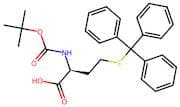
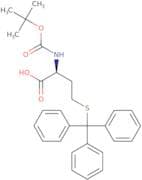
![N-[(1,1-Dimethylethoxy)carbonyl]-S-(triphenylmethyl)-L-homocysteine](/_next/image/?url=https%3A%2Fstatic.cymitquimica.com%2Fcas-image%2Fthumb-webp%2F309484-n-11-dimethylethoxy-carbonyl-s-triphenylmethyl-l-homocysteine.webp&w=3840&q=75)
CAS 201419-16-1
:N-[(1,1-Diméthyléthoxy)carbonyl]-S-(triphenylméthyl)-L-homocystéine
- N-[(1,1-Dimethylethoxy)carbonyl]-S-(triphenylmethyl)-L-homocysteine
- N-tert-Butoxycarbonyl-S-trityl-L-homocysteine
- (S)-2-((tert-Butoxycarbonyl)amino)-4-(tritylthio)butanoic acid
- L-Homocysteine, N-[(1,1-dimethylethoxy)carbonyl]-S-(triphenylmethyl)-
Boc-Homocys(Trt)-OH
CAS :Bachem ID: 4025120.
Formule :C28H31NO4SDegré de pureté :> 99%Couleur et forme :White PowderMasse moléculaire :477.62L-Homocysteine, N-[(1,1-dimethylethoxy)carbonyl]-S-(triphenylmethyl)-
CAS :Formule :C28H31NO4SDegré de pureté :95%Couleur et forme :SolidMasse moléculaire :477.6150Boc-S-Trityl-L-Homocysteine
CAS :Boc-S-Trityl-L-HomocysteineDegré de pureté :95%Couleur et forme :SolidMasse moléculaire :477.62g/molBoc-L-HomoCys(Trt)-OH
CAS :Formule :C28H31NO4SDegré de pureté :95%Couleur et forme :SolidMasse moléculaire :477.62Boc-S-trityl-L-homocysteine
CAS :Boc-S-trityl-L-homocysteine is a synthetic molecule that is used as a prodrug to introduce the amino acid homocysteine into cells. It has been shown to have anti-cancer and estrogen receptor modulating properties. Boc-S-trityl-L-homocysteine is synthesized by reacting L-homocysteine with diisopropylamino chlorides in the presence of sodium hydroxide, followed by ligation with dicyclohexylcarbodiimide. The compound adopts a centrosymmetric conformation due to the presence of two chiral centers at C3 and C4 positions on the pyridyl ring. The active site consists of an aromatic ring with three substituents, one of which is an amide group. This chemical transformation occurs through a nucleophilic attack by the amide group on an electrophilic carbonyl carbon atom.
Formule :C28H31NO4SDegré de pureté :Min. 95%Couleur et forme :PowderMasse moléculaire :477.62 g/mol
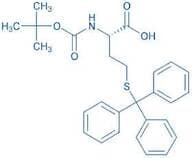

![L-Homocysteine, N-[(1,1-dimethylethoxy)carbonyl]-S-(triphenylmethyl)-](/_next/image/?url=https%3A%2Fstatic.cymitquimica.com%2Fproducts%2FIN%2Fthumb%2FDA002DEG.jpg&w=3840&q=75)