CAS 25036-25-3
:poly(bisphénol A-co-épichlorhydrine)
Description :
poly(bisphénol A-co-épichlorhydrine), avec le numéro CAS 25036-25-3, est un polymère synthétique qui présente des caractéristiques uniques en raison de sa structure copolymère. Ce matériau est formé par la polymérisation de bisphénol A et d'épichlorhydrine, résultant en une résine thermodurcissable connue pour sa résistance chimique exceptionnelle, sa résistance mécanique et sa stabilité thermique. Il est souvent utilisé dans des applications nécessitant des revêtements durables, des adhésifs et des scellants, en particulier dans des environnements exposés à l'humidité et à divers produits chimiques. La présence de bisphénol A contribue à la rigidité et aux propriétés thermiques du polymère, tandis que le composant épichlorhydrine améliore sa flexibilité et ses capacités d'adhésion. De plus, poly(bisphénol A-co-épichlorhydrine) peut être modifié pour améliorer ses caractéristiques de performance, le rendant adapté à un large éventail d'applications industrielles. Cependant, il est important de prendre en compte les préoccupations environnementales et sanitaires associées au bisphénol A, ce qui conduit à des recherches continues sur des alternatives et des formulations plus sûres.
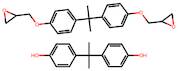
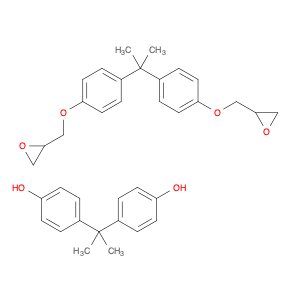
Formule :(C21H24O4·C15H16O2)x
InChI :InChI=1S/C21H24O4.C15H16O2/c1-21(2,15-3-7-17(8-4-15)22-11-19-13-24-19)16-5-9-18(10-6-16)23-12-20-14-25-20;1-15(2,11-3-7-13(16)8-4-11)12-5-9-14(17)10-6-12/h3-10,19-20H,11-14H2,1-2H3;3-10,16-17H,1-2H3
Code InChI :InChIKey=KHORFZBBHPTCQP-UHFFFAOYSA-N
SMILES :C(C)(C)(C1=CC=C(OCC2CO2)C=C1)C3=CC=C(OCC4CO4)C=C3.C(C)(C)(C1=CC=C(O)C=C1)C2=CC=C(O)C=C2
Synonymes :- 2,2-Bis(4-glycidyloxyphenyl)propane-2,2-bis(hydroxyphenyl)propane copolymer
- 4,4′-Isopropylidenediphenol-Rutapox 0162 copolymer
- AER 260-BPA-M copolymer
- Adeka EP 4100-Bisphenol A copolymer
- Araldite GT 6750
- Bisphenol A diglycidyl ether-bisphenol A copolymer
- Bisphenol A diglycidyl ether-bisphenol A-dodecylphenol copolymer
- Bisphenol A-DGEBA copolymer
- Bisphenol A-E 12 copolymer
- Bisphenol A-Epiclon 850S copolymer
- Bisphenol A-Epikote 828EL copolymer
- Bisphenol A-Epikote 828LV copolymer
- Bisphenol A-Epon 829 polymer
- Bisphenol A-JER 828EL copolymer
- Bisphenol A-Rutapox 0162 copolymer
- Bisphenol A-YD 8125 copolymer
- Bisphenol A-bisphenol A diglycidyl ether copolymer
- Bisphenol A-bisphenol A diglycidyl ether polymer
- Bisphenol A-bisphenol A diglycidyl ether-piperidine copolymer
- Cne 00105
- DGEBA-bisphenol A copolymer
- Di(4-hydroxyphenol)isopropylidene diglycidyl ether-di(4-hydroxyphenol)isopropylidene copolymer
- Diaplast D
- Epi-Rez 3515W60
- Epi-Rez 5223
- Epikote 1001F
- Epikote 1002F
- Epikote 1004F
- Epon 1002F
- Epon 1101F
- Epon Resin 1002F
- Epotuf 37-001
- Exa 8067
- Jer 1004F
- Kd 212
- Oxirane, 2,2′-[(1-methylethylidene)bis(4,1-phenyleneoxymethylene)]bis-, polymer with 4,4′-(1-methylethylidene)bis[phenol]
- Phenol, 4,4′-(1-methylethylidene)bis-, polymer with 2,2′-[(1-methylethylidene)bis(4,1-phenyleneoxymethylene)]bis[oxirane]
- Phenol, 4,4′-isopropylidenedi-, polymer with 2,2-bis[p-(2,3-epoxypropoxy)phenyl]propane
- Poly(Bisphenol A-co-epichlorohydrin), glycidyl end-capped
- Propane, 2,2-bis[p-(2,3-epoxypropoxy)phenyl]-, polymer with 4,4′-isopropylidenediphenol
- Xu 71909.04
- Xu 71919.03
- diglycidyletherofbisphenola-basedepoxyresins,mediumtohigh
- Poly(Bisphenol A-co-epichlorohydrin), glycidyl end-capped average Mn ~1,750
- polymerofdiglycidyletherofbisphenolaandbisphenola
- POLY(BISPHENOL A-CO-EPICHLOROHYDRIN), GL YCIDYL END-CAPPED, AVE. MN CA. 355
- POLY(BISPHENOL A-CO-EPICHLOROHYDRIN), GL YCIDYL END-CAPPED, AVE. MN CA. 6,100
- Poly(Bisphenol A-co-epichlorohydrin) glycidyl end-capped ISO 9001:2015 REACH
- Phenol,4,4’-(1-methylethylidene)bis-,polymerwith2,2’-[(1-methylethylidene)bis(4,1-phenyleneoxymethylene)]bis(oxirane)
- POLY(BISPHENOL A-CO-EPICHLOROHYDRIN), GL YCIDYL END-CAPPED, AVE. MN CA. 348
- Poly(Bisphenol A-co-epichlorohydrin), glycidyl end-capped average Mn ~377
- ADVANCEDBISPHENOLA/EPICHLOROHYDRINEPOXYRESIN
- is(4,1-phenyleneoxymethylene)]bis[oxirane]
- 4,4’-(1-methylethylidene)bisphenol,polymerwith2,2’-[(1-methylethylidene)bis
- Phenol, 4,4-(1-methylethylidene)bis-, polymer with 2,2-(1-methylethylidene)bis(4,1-phenyleneoxymethylene)bisoxirane
- POLY(BISPHENOL A-CO-EPICHLOROHYDRIN), GL YCIDYL END-CAPPED, AVE. MN CA. 4,000
- Bisphenol A-diglycidyl ether copolymer
- POLY(BISPHENOL A-CO-EPICHLOROHYDRIN), GL YCIDYL END-CAPPED, AVE. MN CA. 377
- diglycidyletherofbisphenola(non-specificname)
- BISPHENOLADIGLYCIDYLETHER-BISPHENOLACOPOLYMER
- POLY(BISPHENOL A-CO-EPICHLOROHYDRIN), GL YCIDYL END-CAPPED, AVE. MN CA. 1,075
- bisphenola/epichlorohydrinbasedepoxyresins(non-specificname)
- molecularweightsolids
- Poly(Bisphenol A-co-epichlorohydrin), glycidyl end-capped average Mn ~1,075
- polymerofbisphenolaandepichlorohydrin
- POLY(BISPHENOL A-CO-EPICHLOROHYDRIN), GLYCIDYL END-CAPPED, AVE. MN CA. 480
- TIANFU-CHEM CAS NO.25036-25-3 Poly(Bisphenol A-co-epichlorohydrin) glycidyl end-capped
- mediumtohighmolecularweightsoliddgebpa-basedepoxyresins
- Poly(Bisphenol A-co-epichlorohydrin), glycidyl end-capped average Mn ~355
- POLY(BISPHENOL A-CO-EPICHLOROHYDRIN), GL YCIDYL END-CAPPED, AVE. MN CA. 1,750
- POLY(BISPHENOL A-CO-EPICHLOROHYDRIN), GLYCIDYL END-CAPPED, AVE. MN CA. 374
- Voir plus de synonymes
Filtrer par
Pourcentage de pureté
0
100
|
0
|
50
|
90
|
95
|
100
3 produits trouvés.
- Tri par prix ascendant
- Tri par prix descendant
- Puretés inférieures
- Puretés supérieures
- Livraison estimée la plus rapide
Poly(Bisphenol A-Co-Epichlorohydrin), Glycidyl End-Capped
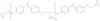
CAS :Poly(Bisphenol A-Co-Epichlorohydrin), Glycidyl End-CappedDegré de pureté :average Mn ~377Masse moléculaire :568.71g/molBisphenol A-bisphenol A diglycidyl ether copolymer
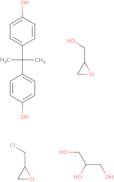
CAS :Formule :C24H35ClO8Couleur et forme :SolidMasse moléculaire :486.9829Poly(Bisphenol A-co-epichlorohydrin) glycidyl end-capped
CAS :Poly(Bisphenol A-co-epichlorohydrin) glycidyl end-capped is a thermoplastic polymer that can be used for automotive parts, coatings, and other industrial applications. Poly(BPA-co-EPI) has been shown to have excellent resistance to thermal degradation, good mechanical properties at high temperatures, and good radiation resistance. The polymer is resistant to ethylene and styrene monomer evaporation during processing. Generally, the material can be used as a substitute for polyethylene terephthalate (PET), polyvinyl chloride (PVC), or acrylonitrile butadiene styrene (ABS).Degré de pureté :Min. 95%Couleur et forme :Clear Viscous LiquidMasse moléculaire :568.70 g/mol