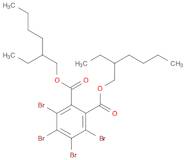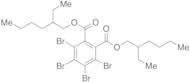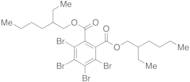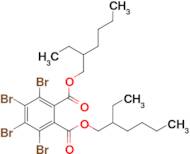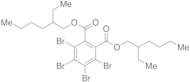
CAS 26040-51-7
:Bis(2-éthylhexyl) tétrabromophtalate
Description :
Bis(2-éthylhexyl) tétrabromophtalate (CAS 26040-51-7) est un retardant de flamme bromé couramment utilisé dans diverses applications polymères pour améliorer la résistance au feu. Ce composé se caractérise par son poids moléculaire élevé et la présence de plusieurs atomes de brome, qui contribuent à son efficacité en tant que retardant de flamme en favorisant la formation de charbon et en réduisant l'inflammabilité. Il s'agit généralement d'un liquide ou d'un solide visqueux à température ambiante, avec une faible volatilité, ce qui le rend adapté à l'incorporation dans des plastiques et d'autres matériaux. La substance est relativement stable dans des conditions normales, mais peut se dégrader lorsqu'elle est exposée à une chaleur extrême ou à la lumière UV. Sa persistance environnementale soulève des préoccupations concernant la bioaccumulation et la toxicité potentielle pour les organismes aquatiques. Le contrôle réglementaire a augmenté en raison de sa nature bromée, entraînant des enquêtes sur des alternatives plus sûres. Dans l'ensemble, Bis(2-éthylhexyl) tétrabromophtalate joue un rôle essentiel dans l'amélioration de la sécurité incendie des produits de consommation, mais son impact environnemental nécessite une gestion et une évaluation attentives.
Formule :C24H34Br4O4
InChI :InChI=1/C24H34Br4O4/c1-5-9-11-15(7-3)13-31-23(29)17-18(20(26)22(28)21(27)19(17)25)24(30)32-14-16(8-4)12-10-6-2/h15-16H,5-14H2,1-4H3
Code InChI :InChIKey=UUEDINPOVKWVAZ-UHFFFAOYSA-N
SMILES :C(OCC(CCCC)CC)(=O)C1=C(C(OCC(CCCC)CC)=O)C(Br)=C(Br)C(Br)=C1Br
Synonymes :- 1,2-Benzenedicarboxylic acid, 3,4,5,6-tetrabromo-, 1,2-bis(2-ethylhexyl) ester
- 1,2-Benzenedicarboxylic acid, 3,4,5,6-tetrabromo-, bis(2-ethylhexyl) ester
- Behtbp
- Bis(2-Ethylhexyl) 3,4,5,6-Tetrabromobenzene-1,2-Dicarboxylate
- Bis(2-ethyl-1-hexyl) tetrabromophthalate
- Bis(2-ethylhexyl) 2,3,4,5-Tetrabromophthalate
- Bis(2-ethylhexyl) 3,4,5,6-tetrabromophthalate
- Di(2-ethylhexyl) tetrabromophthalate
- Dp 45
- Frp 45
- Phthalic acid, tetrabromo-, bis(2-ethylhexyl) ester
- Phthalic acid, tetrabromo-, di(2-ethylhexyl) ester
- Pyronil 45
- Uniplex FRP 45
- tetrabromophthalic acid bis(2-ethylhexyl) ester
- 2-benzenedicarboxylic acid, 3,4,5,6-tetrabromo-bis(2-ethylhexyl) ester
- 3,4,5,6-Tetrabromo-1,2-benzenedicarboxylic acid dioctyl ester
- bis(2-ethylhexyl) tetrabromophthalate
- Bis(2-ethylhexyl)tetrabromophthalate Solution
- Bis(2-ethylhexyl)tetrabromphthalat
- Voir plus de synonymes
Trier par
Degré de pureté (%)
0
100
|
0
|
50
|
90
|
95
|
100
8 produits trouvés.
1,2-Benzenedicarboxylic acid, 3,4,5,6-tetrabromo-, 1,2-bis(2-ethylhexyl) ester
CAS :Formule :C24H34Br4O4Degré de pureté :95%Couleur et forme :LiquidMasse moléculaire :706.1404Bis(2-Ethylhexyl) 3,4,5,6-Tetrabromophthalate
CAS :Bis(2-Ethylhexyl) 3,4,5,6-TetrabromophthalateFormule :C24H34Br4O4Degré de pureté :94%Masse moléculaire :706.14Bis(2-ethylhexyl) 3,4,5,6-tetrabromophthalate
CAS :Formule :C24H34Br4O4Couleur et forme :NeatMasse moléculaire :706.14Bis(2-ethylhexyl) 3,4,5,6-tetrabromophthalate 100 µg/mL in Hexane
CAS :Formule :C24H34Br4O4Couleur et forme :Single SolutionMasse moléculaire :706.14Bis(2-ethylhexyl) 3,4,5,6-tetrabromophthalate
CAS :Degré de pureté :95%Masse moléculaire :706.1480102539062Pyronil 45
CAS :Applications Pyronil 45 is a brominated phthalate derivative used in flame-retardant polyvinyl chloride compositions. Flame Retardant
References Davis, E., et al.: Environ. Sci. Technol., 43, 5739 (2009),Formule :C24H34Br4O4Couleur et forme :NeatMasse moléculaire :706.14TBPH-1
CAS :TBPH is a brominated flame retardant that exacerbates hepatic steatosis, inflammation, and fibrosis in non-alcoholic steatohepatitis (NASH) mouse models. It disrupts phospholipid metabolism, reducing levels of cardiolipin (CL) and phosphatidylserine (PS). TBPH impairs endoplasmic reticulum-mitochondria (ER-Mito) contact, leading to mitochondrial dysfunction. Additionally, TBPH induces lung injury through a mitochondrial-derived ds-DNA mediated inflammatory response. It is also used to investigate the role of MFN2-mediated ER-Mito contact in lipid metabolism homeostasis.Formule :C24H34Br4O4Masse moléculaire :706.15