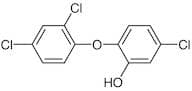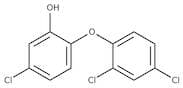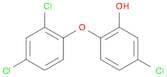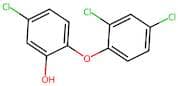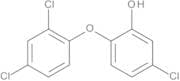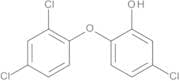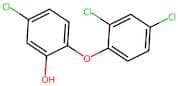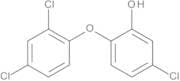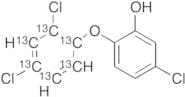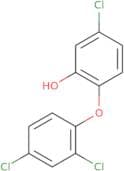
CAS 3380-34-5
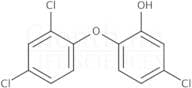
:Triclosan
- 2',4',4-Trichloro-2-hydroxydiphenyl ether
- 2',4',4-Trichloro-2-hydroxydiphenylether
- 2',4,4'-Trichloro-2-hydroxydiphenyl ether
- 2'-Hydroxy-2,4,4'-Trichloro-Phenylethe
- 2'-Hydroxy-2,4,4'-trichlorodiphenyl ether
- 2,2'-Oxybis(1',5'-dichlorophenyl-5-chlorophenol)
- 2,2′-Oxybis(1′,5′-dichlorophenyl-5-chlorophenol)
- 2,4,4'-Trichlorine-2'-Hydroxyl Diphenyl Ether
- 2,4,4'-Trichlorine-2'-Hydroxyl Diphenyl Ethyl
- 2,4,4'-Trichloro-2'-Hydroxy Diphenylether
- 2,4,4'-Trichloro-2'-hydroxyldiphenyl ether
- 2,4,4-Trichloro-2-hydroxydiphenyl ether
- 2-(2,4-Dichlorophenoxy)-5-chlorophenol
- 2-Hydroxy-2',4,4'-trichlorodiphenyl ether
- 3-Chloro-6-(2,4-dichlorophenoxy)phenol
- 4-Chloro-2-hydroxyphenyl 2,4-dichlorophenyl ether
- 4-Chloro-2-hydroxyphenyl2,4-dichlorophenyl ether
- 5-Chloro-2-(2', 4'-dichlorophenoxy) phenol
- 5-Chloro-2-(2,4-Dichlorophenoxy)-Pheno2,4,4-Trichloro-2-Hydroxydiphenylether(Irgasandp-300)
- 5-Chloro-2-(2,4-dichlorophenoxy) phen
- 5-Chloro-2-(2,4-dichlorophenoxy)phenol
- Anvasan AM 110
- Anvasan AM 110 new
- Aquasept
- Bacti-Stat soap
- Cansan TCH
- Ch 3565
- Ch 3635
- Ch3565
- Cloxifenol
- Diphenyl Ether, 2,4,4'-Trichloro-2'-Hydroxy-
- Dp 300
- Dp300
- Ether,2'-Hydroxy-2,4,4'-Trichlorodiphenyl
- Gamophen
- Germicide CA
- Invasan
- Invasan DP 300R
- Irgacare-MP
- Irgacide LP 10
- Irgaguard B 1000
- Irgaguard B 1325
- Irgasan
- Irgasan CH 3565
- Irgasan DP 30
- Irgasan DP 300
- Irgasan DP 3000
- Irgasan DP 400
- Irgasan PE 30
- Irgasan PG 60
- Irgasandp300
- Microban
- Microban Additive B
- Microban B
- Microfresh 9200-200
- Microfresh Liquid Formulation 9200-200
- Nm 100
- Oletron
- Phenol, 5-chloro-2-(2,4-dichlorophenoxy)-, dihydrogen phosphate
- Phenol,5-chloro-2-(2,4-dichlorophenoxy)-
- Sanitized XTX
- Sapoderm
- SterZac
- Tccp
- Thdp
- Tinosan AM 100
- Tinosan AM 110
- Triclosam
- Triclosan(USP 30)
- Ultra-Fresh NM 100
- Ultra-Fresh NM-V 2
- Ultrafresh NM-V 2
- Vinyzene DP 7000
- Yujiexin
- Zilesan UW
- Voir plus de synonymes
Triclosan
CAS :Formule :C12H7Cl3O2Degré de pureté :>98.0%(GC)Couleur et forme :White to Almost white powder to crystalMasse moléculaire :289.545-Chloro-2-(2,4-dichlorophenoxy)phenol, 99%
CAS :This Thermo Scientific Chemicals brand product was originally part of the Alfa Aesar product portfolio. Some documentation and label information may refer to the legacy brand. The original Alfa Aesar product / item code or SKU reference has not changed as a part of the brand transition to Thermo SciFormule :C12H7Cl3O2Degré de pureté :99%Couleur et forme :White, Crystals or powder or crystalline powderMasse moléculaire :289.54Triclosan
CAS :Ether-phenols, ether-alcohol-phenols and their halogenated, sulfonated, nitrated or nitrosated derivativesFormule :C12H7Cl3O2Couleur et forme :White Off-White Crystalline PowderMasse moléculaire :287.951165-Chloro-2-(2,4-Dichlorophenoxy)Phenol
CAS :Formule :C12H7Cl3O2Degré de pureté :98%Couleur et forme :SolidMasse moléculaire :289.5418Triclosan
CAS :Triclosan (Irgasan) is an antibacterial and antifungal agent.Formule :C12H7Cl3O2Degré de pureté :99.63%Couleur et forme :White Solid CrystallineMasse moléculaire :289.54Triclosan
CAS :Formule :C12H7Cl3O2Degré de pureté :≥ 98.0%Couleur et forme :White crystalline powder or crystalsMasse moléculaire :289.55Triclosan, USP grade
CAS :Formule :C12H7Cl3O2Degré de pureté :≤ 0.1%Couleur et forme :White crystalline powder or crystalsMasse moléculaire :289.55Triclosan 10 µg/mL in Cyclohexane
CAS :Formule :C12H7Cl3O2Couleur et forme :Single SolutionMasse moléculaire :289.54Irgasan
CAS :IrgasanFormule :C12H7Cl3O2Degré de pureté :98%Couleur et forme : white crystalline powderMasse moléculaire :289.54g/molTriclosan
CAS :Applications Triclosan is used as bactericide and preservative for cosmetic and detergent compositions (1). Broadly used as an antiseptic and disinfectant (2).This compound is a contaminant of emerging concern (CECs). Drinking water contaminant candidate list 3 (CCL 3) compound as per United States Environmental Protection Agency (EPA). Environmental contaminants; Food contaminants.
Not a dangerous good if item is equal to or less than 1g/ml and there is less than 100g/ml in the package
References 1. Lindström, A. et al.: Environ. Sci. Technol. 2002 Jun 1;36(11):2322-9. 2. Ruszkiewicz, J. et al.: J. Toxicol. Environ. Health B. Crit. Rev. 2017;20(2):104-117.Formule :C12H7Cl3O2Couleur et forme :NeatMasse moléculaire :289.54Triclosan-13C6
CAS :Produit contrôléApplications Isotope labelled Triclosan is used as bactericide and preservative for cosmetic and detergent compositions (1). Broadly used as an antiseptic and disinfectant (2). This compound is a contaminant of emerging concern (CECs). Drinking water contaminant candidate list 3 (CCL 3) compound as per United States Environmental Protection Agency (EPA). Environmental contaminants; Food contaminants.
Not a dangerous good if item is equal to or less than 1g/ml and there is less than 100g/ml in the package
References 1. Lindström, A. et al.: Environ. Sci. Technol. 2002 Jun 1;36(11):2322-9. 2. Ruszkiewicz, J. et al.: J. Toxicol. Environ. Health B. Crit. Rev. 2017;20(2):104-117.Formule :C613C6H7Cl3O2Couleur et forme :WhiteMasse moléculaire :295.5Trichlorosan
CAS :Trichlorosan is a biocide that is used as a disinfectant and preservative, and has also been shown to have antibacterial properties. It is often used in industrial settings to inhibit the growth of bacteria in process water, cooling towers, and wastewater treatment systems. Trichlorosan has been shown to be genotoxic in rats at high doses. This chemical can be found in personal care products such as soaps, toothpaste, mouthwash, deodorants, or body lotion. It can also be found in some household items such as kitchenware, clothes and bedding. Triclosan is one of the active ingredients in trichlorosan that prevents bacterial growth by binding to the enzyme that catalyzes the conversion of glycerol to fatty acids and lysing cells through cell membrane disruption. The enzyme activity index for triclosan was determined by measuring the amount of time it takes for a solution containing benzalkonium chloride (B
Formule :C12H7Cl3O2Degré de pureté :Min. 95%Couleur et forme :White PowderMasse moléculaire :289.54 g/mol