CAS 42553-65-1
:Crocin
Description :
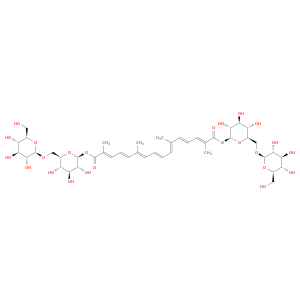
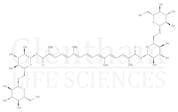
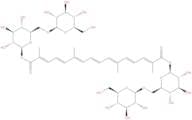
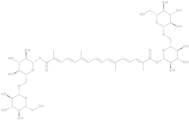
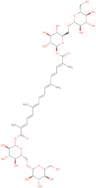
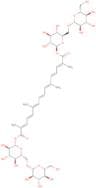
Crocin est un pigment caroténoïde principalement dérivé de la plante de safran, Crocus sativus. Il est connu pour sa couleur jaune-orange vibrante et est responsable de la teinte caractéristique du safran. Chimiquement, Crocin est un dérivé glycosylé de la crocétine, consistant en un squelette d'acide dicarboxylique avec plusieurs moitiés de sucre attachées, ce qui améliore sa solubilité dans l'eau. Crocin présente diverses activités biologiques, y compris des effets antioxydants, anti-inflammatoires et des effets neuroprotecteurs potentiels, ce qui le rend intéressant tant dans l'industrie alimentaire que pharmaceutique. Il est souvent étudié pour ses applications thérapeutiques potentielles, en particulier dans le contexte des maladies neurodégénératives et des troubles de l'humeur. De plus, Crocin est reconnu pour son rôle en tant que colorant naturel dans les produits alimentaires, offrant une alternative sûre aux colorants synthétiques. Sa stabilité et sa biodisponibilité sont des facteurs importants dans son application, et la recherche en cours continue d'explorer sa gamme complète de bienfaits et d'utilisations pour la santé.
Formule :C44H64O24
InChI :InChI=1S/C44H64O24/c1-19(11-7-13-21(3)39(59)67-43-37(57)33(53)29(49)25(65-43)17-61-41-35(55)31(51)27(47)23(15-45)63-41)9-5-6-10-20(2)12-8-14-22(4)40(60)68-44-38(58)34(54)30(50)26(66-44)18-62-42-36(56)32(52)28(48)24(16-46)64-42/h5-14,23-38,41-58H,15-18H2,1-4H3/b6-5+,11-7+,12-8+,19-9+,20-10+,21-13+,22-14+/t23-,24-,25-,26-,27-,28-,29-,30-,31+,32+,33+,34+,35-,36-,37-,38-,41-,42-,43+,44+/m1/s1
Code InChI :InChIKey=SEBIKDIMAPSUBY-RTJKDTQDSA-N
SMILES :C(O[C@@H]1O[C@H](CO)[C@@H](O)[C@H](O)[C@H]1O)[C@H]2O[C@@H](OC(/C(=C/C=C/C(=C/C=C/C=C(/C=C/C=C(/C(O[C@@H]3O[C@H](CO[C@@H]4O[C@H](CO)[C@@H](O)[C@H](O)[C@H]4O)[C@@H](O)[C@H](O)[C@H]3O)=O)\C)\C)/C)/C)=O)[C@H](O)[C@@H](O)[C@@H]2O
Synonymes :- 6-O-β-D-glucopyranosyl-1-O-[(2E,4E,6E,8E,10Z,12E,14Z)-16-{[(6-O-β-D-glucopyranosyl-β-D-glucopyranosyl)oxy]methyl}-2,6,11,15-tetramethylheptadeca-2,4,6,8,10,12,14,16-octaenoyl]-β-D-glucopyranose
- 8,8′-Diapo-ψ,ψ-carotenedioic acid, bis(6-O-β-<span class="text-smallcaps">D</smallcap>-glucopyranosyl-β-<smallcap>D</span>-glucopyranosyl) ester
- Crocetin bis(gentiobiosyl) ester
- Crocetin di(β-<span class="text-smallcaps">D</span>-gentiobiosyl) ester
- Crocetin di-β-gentiobiosyl ester
- Crocetin digentiobioside
- Crocin
- Crocin (gardenia fruit
- Crocin 1
- Crocin 4
- Crocin A
- Kiriyasu Oil Yellow GY
- Saffron
- Saffron (Natural)
- Trans-crocin-1
- all-trans-Crocetin di-β-<span class="text-smallcaps">D</span>-gentiobiosyl ester
- bis[(2S,3R,4S,5S,6R)-3,4,5-trihydroxy-6-({[(2R,3R,4S,5S,6R)-3,4,5-trihydroxy-6-(hydroxymethyl)tetrahydro-2H-pyran-2-yl]oxy}methyl)tetrahydro-2H-pyran-2-yl] (2E,4E,6E,8E,10E,12E,14E)-2,6,11,15-tetramethylhexadeca-2,4,6,8,10,12,14-heptaenedioate (non-preferred name)
- trans-Crocetin di(β-<span class="text-smallcaps">D</span>-gentiobiosyl) ester
- α-Crocin
- β-<span class="text-smallcaps">D</smallcap>-Glucopyranose, 6-O-β-<smallcap>D</span>-glucopyranosyl-, 1,1′-[(2E,4E,6E,8E,10E,12E,14E)-2,6,11,15-tetramethyl-2,4,6,8,10,12,14-hexadecaheptaenedioate]
- 8,8′-Diapo-ψ,ψ-carotenedioic acid, bis(6-O-β-D-glucopyranosyl-β-D-glucopyranosyl) ester
- Voir plus de synonymes
Trier par
Degré de pureté (%)
0
100
|
0
|
50
|
90
|
95
|
100
13 produits concernés.
Crocin (Gardenia Fruits Extract)
CAS :Formule :C44H64O24Degré de pureté :multi component mixture(HPLC)Couleur et forme :Light yellow to Brown powder to crystalMasse moléculaire :976.97Crocin
CAS :Crocin: a water-soluble carotenoid in saffron, used for flavoring, coloring, and in Chinese medicine; inhibits TNF-alpha-induced apoptosis in cells.Formule :C44H64O24Degré de pureté :98.13% - 99.27%Couleur et forme :Solid /Di-Gentiobiose Ester/ SolidMasse moléculaire :976.96Crocin I, 98%
CAS :Formule :C44H64O24Degré de pureté :(HPLC) ≥ 98.0%Couleur et forme :Orange to dark red powderMasse moléculaire :976.97Crocin I
CAS :Crocin is a water-soluble carotenoid pigment of saffron (Crocus sativus L.), it has been used as a spice for flavoring and coloring food preparations. Crocin has anti-inflammatory, anti-oxidative, anti-apoptotic, anti-asthma, anti-cancer, and hypolipidemic effects. Crocin improves toxic effects of diazinon via reducing lipid peroxidation and restoring altered contractile and relaxant responses in rat aorta; it also protects retinal photoreceptors against light-induced cell death. Crocin can also promote ovarian cancer HO-8910 cell apoptosis, most likely by increasing p53 and Fas/APO-1 expression, and then activating the apoptotic pathway regulated by Caspase-3.Formule :C44H64O24Degré de pureté :95%~99%Masse moléculaire :976.972Crocin
CAS :Natural glycosideFormule :C44H64O24Degré de pureté :≥ 95.0 % (HPLC)Couleur et forme :PowderMasse moléculaire :976.98Crocin
CAS :Stability Light Sensitive
Applications Crocin, is a natural carotenoid derived the flowers crocus and gardenia. Crocin has been shown to be a potent antioxidant. It has also been shown to have an antiproliferative action against cancer cells in vitro, and also possessing possible antidepressant properties.
References Zheng, Y. Q., et al.: Brain Res., 1138, 86 (2006); Hosseinzadeh, H., et al.: PTR, 24 (5), 726 (2010); Ochiai, T., et al.: Biochim. Biophys. Acta., 1770(4), 578 (2006);Formule :C44H64O24Couleur et forme :Dark Yellow Crystalline PowderMasse moléculaire :976.96Crocin I
CAS :Crocin is a pharmaceutical product which is an antipyretic and analgesic medication, primarily composed of paracetamol (acetaminophen). It is synthesized through chemical processes originally derived from coal tar, although modern production predominantly utilizes petrochemical sources. The mode of action of Crocin involves the inhibition of cyclooxygenase (COX) enzymes, particularly COX-2, in the central nervous system. This action leads to a decrease in the synthesis of prostaglandins, which are responsible for pain and fever.Formule :C44H64O24Degré de pureté :Min. 98.0 Area-%Couleur et forme :PowderMasse moléculaire :976.96 g/molCrocin - microscopy grade
CAS :Crocin is a carotenoid found in the fruit of Crocus sativus. It has been shown to have potential anticancer activity, as well as antioxidant and anti-inflammatory properties. Crocin has demonstrated significant cytotoxicity against cancer cells in vitro. The mechanism of action is not fully understood, but it may be due to its ability to inhibit oxidative injury and receptor activity. Crocin has also been shown to have an effect on eye disorders such as retinitis pigmentosa and macular degeneration, which may be due to its antioxidant properties. The analytical method for crocin is high performance liquid chromatography (HPLC). HPLC separation is achieved using a reversed-phase column with gradient elution using water, acetonitrile and methanol. Preparative HPLC is used for isolation from natural sources.Formule :C44H64O24Degré de pureté :Min. 95%Couleur et forme :PowderMasse moléculaire :976.96 g/mol