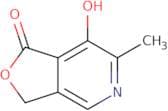
CAS 4753-19-9
:4-Pyridoxolactone
- 4-Pyridinecarboxylic acid, 3-hydroxy-5-(hydroxymethyl)-2-methyl-, γ-lactone
- 4-Pyridoxic acid lactone
- 4-Pyridoxolactone
- Furo(3,4-c)pyridin-1(3H)-one, 7-hydroxy-6-methyl-
- Isonicotinic acid, 3-hydroxy-5-(hydroxymethyl)-2-methyl-, γ-lactone
- NotAvailable
- β-Pyracin
- β-Pyracine
- 7-Hydroxy-6-methylfuro[3,4-c]pyridin-1(3H)-one
7-Hydroxy-6-methylfuro[3,4-c]pyridin-1(3H)-one
CAS :7-Hydroxy-6-methylfuro[3,4-c]pyridin-1(3H)-oneFormule :C8H7NO3Degré de pureté :≥95%Masse moléculaire :165.157-Hydroxy-6-methylfuro[3,4-c]pyridin-1(3H)-one
CAS :7-Hydroxy-6-methylfuro[3,4-c]pyridin-1(3H)-oneFormule :C8H7NO3Degré de pureté :98%Masse moléculaire :165.157-Hydroxy-6-methylfuro[3,4-c]pyridin-1(3H)-one
CAS :Formule :C8H7NO3Degré de pureté :98.5%Couleur et forme :SolidMasse moléculaire :165.14614-Pyridoxolactone
CAS :4-Pyridoxolactone is a product obtained from pyridoxine hydrochloride by oxidation with an oxidizing agent. It can be used as a pharmaceutical intermediate and in the preparation of pharmaceutical preparations. 4-Pyridoxolactone can be used to prepare reaction products with carbonyl groups, phosphatase, and other enzymes. These products have been shown to have antioxidant effects in human urine samples. The enzyme activities were found to be reversible in this study. This compound has an optimum pH of 8–8.5 and is stable at temperatures up to 100°C under alkaline conditions.
Formule :C8H7NO3Degré de pureté :Min. 95%Couleur et forme :PowderMasse moléculaire :165.15 g/mol4-Pyridoxolactone
CAS :Produit contrôléApplications 4-Pyridoxolactone is an intermediate in synthesizing Vitamin B6 Oxo-4-(N-butanoic Acid)-N-hydroxysuccinimide (V675635), which is a vitamin B6 related compound (P991735), and also a derivative compound of Vitamin B6 4-(N-Butanoic Acid)-N-hydroxysuccinimide (V675630). Vitamin B6 4-(N-Butanoic Acid)-N-hydroxysuccinimide (V675630) is a useful synthetic intermediate and a related compound of thiamine (T344185). Thiamine or vitamin B1 is an essential nutrient required for carbohydrate metabolism and it is also involved in nerve function.
References Kawaski, T., et al.: Methods Enzymol., 122, 15 (1986); Mascher, H., et al.: J. Pharm. Sci., 82, 56 (1993)Formule :C8H7NO3Couleur et forme :NeatMasse moléculaire :165.15


![7-Hydroxy-6-methylfuro[3,4-c]pyridin-1(3H)-one](/_next/image/?url=https%3A%2Fstatic.cymitquimica.com%2Fproducts%2FIN%2Fthumb%2FDA00DLPG.jpg&w=3840&q=75)