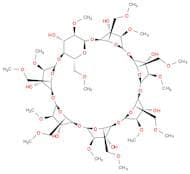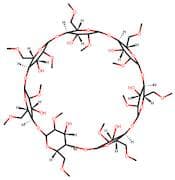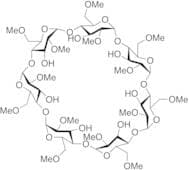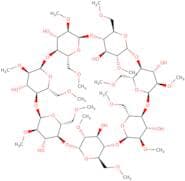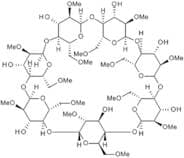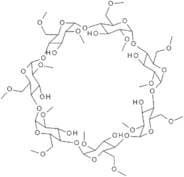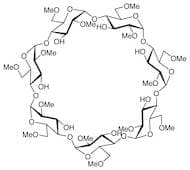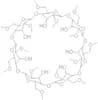
CAS 51166-71-3
:Di-O-méthyl-β-cyclodextrine
- 2,4,7,9,12,14,17,19,22,24,27,29,32,34-Tetradecaoxaoctacyclo[31.2.2.2<sup>3,6</sup>.2<sup>8,11</sup>.2<sup>13,16</sup>.2<sup>18,21</sup>.2<sup>23,26</sup>.2<sup>28,31</sup>]nonatetracontane, β-cyclodextrin deriv.
- 2,6-2-Methyl-Beta-Cyclodextrin
- 2,6-Di-O-Methyl-Beta-Cyclodextrin
- 2,6-Di-O-methyl-β-cyclodextrin
- 2,6-Dimethyl-β-cyclodextrin
- 2<sup>A</sup>,2<sup>B</sup>,2<sup>C</sup>,2<sup>D</sup>,2<sup>E</sup>,2<sup>F</sup>,2<sup>G</sup>,6<sup>A</sup>,6<sup>B</sup>,6<sup>C</sup>,6<sup>D</sup>,6<sup>E</sup>,6<sup>F</sup>,6<sup>G</sup>-Tetradeca-O-methyl-β-cyclodextrin
- 2<sup>A</sup>,6<sup>A</sup>-Di-O-methyl-β-cyclodextrin
- Beta W 7M1.8
- Di-O-methyl-β-cyclodextrin
- Dimeb
- Dimeb 50
- Dimethyl-β-cyclodextrin
- Hepta-(2,6-di-oxy-methyl)-β-cyclodextrin
- Heptakis(2,6-di-O-methyl)-β-cyclodextrin
- Tetradeca-O-methyl-β-cyclodextrin
- Tetradecakis-2,6-O-methylcycloheptaamylose
- β-Cyclodextrin, 2<sup>A</sup>,2<sup>B</sup>,2<sup>C</sup>,2<sup>D</sup>,2<sup>E</sup>,2<sup>F</sup>,2<sup>G</sup>,6<sup>A</sup>,6<sup>B</sup>,6<sup>C</sup>,6<sup>D</sup>,6<sup>E</sup>,6<sup>F</sup>,6<sup>G</sup>-tetradeca-O-methyl-
- β-Cyclodextrin, 2A,2B,2C,2D,2E,2F,2G,6A,6B,6C,6D,6E,6F,6G-tetradeca-O-methyl-
- 2A,2B,2C,2D,2E,2F,2G,6A,6B,6C,6D,6E,6F,6G-Tetradeca-O-methyl-β-cyclodextrin
- Voir plus de synonymes
2,6-Di-O-methyl-β-cyclodextrin
CAS :Formule :C56H98O35Degré de pureté :98%Couleur et forme :SolidMasse moléculaire :1331.3563Heptakis(2,6-di-O-methyl)-b-cyclodextrin
CAS :Formule :C56H98O35Degré de pureté :≥ 98% (2,6-Di-O-methyl-b-CD + other methyl CDs)Couleur et forme :White to off-white powderMasse moléculaire :1331.36Heptakis(2,6-di-O-methyl)-β-cyclodextrin content > 35% (DS~14)
CAS :Heptakis(2,6-di-O-methyl)-β-cyclodextrin content > 35% (DS~14)Formule :C56H98O35Degré de pureté :95%Masse moléculaire :1,331.36g/molDi-O-methyl-b-cyclodextrin (90%)
CAS :Produit contrôléApplications Induces the release of cholesterol from cholesterol-rich lipid rafts located on the surface of cells, making it a good agent for removing cholesterol from processed foods
References Krajian, H., et al.: Anal. Bioanal. Chem., 394, 2193 (2009), Perez-Cruz, F., et al.: Bioorg. Med. Chem., 17, 4604 (2009), Motoyama, K., et al.: Biol. Pharm. Bull., 32, 700 (2009), Padula, C., et al.: Int. J. Pharm., 372, 12 (2009), Chen, Z., et al.: J. Pharm. Sci., 98, 229 (2009),Formule :C56H98O35Degré de pureté :90%Couleur et forme :White To Off-WhiteMasse moléculaire :1331.362,6-Dimethyl-β-cyclodextrin
CAS :This functionalised beta-cyclodextrin (β-CD) derivative is a functionalized cyclic oligosaccharide composed of seven glucose units, characterized by a hydrophilic exterior and a lipophilic cavity (bigger than α-CD and smaller than γ-CDs), which allows it to encapsulate various guest molecules. This structural feature facilitates its use in multiple applications, including pharmaceuticals, food enhancement, and cosmetics. In the pharmaceutical industry, it enhances the solubility and stability of poorly water-soluble drugs, improving their bioavailability and efficacy while also masking unpleasant tastes. The food sector utilizes it as a stabilizer for flavors, colors, and nutrients, extending shelf life by protecting sensitive ingredients from degradation. In cosmetics, it serves as a complexing agent for fragrances and active components, ensuring their stability and controlled release. Its use expands to many other fields, including nanotechnology for drug delivery systems, environmental remediation for extracting organic pollutants, textiles for slow-release fragrances, and analytical chemistry for chiral separation.
Formule :C56H98O35Degré de pureté :Min. 98 Area-%Masse moléculaire :1,331.36 g/mol2,6-Dimethyl-beta-cyclodextrin
CAS :This beta-cyclodextrin (β-CD) derivative is a functionalized cyclic oligosaccharide composed of seven glucose units, characterized by a hydrophilic exterior and a lipophilic cavity (bigger than α-CD and smaller than γ-CDs), which allows it to encapsulate various guest molecules. This structural feature facilitates its use in multiple applications, including pharmaceuticals, food enhancement, and cosmetics. In the pharmaceutical industry, it enhances the solubility and stability of poorly water-soluble drugs, improving their bioavailability and efficacy while also masking unpleasant tastes. The food sector utilizes it as a stabilizer for flavors, colors, and nutrients, extending shelf life by protecting sensitive ingredients from degradation. In cosmetics, it serves as a complexing agent for fragrances and active components, ensuring their stability and controlled release. Its use expands to many other fields, including nanotechnology for drug delivery systems, environmental remediation for extracting organic pollutants, textiles for slow-release fragrances, and analytical chemistry for chiral separation.Formule :C56H98O35Degré de pureté :Min. 98%Couleur et forme :White PowderMasse moléculaire :1,331.36 g/mol2,6-Dimethyl-b-cyclodextrin - Technical
CAS :This beta-cyclodextrin (β-CD) derivative is a functionalized cyclic oligosaccharide composed of seven glucose units, characterized by a hydrophilic exterior and a lipophilic cavity (bigger than α-CD and smaller than γ-CDs), which allows it to encapsulate various guest molecules. This structural feature facilitates its use in multiple applications, including pharmaceuticals, food enhancement, and cosmetics. In the pharmaceutical industry, it enhances the solubility and stability of poorly water-soluble drugs, improving their bioavailability and efficacy while also masking unpleasant tastes. The food sector utilizes it as a stabilizer for flavors, colors, and nutrients, extending shelf life by protecting sensitive ingredients from degradation. In cosmetics, it serves as a complexing agent for fragrances and active components, ensuring their stability and controlled release. Its use expands to many other fields, including nanotechnology for drug delivery systems, environmental remediation for extracting organic pollutants, textiles for slow-release fragrances, and analytical chemistry for chiral separation.Formule :C56H98O35Degré de pureté :Min. 98%Couleur et forme :White PowderMasse moléculaire :1,331.36 g/mol2,6-Di-O-methyl-β-cyclodextrin
CAS :Formule :C56H98O35Degré de pureté :>95.0%(HPLC)Couleur et forme :White to Light yellow powder to crystalMasse moléculaire :1,331.372,6-DI-O-METHYL-β-CYCLODEXTRIN
CAS :Degré de pureté :98%Couleur et forme :SolidMasse moléculaire :1331.36499