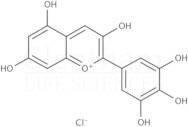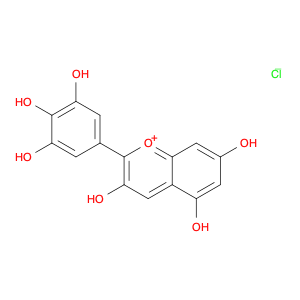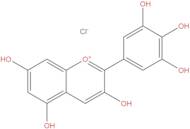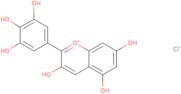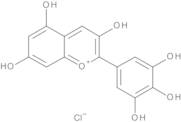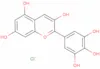
CAS 528-53-0
:Chlorure de delphinidine
Description :
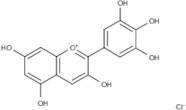
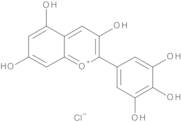
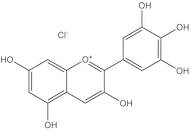
Chlorure de delphinidine est une anthocyanidine qui se produit naturellement, un type de pigment flavonoïde trouvé dans divers fruits et fleurs, contribuant à leurs couleurs rouge, bleue ou violette. Elle se caractérise par sa formule chimique, qui inclut généralement un groupe hydroxyle et un groupe méthoxy, influençant sa solubilité et sa stabilité. Chlorure de delphinidine est connu pour ses propriétés antioxydantes, qui peuvent aider à protéger les cellules du stress oxydatif. Elle présente une forte absorption dans le spectre de la lumière visible, ce qui la rend utile dans les colorants alimentaires et comme teinture naturelle. Le composé est soluble dans l'eau et l'alcool, mais sa stabilité peut être affectée par le pH et l'exposition à la lumière. De plus, la delphinidine a été étudiée pour ses potentiels bienfaits pour la santé, y compris des propriétés anti-inflammatoires et anticancéreuses. Sa forme chlorure indique la présence d'ions chlorure, qui peuvent influencer sa réactivité et ses interactions dans divers environnements chimiques. Dans l'ensemble, Chlorure de delphinidine est un composé significatif tant dans la chimie des produits naturels que dans les applications thérapeutiques potentielles.
Formule :C15H11ClO7
InChI :InChI=1/C15H10O7.2ClH/c16-7-3-9(17)8-5-12(20)15(22-13(8)4-7)6-1-10(18)14(21)11(19)2-6;;/h1-5H,(H5-,16,17,18,19,20,21);2*1H/p-1
Code InChI :InChIKey=FFNDMZIBVDSQFI-UHFFFAOYSA-N
SMILES :OC=1C(=[O+]C2=C(C1)C(O)=CC(O)=C2)C3=CC(O)=C(O)C(O)=C3.[Cl-]
Synonymes :- 1-Benzopyrylium, 3,5,7-trihydroxy-2-(3,4,5-trihydroxyphenyl)-, chloride
- 1-Benzopyrylium, 3,5,7-trihydroxy-2-(3,4,5-trihydroxyphenyl)-, chloride (1:1)
- 3,3′,4′,5,5′,7-Hexahydroxy-2-phenylbenzopyrylium chloride
- 3,3′,4′,5,5′,7-Hexahydroxyflavylium chloride
- 3,5,7-Trihydroxy-2-(3,4,5-Trihydroxyphenyl)Chromenium Chloride
- 3,5,7-Trihydroxy-2-(3,4,5-trihydroxyphenyl)-1-benzopyrylium chloride
- Ccris 2518
- Delfinidol chloride
- Delphinidin
- Delphinidin Chloride
- Delphinidine
- Delphinidol
- Ephdine
- Flavylium 3,3',4',5,5',7-hexahydroxy-, chloride (8CI)
- Flavylium, 3,3′,4′,5,5′,7-hexahydroxy-, chloride
- IdB 1056
- 3,5,7-Trihydroxy-2-(3,4,5-trihydroxyphenyl)benzopyrylium chloride
- DELPHINIDINE CHLORIDE
- 2-(3,4,5-trihydroxyphenyl)chromene-3,5,7-triol chloride
- 3,3',4',5,5',7-Hexahydroxy-2-phenylbenzopyrylium chloride
- 3’,4’,5,5’,7-hexahydroxy-flavyliumchloride
- 3,5,7-trihydroxy-2-(3,4,5-trihydroxyphenyl)-1-benzopyryliumchloride
- DELPHINIDIN CHLORIDE(P)
- ANTHOCYANIN
- DELPHINIDIN CHLORIDE WITH HPLC
- delfinidolchloride
- Delfinidol
- 3,3',4',5,5',7-HEXAHYDROXYFLAVYLIUM CHLORIDE
- 3,3',4',5,5',7-HEXAHYDROXYFLAVYLIUM
- DELPHINIDIN CHLORIDE hplc
- 3,5,7-trihydroxy-2-(3,4,5-trihydroxyphenyl)-1-benzopyryliuchloride
- Voir plus de synonymes
Filtrer par
Pourcentage de pureté
0
100
|
0
|
50
|
90
|
95
|
100
15 produits trouvés.
- Tri par prix ascendant
- Tri par prix descendant
- Puretés inférieures
- Puretés supérieures
- Livraison estimée la plus rapide
3,5,7-Trihydroxy-2-(3,4,5-trihydroxyphenyl)chromenylium chloride
CAS :3,5,7-Trihydroxy-2-(3,4,5-trihydroxyphenyl)chromenylium chlorideFormule :C15H11ClO7Degré de pureté :99%Couleur et forme :SolidMasse moléculaire :338.7Delphinidin Chloride
CAS :Formule :C15H11ClO7Degré de pureté :99%Couleur et forme :SolidMasse moléculaire :338.6966Delphinidin chloride
CAS :Delphinidin chloride, a berry/red wine pigment, induces NO release for vascular relaxation and inhibits growth signaling, promoting apoptosis/autophagy.Formule :C15H11ClO7Degré de pureté :98.51% - 99.93%Couleur et forme :Brown SolidMasse moléculaire :338.697Delphinidin chloride
CAS :Delphinidin chloride analytical standard provided with w/w absolute assay, to be used for quantitative titration.Formule :C15H11O7ClDegré de pureté :(HPLC) ≥97%Couleur et forme :PowderMasse moléculaire :338.7Delphinidin chloride (Standard)
CAS :Delphinidin chloride (Standard) is a reference standard for research and analysis in studies involving Delphinidin chloride. Delphinidin chloride, a natural plant pigment found in berries and red wine, is a precursor of certain anthocyanins. Delphinidin chloride induces the release of nitric oxide from the vascular endothelium, resulting in vascular relaxation. At the dose of 1-40 μM, epithelial growth factor receptor signaling and estrogen receptor α expression were inhibited, which was associated with apoptosis and autophagy. Delphinidin chloride regulates JAK/STAT3 and MAPKinase signaling. Delphinidin also inhibited the histone acetyltransferase activity of p300/CBP (IC50 was about 30 μM).Formule :C15H11ClO7Masse moléculaire :338.697Delphinidin Chloride (>80% purity)
CAS :Produit contrôléFormule :C15H11O7·ClDegré de pureté :>80%Couleur et forme :NeatMasse moléculaire :338.7Delphinidin chloride
CAS :3,5,7-Trihydroxy-2-(3,4,5-trihydroxyphenyl)chromenylium chlorideFormule :C15H11ClO7Degré de pureté :99%Masse moléculaire :338.7Delphinidin chloride
CAS :Oxygen-heterocyclic compoundFormule :C15H11O7ClDegré de pureté :≥ 90.0 % (HPLC)Couleur et forme :PowderMasse moléculaire :338.7Delphinidin chloride
CAS :Delphinidin chloride is a naturally occurring anthocyanin, which is a type of pigment commonly found in plants. It is sourced primarily from fruits and flowers, such as grapes, berries, and petunias, where it contributes to their vivid blue or purple coloration. The mode of action of delphinidin chloride is largely attributed to its potent antioxidant properties, which involve scavenging reactive oxygen species and thereby reducing oxidative stress in biological systems.Formule :C15H11O7ClDegré de pureté :Min. 95%Couleur et forme :Red PowderMasse moléculaire :338.7 g/molDelphinidin Chloride
CAS :Produit contrôléApplications Delphinidin Chloride is an anthocyanidin; antioxidant. Delphinidin Chloride is a pigment found in grapes, cranberries, and pomegranates.
References ,Sweeney, M., et al.: Nutr. Neurosci., 5, 427 (2002), Wu, X., et al.: J. Nutr., 132, 1865 (2002), Gavrilova, V., et al.: J. Agric. Food Chem., 59, 4009 (2011),Formule :C15H11O7·ClCouleur et forme :NeatMasse moléculaire :338.7