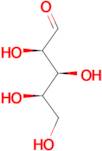
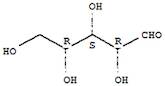
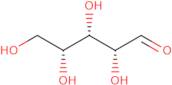
CAS 58-86-6
:(+)-Xylose
Description :
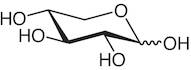
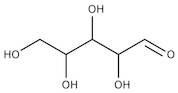
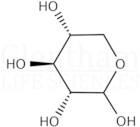
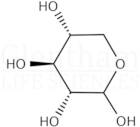
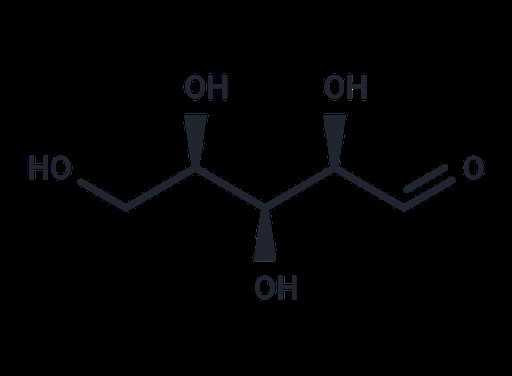
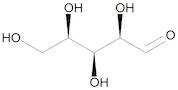
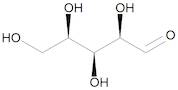
(+)-Xylose, avec le numéro CAS 58-86-6, est un sucre aldopentose qui se produit naturellement, spécifiquement un monosaccharide à cinq carbones. Il est classé comme un D-sucre et se trouve couramment dans divers matériaux végétaux, en particulier dans l'hémicellulose du bois et dans certains fruits. La formule moléculaire de (+)-Xylose est C5H10O5, et il existe sous une forme cristalline qui est typiquement blanche ou incolore. Ce sucre est connu pour son goût sucré, bien qu'il soit moins sucré que le glucose. (+)-Xylose est soluble dans l'eau, ce qui facilite son absorption dans les systèmes biologiques. Il joue un rôle significatif dans le métabolisme des glucides et est souvent utilisé dans des environnements de laboratoire pour divers tests biochimiques, y compris des tests d'absorption intestinale. De plus, il est important dans l'industrie alimentaire et peut être utilisé dans la production de xilo-oligosaccharides, qui ont des propriétés prébiotiques. Le composé peut exister sous différentes formes anomériques, la configuration D étant la plus répandue dans la nature.
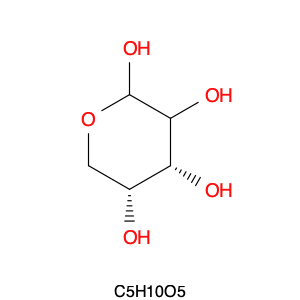
Formule :C5H10O5
InChI :InChI=1S/C5H10O5/c6-1-3(8)5(10)4(9)2-7/h1,3-5,7-10H,2H2/t3-,4+,5+/m0/s1
Code InChI :InChIKey=PYMYPHUHKUWMLA-VPENINKCSA-N
SMILES :[C@H]([C@@H](CO)O)([C@H](C=O)O)O
Synonymes :- (+)-Xylose
- (2R,3S,4R)-2,3,4,5-Tetrahydroxypentanal
- 2,3,4,5-Tetrahydroxypentanal
- <span class="text-smallcaps">D</span>-(+)-Xylose
- Brn 1562108
- Ccris 1899
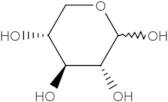
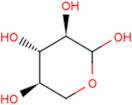
- D-xylopyranose
- FEMA No. 3606
- Holzzucker
- Hsdb 3273
- Unii-A1Ta934Ako
- Wood sugar
- Xilosa, Pura
- Xylose, <span class="text-smallcaps">D</span>-
- Xylose, D-
- alpha-D-xylopyranose
- beta-D-xylopyranose
- Voir plus de synonymes
Filtrer par
Pourcentage de pureté
0
100
|
0
|
50
|
90
|
95
|
100
- Tri par prix ascendant
- Tri par prix descendant
- Puretés inférieures
- Puretés supérieures
- Livraison estimée la plus rapide
D-(+)-Xylose
CAS :Formule :C5H10O5Degré de pureté :>98.0%(HPLC)Couleur et forme :White powder to crystalMasse moléculaire :150.13D-(+)-Xylose, 98+%
CAS :D-(+)-Xylose is used to prepare furfural by acid catalyzed degradation reaction, which acts as a solvent as well as a precursor to synthetic polymers. It is a useful animal medicine involved in the treatment of malabsorption. It finds application in the production of sugar substitute xylitol by subFormule :C5H10O5Degré de pureté :98+%Couleur et forme :White to pale cream, Crystals or powder or crystalline powderMasse moléculaire :150.13D-(+)-Xylose, 10mM (in DMSO)
CAS :D-(+)-Xylose, 10mM (in DMSO)Formule :C5H10O5Degré de pureté :≥98%, 10 mM in DMSOMasse moléculaire :150.13D-(+)-Xylose
CAS :D-(+)-XyloseFormule :C5H10O5Degré de pureté :98%Couleur et forme :White Solid-CrystalsMasse moléculaire :150.1299D-(+)-Xylose
CAS :Formule :C5H10O5Degré de pureté :≥ 98.5%Couleur et forme :White to colourless crystalline powderMasse moléculaire :150.13D-(+)-Xylose, USP grade
CAS :Formule :C5H10O5Degré de pureté :98.0 - 102.0 % (dried basis)Couleur et forme :White crystalline powderMasse moléculaire :150.13D-Xylose
CAS :D-XyloseFormule :C5H10O5Degré de pureté :98%Couleur et forme :Solid-CrystalsMasse moléculaire :150.1299D-(+)-Xylose (Standard)
CAS :D-(+)-Xylose (Standard) is the standard substance of D-(+)-Xylose, and it is applicable for quantitative analysis, quality control, and related research in biochemical experiments. D-(+)-Xylose (Wood sugar) is an aldopentose - a monosaccharide containing five carbon atoms and an aldehyde functional group. It has chemical formula C5H10O5 and is 40% as sweet as sucrose. Xylose is also found in mucopolysaccharides of connective tissue and sometimes in the urine. Xylose is the first sugar added to serine or threonine residues during proteoglycan type O-glycosylation. Therefore xylose is involved in the biosythetic pathways of most anionic polysaccharides such as heparan sulphate and chondroitin sulphate. In medicine, xylose is used to test for malabsorption by administering a xylose solution to the patient after fasting. If xylose is detected in the blood and/or urine within the next few hours, it has been absorbed by the intestines. Xylose is said to be one of eight sugars which are essential for human nutrition, the others being galactose, glucose, mannose, N-acetylglucosamine, N-acetylgalactosamine, fucose, and sialic acid. . Xylose in the urine is a biomarker for the consumption of apples and other fruits.Formule :C5H10O5Masse moléculaire :150.13D-(+)-Xylose
CAS :D-(+)-Xylose analytical standardFormule :C5H10O5Degré de pureté :(HPLC) ≥95%Couleur et forme :PowderMasse moléculaire :150.14D-Xylose-1,2,3,4,5,5'-C-d6
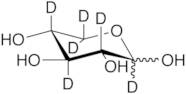
CAS :Produit contrôléApplications D-Xylose-1,2,3,4,5,5'-C-d6 is a labeled analog of D-Xylose, which is used in diagnostic malabsorption tests as well as in the production of Furfural.
References Ehrenpreis E.D. et al.: J. Acquir. Immune. Defic. Syndr., 5, 1047 (1992); Sérgio L. et al.: Cat. Comm., 9, 2144 (2008);Formule :C5H4D6O5Couleur et forme :NeatMasse moléculaire :156.17D-Xylose
CAS :Applications D-Xylose is used in diagnostic malabsorption tests as well as in the production of Furfural.
References Ehrenpreis E.D. et al.: J. Acquir. Immune. Defic. Syndr., 5, 1047 (1992); Sérgio L. et al.: Cat. Comm., 9, 2144 (2008);Formule :C5H10O5Couleur et forme :NeatMasse moléculaire :150.13D-(+)-Xylose
CAS :D-(+)-Xylose (Wood sugar) is an aldopentose. Xylose is also found in mucopolysaccharides of connective tissue and sometimes in the urine.Formule :C5H10O5Degré de pureté :99.84% - 99.85%Couleur et forme :White SolidMasse moléculaire :150.13D-(+)-Xylose extrapure
CAS :Formule :C5H10O5Couleur et forme :White to off-white, Crystalline powder, Clear, ColourlessMasse moléculaire :150.13D-(+)-Xylose ExiPlus, Multi-Compendial
CAS :Formule :C5H10O5Couleur et forme :White to off-white, Crystalline powder, ClearMasse moléculaire :150.13D-Xylose
CAS :Xylose (Xyl) is an aldopentose also known as wood sugar (Collins, 2006). The main sources of xylose are hemicelluloses found in hardwood and perennial plants, such as, grasses, cereals, and herbs (Petzold-Welcke, 2014) and some algae. Xylose is used in the production of xylitol, a low calory sugar substitute. Xylose is used in glycosaminoglycan (GAG) biosynthesis, which is initiated by peptide O-xylosyltransferases, which transfer xylose onto selected serine residues in the core proteins. The first enzyme in the pathway, peptide O-xylosyltransferase, catalyzes the transfer of xylose from uridine diphosphate (UDP)-α-D-xylose onto serine and thus determines the site(s) of GAG attachment on the core protein (Briggs, 2018).Formule :C5H10O5Degré de pureté :Min. 99.0 Area-%Masse moléculaire :150.13 g/mol