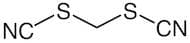
CAS 6317-18-6
:Méthylène bis(thiocyanate)
- Antiblu 3737
- Antiblu 3738
- Basiment 540
- Bis(thiocyanato)methane
- Busan 110
- Dithiocyanomethane
- Kilstain
- MTC
- Metasol T 10
- Methanediyl Bis(Thiocyanate)
- Methylene Bisthiocyanate
- Methylene bis(thiocyanate)
- Methylene thiocyanate
- Methylenedirhodanide
- Methylenedithiocyanate
- NSC 40464
- Nalco 5793
- Nalco D 2303
- Nalfloc N 206
- Proxel MB
- Slimicide MC
- Thiocyanic acid, C,C′-methylene ester
- Thiocyanic acid, methylene ester
- V 709
- Wt 307B
- Voir plus de synonymes
Methylene Dithiocyanate
CAS :Produit contrôléFormule :C3H2N2S2Degré de pureté :>99.0%(GC)Couleur et forme :White to Light yellow to Light orange powder to crystalMasse moléculaire :130.18Methylene Dithiocyanate
CAS :Produit contrôléMethylene DithiocyanateFormule :C3H2N2S2Degré de pureté :>99.0%Masse moléculaire :130.18Methylene bisthiocyanate (Standard)
CAS :Produit contrôléMethylene bisthiocyanate (Standard) is a reference standard of Methylene bisthiocyanate intended for quantitative analysis, quality control, and related biochemical research applications.Formule :C3H2N2S2Couleur et forme :SolidMasse moléculaire :130.19Methylene dithiocyanate
CAS :Produit contrôléFormule :C3H2N2S2Couleur et forme :NeatMasse moléculaire :130.19Methylene Dithiocyanate
CAS :Produit contrôléApplications Methylene Dithiocyanate emulsion is used as bactericide.
Not a dangerous good if item is equal to or less than 1g/ml and there is less than 100g/ml in the package
References Butler, E., et al.: Toxicol. Appl. Pharmacol., 93, 72 (1988), Dix, D., et al.: Toxicol. Sci., 95, 5 (2007), Abbott, B., et al.: Reprod. Toxicol., 27, 246 (2008),Formule :C3H2N2S2Couleur et forme :NeatMasse moléculaire :130.19Methylene bis thiocyanate
CAS :Produit contrôléMethylene bis thiocyanate is a biocide that reacts with fatty acids to produce ethylene diamine, which causes death by suffocation. It has been used in wastewater treatment and in the analytical method of determining the redox potential of a solution. Methylene bis thiocyanate has been found to have synergistic effects when combined with benzalkonium chloride and sodium carbonate. Methylene bis thiocyanate is toxic to living organisms, as it interferes with oxidative phosphorylation by inhibiting electron transport from cytochrome c to oxygen.
Methylene bis thiocyanate can cause skin irritation, dermatitis, and eczema. Methylene bis thiocyanate may also cause respiratory irritation if inhaled or swallowed.Formule :C3H2N2S2Degré de pureté :Min. 95%Couleur et forme :PowderMasse moléculaire :130.19 g/mol