CAS 778-82-5
:Acétate d'éthyle 1H-indole-3
Description :
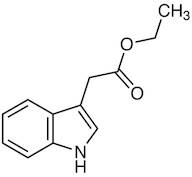
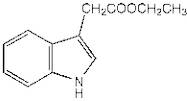
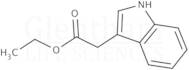
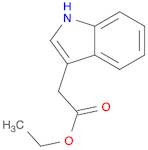
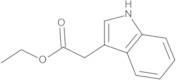
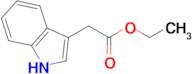
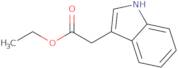
Acétate d'éthyle 1H-indole-3, avec le numéro CAS 778-82-5, est un composé organique qui appartient à la classe des dérivés de l'indole. Il présente un cycle indole, qui est une structure bicyclique composée d'un cycle benzénique fusionné à un cycle pyrrole, et un groupe fonctionnel acétate attaché à l'atome d'azote de l'indole. Ce composé est typiquement un liquide incolore à jaune pâle avec une odeur caractéristique. Acétate d'éthyle 1H-indole-3 est connu pour ses applications dans la synthèse de divers médicaments et agrochimiques, ainsi que pour son utilisation potentielle en parfumerie en raison de son parfum agréable. Il est modérément soluble dans les solvants organiques et présente une faible solubilité dans l'eau. Le composé est stable dans des conditions normales, mais doit être manipulé avec précaution, car il peut présenter des risques pour la santé s'il est ingéré ou inhalé. Sa réactivité peut être influencée par la présence d'autres groupes fonctionnels et par les conditions environnementales, ce qui en fait un sujet d'intérêt en synthèse organique et en chimie médicinale.
Formule :C12H13NO2
InChI :InChI=1S/C12H13NO2/c1-2-15-12(14)7-9-8-13-11-6-4-3-5-10(9)11/h3-6,8,13H,2,7H2,1H3
Code InChI :InChIKey=HUDBDWIQSIGUDI-UHFFFAOYSA-N
SMILES :C(C(OCC)=O)C=1C=2C(NC1)=CC=CC2
Synonymes :- (1H-Indol-3-yl)acetic acid ethyl ester
- 1H-indole-3-acetic acid, ethyl ester
- 3-[(Ethoxycarbonyl)methyl]indole
- Ethyl (1H-indol-3-yl)acetate
- Ethyl 1H-indol-3-ylacetate
- Ethyl 1H-indole-3-acetate
- Ethyl 2-(1H-indol-3-yl)acetate
- Ethyl 2-(indol-3-yl)acetate
- Ethyl indole-3-acetate
- Ethyl β-indolylacetate
- IAA ethyl ester
- Indole-3-acetic acid, ethyl ester
- Voir plus de synonymes
Filtrer par
Pourcentage de pureté
0
100
|
0
|
50
|
90
|
95
|
100
9 produits trouvés.
- Tri par prix ascendant
- Tri par prix descendant
- Puretés inférieures
- Puretés supérieures
- Livraison estimée la plus rapide
Ethyl 3-Indoleacetate
CAS :Formule :C12H13NO2Degré de pureté :>98.0%(GC)Couleur et forme :White to Light yellow to Light orange powder to crystalMasse moléculaire :203.24Ethyl indole-3-acetate, 98+%
CAS :This Thermo Scientific Chemicals brand product was originally part of the Alfa Aesar product portfolio. Some documentation and label information may refer to the legacy brand. The original Alfa Aesar product / item code or SKU reference has not changed as a part of the brand transition to Thermo SciFormule :C12H13NO2Degré de pureté :98+%Couleur et forme :White to cream to pale brown or pale yellow, PowderMasse moléculaire :203.24Indole-3-acetic acid ethyl ester
CAS :Formule :C12H13NO2Degré de pureté :≥ 98.0%Couleur et forme :White to light yellow or pale-brown powder to crystalsMasse moléculaire :203.24Ethyl 2-(1H-indol-3-yl)acetate
CAS :Ethyl 2-(1H-indol-3-yl)acetateFormule :C12H13NO2Degré de pureté :>98%Masse moléculaire :203.24Ethyl 2-(1H-indol-3-yl)acetate
CAS :Formule :C12H13NO2Degré de pureté :98%Couleur et forme :SolidMasse moléculaire :203.2371Ethyl Indole-3-acetate
CAS :Produit contrôléApplications Ethyl Indole-3-acetate is a compound used in the synthesis of 9H-Pyrrolo[1,2-α]Indoles via Michael Addition-Condensation with α,β-Unsaturated Ketimines.
References Zhang, M., et al.: J. Heterocyclic Chem. (2016)Formule :C12H13NO2Couleur et forme :NeatMasse moléculaire :203.24Ethyl 3-indoleacetate
CAS :Formule :C12H13NO2Degré de pureté :98%Couleur et forme :SolidMasse moléculaire :203.241Ethyl 2-(1H-indol-3-yl)acetate
CAS :Ethyl 2-(1H-indol-3-yl)acetateFormule :C12H13NO2Degré de pureté :98%Masse moléculaire :203.24Ethyl indole-3-acetate
CAS :Ethyl indole-3-acetate (EIA) is a compound that inhibits the growth of certain cancer cells. It belongs to the group of acyl halides. EIA inhibits the synthesis of nucleic acids, proteins and other macromolecules by the cancer cells. It has been shown to be effective in reducing the size of tumors in mice with prostate and breast cancer. This compound also inhibits enzymes such as abscisic acid oxidase, which is responsible for converting abscisic acid into reactive oxygen species. EIA has been shown to have hemolytic activity in human lung tissue, but not ovules or human erythrocytes. This may be due to its ability to inhibit hormone production and cause an increase in progesterone levels.Formule :C12H13NO2Degré de pureté :Min. 95%Couleur et forme :PowderMasse moléculaire :203.24 g/mol