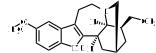
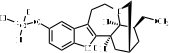
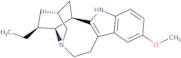
CAS 83-74-9
:(-)-Ibogaïne
Formule :C20H26N2O
InChI :InChI=1S/C20H26N2O/c1-3-13-8-12-9-17-19-15(6-7-22(11-12)20(13)17)16-10-14(23-2)4-5-18(16)21-19/h4-5,10,12-13,17,20-21H,3,6-9,11H2,1-2H3/t12-,13+,17+,20+/m1/s1
Code InChI :InChIKey=HSIBGVUMFOSJPD-CFDPKNGZSA-N
SMILES :C(C)[C@@H]1[C@]2([C@@]3(C4=C(C=5C(N4)=CC=C(OC)C5)CC[N@]2C[C@@](C3)(C1)[H])[H])[H]
Synonymes :- 6,9-Methano-5H-pyrido[1′,2′:1,2]azepino[4,5-b]indole, ibogamine deriv.
- 7-Ethyl-6,6beta,7,8,9,10,12,13-octahydro-2-methoxy-6,9-methano-5H-pyrido(1',2':1,2)azepino(5,4-b)indole
- DEA No. 7260
- Endabuse
- Ibogain
- Ibogaine
- Ibogaine (8CI)
- Ibogamine, 12-methoxy-
- Nih 10567
- Nsc 249764
- Tabernanthe iboga
- Unii-3S814I130U
- 12-Methoxyibogamine
- Voir plus de synonymes
Filtrer par
Pourcentage de pureté
0
100
|
0
|
50
|
90
|
95
|
100
3 produits trouvés.
- Tri par prix ascendant
- Tri par prix descendant
- Puretés inférieures
- Puretés supérieures
- Livraison estimée la plus rapide
Ibogaine-13C-d3
CAS :Formule :C1913CH23D3N2OCouleur et forme :White To Off-White SolidMasse moléculaire :314.45Ibogaine
CAS :Produit contrôléIbogaine is a psychoactive substance, which is an indole alkaloid derived from the root bark of the Tabernanthe iboga plant. This plant is native to Central Africa and has been traditionally used in spiritual and healing ceremonies by indigenous communities. Ibogaine acts primarily as a serotonergic and dopaminergic system modulator, exhibiting complex interactions at several neurotransmitter systems, including NMDA receptors and sigma-2 receptors, and functioning as an antagonist at the α3β4 nicotinic acetylcholine receptors.Current research focuses on its potential applications in interrupting substance addiction cycles, particularly for opioids and stimulants, by reducing withdrawal symptoms and cravings. Its ability to induce an altered state of consciousness is also being studied in the context of psychotherapy. However, the administration of Ibogaine requires careful clinical oversight due to its potent psychoactive effects and potential cardiac risks. Preclinical and clinical studies continue to investigate its efficacy and safety profile, with a focus on understanding the neurobiological mechanisms underlying its therapeutic benefits.Formule :C20H26N2ODegré de pureté :Min. 98 Area-%Couleur et forme :PowderMasse moléculaire :310.43 g/mol