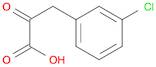
CAS 96406-06-3
:Formule :C9H7ClO3
InChI :InChI=1S/C9H7ClO3/c10-7-3-1-2-6(4-7)5-8(11)9(12)13/h1-4H,5H2,(H,12,13)
Code InChI :RQLSQGBGWWZKEL-UHFFFAOYSA-N
SMILES :C1=CC(=CC(=C1)Cl)CC(=O)C(=O)O
Filtrer par
Pourcentage de pureté
0
100
|
0
|
50
|
90
|
95
|
100
4 produits trouvés.
- Tri par prix ascendant
- Tri par prix descendant
- Puretés inférieures
- Puretés supérieures
- Livraison estimée la plus rapide
3-(3-Chlorophenyl)-2-oxopropanoic acid
CAS :3-(3-Chlorophenyl)-2-oxopropanoic acidFormule :C9H7ClO3Degré de pureté :95%Masse moléculaire :198.63-(3-Chlorophenyl)-2-oxopropanoic acid
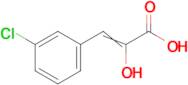
CAS :Formule :C9H7ClO3Degré de pureté :95%Masse moléculaire :198.60313-(3-chlorophenyl)-2-hydroxyprop-2-enoic acid
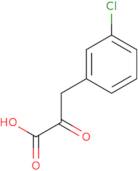
CAS :Degré de pureté :95%Masse moléculaire :198.60000613-(3-Chlorophenyl)-2-oxopropanoic acid
CAS :3-(3-Chlorophenyl)-2-oxopropanoic acid is a diastereomer of 2-phenylpropanoic acid. It is used in the synthesis of diketopiperazines, which are analogues of amphetamines. The synthesis proceeds by the addition of ethyl chloroacetate to α-chloroacrylic acid followed by reaction with cyclohexanol and then reduction with lithium aluminum hydride. The stereoselectivity of this reaction is determined by the enantioselective transfer of a proton from the hydroxyl group to the adjacent carbonyl group. This process occurs more readily when an enantiomerically pure chiral catalyst is used, leading to a diastereoselective synthesis.Formule :C9H7ClO3Degré de pureté :Min. 95%Masse moléculaire :198.6 g/mol