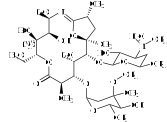
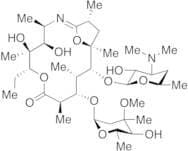
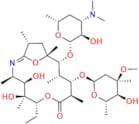
CAS 99290-97-8
:(1Z,3R,4R,5S,6R,9R,10S,11S,12R,13R,15R)-10-[(2,6-Didésoxy-3-C-méthyl-3-O-méthyl-α-L-ribo-hexopyranosyl)oxy]-6-éthyl-4,5-dihydroxy-3,5,9,11,13,15-hexaméthyl-12-[[3,4,6-tridésoxy-3-(diméthylamino)-β-D-xylo-hexopyranosyl]oxy]-7,16-dioxa-2-azabicyclo[11.2.1]hexadéc-1-én-8-one
Description :
La substance chimique portant le nom "(1Z,3R,4R,5S,6R,9R,10S,11S,12R,13R,15R)-10-[(2,6-Didésoxy-3-C-méthyl-3-O-méthyl-α-L-ribo-hexopyranosyl)oxy]-6-éthyl-4,5-dihydroxy-3,5,9,11,13,15-hexaméthyl-12-[[3,4,6-tridésoxy-3-(diméthylamino)-β-D-xylo-hexopyranosyl]oxy]-7,16-dioxa-2-azabicyclo[11.2.1]hexadéc-1-én-8-one" et le numéro CAS "99290-97-8" est une molécule organique complexe caractérisée par sa stéréochimie complexe et ses multiples groupes fonctionnels. Elle présente une structure bicyclique, qui contribue à sa conformation tridimensionnelle unique. La présence de plusieurs groupes hydroxyles indique un potentiel pour les liaisons hydrogène, influençant sa solubilité et sa réactivité. La molécule contient également des moieties de sucre, suggérant qu'elle pourrait présenter une activité biologique, interagissant possiblement avec des enzymes ou des récepteurs spécifiques. Le groupe diméthylamino pourrait améliorer ses propriétés pharmacologiques, affectant potentiellement son interaction avec les systèmes biologiques. Dans l'ensemble, la complexité structurelle et la diversité fonctionnelle de ce composé en font un sujet d'intérêt en chimie médicinale et en biochimie, en particulier dans le contexte du développement de médicaments et des applications thérapeutiques.
Formule :C37H66N2O12
InChI :InChI=1S/C37H66N2O12/c1-14-25-37(10,44)29(41)22(6)38-32-18(2)16-36(9,51-32)31(50-34-27(40)24(39(11)12)15-19(3)46-34)20(4)28(21(5)33(43)48-25)49-26-17-35(8,45-13)30(42)23(7)47-26/h18-31,34,40-42,44H,14-17H2,1-13H3/b38-32-/t18-,19-,20+,21-,22-,23+,24+,25-,26+,27-,28+,29-,30+,31-,34+,35-,36-,37-/m1/s1
Code InChI :InChIKey=BPENQAXMHXRNMD-ULJZSMOKSA-N
SMILES :O([C@H]1[C@]2(C)O/C(/[C@H](C)C2)=N\[C@H](C)[C@@H](O)[C@](C)(O)[C@@H](CC)OC(=O)[C@H](C)[C@@H](O[C@H]3C[C@](OC)(C)[C@@H](O)[C@H](C)O3)[C@@H]1C)[C@H]4[C@H](O)[C@@H](N(C)C)C[C@@H](C)O4
Synonymes :- (1Z,3R,4R,5S,6R,9R,10S,11S,12R,13R,15R)-10-[(2,6-Dideoxy-3-C-methyl-3-O-methyl-α-L-ribo-hexopyranosyl)oxy]-6-ethyl-4,5-dihydroxy-3,5,9,11,13,15-hexamethyl-12-[[3,4,6-trideoxy-3-(dimethylamino)-β-D-xylo-hexopyranosyl]oxy]-7,16-dioxa-2-azabicyclo[11.2.1]hexadec-1-en-8-one
- 7,16-Dioxa-2-azabicyclo[11.2.1]hexadec-1-en-8-one, 10-[(2,6-dideoxy-3-C-methyl-3-O-methyl-α-L-ribo-hexopyranosyl)oxy]-6-ethyl-4,5-dihydroxy-3,5,9,11,13,15-hexamethyl-12-[[3,4,6-trideoxy-3-(dimethylamino)-β-D-xylo-hexopyranosyl]oxy]-, [3R-(3R*,4R*,5S*,6R*,9R*,10S*,11S*,12R*,13R*,15R*)]-
- 7,16-Dioxa-2-azabicyclo[11.2.1]hexadec-1-en-8-one, 10-[(2,6-dideoxy-3-C-methyl-3-O-methyl-α-L-ribo-hexopyranosyl)oxy]-6-ethyl-4,5-dihydroxy-3,5,9,11,13,15-hexamethyl-12-[[3,4,6-trideoxy-3-(dimethylamino)-β-D-xylo-hexopyranosyl]oxy]-, (1Z,3R,4R,5S,6R,9R,10S,11S,12R,13R,15R)-
Trier par
Degré de pureté (%)
0
100
|
0
|
50
|
90
|
95
|
100
5 produits concernés.
Erythromycin A (6,9-Imino Ether)
CAS :Formule :C37H66N2O12Couleur et forme :White To Off-White SolidMasse moléculaire :730.94Erythromycin A 6,9-Imino Ether
CAS :Stability Hygroscopic
Applications An impurity in the synthesis of Erythromycin (E649950). An antibacterial.
References Zhang, L. et al.: J. Antibio., 64, 243 (2011); Koch, W.L., et al.: Anal. Profiles Drug Subs., 8, 157 (1979),Formule :C37H66N2O12Couleur et forme :White To Off-WhiteMasse moléculaire :730.93Erythromycin A 6,9-imino ether
CAS :Erythromycin is a macrolide antibiotic that inhibits bacterial growth by binding to the 50S ribosomal subunit. It has been shown to have antibacterial activity against both staphylococci and streptococci. Erythromycin binds to the 23S ribosomal RNA, which prevents protein synthesis and cell division. The drug is used for the treatment of infections caused by bacteria susceptible to erythromycin, such as Group P2 (Streptococcus pneumoniae) and Group A (Staphylococcus aureus). Erythromycin also inhibits the biosynthesis of macrolactones, which are antibiotics related to erythromycin. These compounds are found in Streptomyces spp., Actinomycetes spp., and Mycobacterium smegmatis.Formule :C37H66N2O12Degré de pureté :Min. 95%Couleur et forme :White To Off-White SolidMasse moléculaire :730.93 g/mol