Substrats fluorogènes
284 produits trouvés pour "Substrats fluorogènes".
4-Methylumbelliferyl-a-D-mannopyranoside-6-phosphoethanolamine
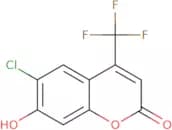
4-Methylumbelliferyl-a-D-mannopyranoside-6-phosphoethanolamine is a synthetic fluorogenic substrate that can be used in the detection of phosphatases. This substrate is a chromogenic and fluorogenic substrate that reacts when it is cleaved by enzymes. It has been shown to work with a number of different enzyme types, including esterases, phosphatases, and proteases. 4-Methylumbelliferyl-a-D-mannopyranoside-6-phosphoethanolamine has demonstrated high quality for use in bioluminescence, food testing, and environmental testing.4Methylumbelliferyl - a - D - mannopyranoside - 6 - phosphoethanolamine has been assigned CAS No. 81771-07-2.Degré de pureté :Min. 95%6-Chloro-7-hydroxy-4-(trifluoromethyl)coumarin
CAS :6-Chloro-7-hydroxy-4-(trifluoromethyl)coumarin is a fungicide that inhibits the growth of fungi by interfering with their DNA synthesis. It does this by inhibiting the activity of two enzymes: the fungal enzyme oxime and the enzyme cinerea, which is found in many fungi. 6-Chloro-7-hydroxy-4-(trifluoromethyl)coumarin has been shown to be effective against Alternaria and Botrytis cinerea. The compound also has an antifungal effect against other types of fungi, such as Penicillium roqueforti, when used in combination with a solvent such as ether.
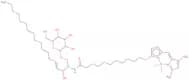
Degré de pureté :Min. 95%Masse moléculaire :264.58 g/molN-(4,4-Difluoro-5,7-dimethyl-4-bora-3a,4a-diaza-s-indacene-3-dodecanoyl)sphingosyl 1-b-D-galactopyranoside
N-(4,4-Difluoro-5,7-dimethyl-4-bora-3a,4a-diaza-s-indacene-3-dodecanoyl)sphingosyl 1bDgalactopyranoside is a fluorescent reagent. It has been used to detect the presence of boron in biological samples and as a substrate for enzymes. This product is also used in the diagnosis of tuberculosis and other bacterial infections. N-(4,4-Difluoro-5,7-dimethyl-4bora3a,4adiazasindacene 3dodecanoyl)sphingosyl 1bDgalactopyranoside is not intended for use in humans or animals and should be handled with care. This product is not available for sale in the state of California.Degré de pureté :Min. 95%Masse moléculaire :861.95 g/molResorufin ethyl ether
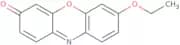
CAS :Resorufin ethyl ether is a fluorescent substrate that is used to measure the activity of cytochrome P450 enzymes. It can be used in vitro to study the effects of drugs on enzyme activities and in vivo to study liver lesions. Resorufin ethyl ether is also used as a model system for studying synchronous fluorescence, which is the emission of light by two or more substances at the same time. The nitrogen atoms in resorufin ethyl ether can be substituted with other atoms such as magnesium or zinc, which will affect its activity and fluorescence properties. Resorufin ethyl ether binds to cytochrome P450 enzymes and therefore inhibits their activity. This inhibition is reversible, and it can be reversed by adding a substance that competes with the substrate for binding sites on the enzyme.Degré de pureté :Min. 95%Masse moléculaire :241.24 g/mol4-Methylumbelliferyl 3-deoxy-D-glycero-a-D-galacto-2-nonulosonic acid sodium salt
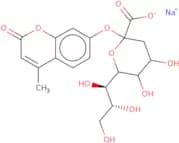
CAS :4-Methylumbelliferyl 3-deoxy-D-glycero-a-D-galacto-2-nonulosonic acid sodium salt is a fluorogenic substrate that can be used to detect enzyme activity. It reacts with the enzyme β-galactosidase, which hydrolyzes lactose in the presence of oxygen and hydrogen peroxide. The product is 4methylumbelliferone, which emits light in the presence of luciferin and an oxidizing agent. This product is used for diagnostics, food testing, and environmental testing. CAS No. 123269-95-4Degré de pureté :Min. 95%Masse moléculaire :489.41 g/mol2-Dodecylresorufin
CAS :2-Dodecylresorufin is a fluorescent probe that reacts with the hydroxyl radicals in the cell, which are generated by the enzyme superoxide dismutase. 2-Dodecylresorufin can be used to measure reactive oxygen species (ROS) and ROS-induced cellular damage. It is also used to study oxidative stress in vitro. The chemical structure of 2-dodecylresorufin contains a linker arm that provides a reversible linkage to the cell surface, allowing for extracellular measurements of reactive oxygen species (ROS). This compound has been shown to have high reactivity, making it useful for studying population dynamics and fluorescent techniques.
Degré de pureté :Min. 95%Masse moléculaire :381.51 g/mol5-Acetamidofluorescein-di-(b-D-galactopyranoside)
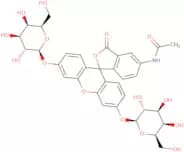
CAS :5-Acetamidofluorescein-di-(b-D-galactopyranoside), also known as C2FDG, is a fluorogenic substrate for beta-galactosidase that generates a green fluorescence after cleavage (Em ~520 nm). It is used in enzyme activity assays and in flow cytometry in animal, bacterial, and yeast cells.Formule :C34H35NO16Degré de pureté :Min. 95%Couleur et forme :Yellow PowderMasse moléculaire :713.65 g/mol4-Methylumbelliferyl 3,4,6-tri-O-acetyl-2-O-(2,3,4-tri-O-benzoyl-a-L-fucopyranosyl)-b-D-galactopyranoside
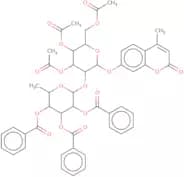
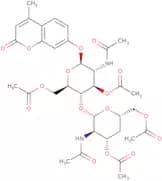
4-Methylumbelliferyl 3,4,6-tri-O-acetyl-2-O-(2,3,4-tri-O-benzoyl-a-L-fucopyranosyl)-b-D-galactopyranoside is a fluorogenic substrate that is used for the detection of β D -galactosidase. β D -Galactosidase is an enzyme that breaks down lactose in milk and is used as a diagnostic tool for identifying lactose intolerance. This substrate can be used as a conjugate in immunoassays to detect antibodies against the enzyme or it can be used to measure the activity of the enzyme in food samples. It also can be used to measure α1,3 galactosyltransferase activity in colorectal cancer cells or bacteria.Degré de pureté :Min. 95%Masse moléculaire :922.9 g/mol4-Methylumbelliferyl 4-deoxy-b-D-chitobiose peracetate
CAS :4-Methylumbelliferyl 4-deoxy-b-D-chitobiose peracetate is a chromogenic substrate used for the detection of β-galactosidase activity. It is an analog of 4-methylumbelliferone that can be hydrolyzed by β-galactosidase to produce fluorescence. This product is supplied as a white crystalline solid and can be stored at room temperature. This substrate has been shown to work well in culture media, food testing, and environmental testing.
Degré de pureté :Min. 95%Couleur et forme :Off-White PowderMasse moléculaire :734.7 g/molD-Alanine 7-amido-4-methylcoumarin free base
CAS :D-Alanine 7-amido-4-methylcoumarin free base is a chromogenic substrate that is used in diagnostic testing. It is used to identify the presence of beta-lactamase, which catalyzes the hydrolysis of penicillin and cephalosporin antibiotics, by turning the substrate into a bright blue color. D-Alanine 7-amido-4-methylcoumarin free base can also be used as a fluorescent substrate for bioluminescence or chemiluminescence reactions. This product is high quality and has CAS number 201847-51-0.
Formule :C13H14N2O3Degré de pureté :Min. 95%Masse moléculaire :246.26 g/molMaltotetraose 2-aminobenzamide
Maltotetraose 2-aminobenzamide is a chemiluminescent substrate that emits light in the presence of certain oxidizing agents. It provides high quality and environmental testing, as well as staining and ligand capability. Maltotetraose 2-aminobenzamide is used in diagnostics to identify bacteria and other microorganisms. Maltotetraose 2-aminobenzamide can be used for the detection of bacterial colonies on agar plates using a fluorogenic substrate, or for the detection of fungi using a chromogenic substrate. Maltotetraose 2-aminobenzamide is also used as an enzyme substrate in food testing or conjugate with enzymes for bioluminescence.
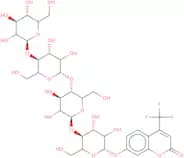
Degré de pureté :Min. 95%4-(Trifluoromethyl)umbelliferyl-b-D-cellotetraoside
CAS :4-(Trifluoromethyl)umbelliferyl-b-D-cellotetraoside is a chemiluminescent substrate that can be used in the detection of peroxidase, horseradish peroxidase, and other enzymes. It is a fluorescent product that emits light upon reaction with hydrogen peroxide. This product has been tested for purity and quality and has shown to have no detectable levels of heavy metals or other contaminants. 4-(Trifluoromethyl)umbelliferyl-b-D-cellotetraoside is not cytotoxic and can be used for the detection of enzyme activity in living cells. 4-(Trifluoromethyl)umbelliferyl-b-D-cellotetraoside is also known as TMBECFDA, which stands for Trifluoromethyl)umbelliferone (Cellobiose) (BiotDegré de pureté :Min. 95%Masse moléculaire :878.7 g/mol4-Methylumbelliferyl phosphate, free acid
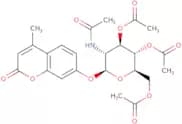
CAS :A sensitive fluorogenic substrate for fluorometric and UV-spectrophotometric assays of phosphatases. It is used for the detection of C. perfringens because acid phosphatase is a highly specific indicator for C. perfringens.Formule :C10H9O6PMasse moléculaire :256.15 g/mol4-Methylumbelliferyl 2-acetamido-3,4,6-tri-O-acetyl-2-deoxy-b-D-glucopyranoside
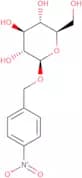
CAS :4-Methylumbelliferyl 2-acetamido-3,4,6-tri-O-acetyl-2-deoxy--bDglucopyranoside is a compound that has been shown to interact with glutamicum and casein kinase. It is also a test compound for corynebacterium glutamicum and interacts with it by functional theory. The compound has been shown to inhibit inflammatory diseases and may be used as a potential treatment for these diseases.Degré de pureté :Min. 95%Masse moléculaire :505.47 g/mol(4-Nitrophenyl)methyl-b-D-glucopyranoside
CAS :This product is a fluorogenic substrate that is used in the detection of enzymes in biological systems. It is also used as a ligand to study enzyme activity and can be used to quantify enzyme activity. This product is made from high-purity, high-quality reagents and is often used as an enzyme substrate in diagnostic kits for food testing, environmental testing, and detection of bacteria with the help of chemiluminescence. The CAS number for this product is 700368-52-1. This product can be used for fluorescence staining and bioluminescence.Degré de pureté :Min. 95%Masse moléculaire :315.28 g/mol2'-(4-Methylumbelliferyl)-a-D-N-glycolylneuraminic acid
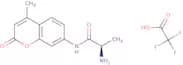
CAS :2'-(4-Methylumbelliferyl)-a-D-N-glycolylneuraminic acid is a fluorogenic substrate that is used for enzymatic labeling of glycolipids. It can be used as a diagnostic or food testing agent, and also has applications in environmental testing. The CAS number for this product is 1434265-32-3.Degré de pureté :Min. 95%Masse moléculaire :483.42 g/molD-Alanine 7-amido-4-methylcoumarin trifluoroacetate salt
CAS :D-Alanine 7-amido-4-methylcoumarin trifluoroacetate salt is a chromogenic substrate for the enzyme Beta-galactosidase. It is used as a diagnostic tool in the detection of certain bacteria, such as Enterobacteriaceae and Clostridium perfringens. It can also be used to detect the presence of beta galactosidase in food products and environmental samples. D-Alanine 7-amido-4-methylcoumarin trifluoroacetate salt has an applications in chemiluminescence, bioluminescence, and fluorescence. This product is not intended for use as a drug or food additive.Formule :C15H15F3N2O5Degré de pureté :Min. 95%Couleur et forme :White/Off-White SolidMasse moléculaire :360.29 g/mol4-Methylumbelliferyl-b-D-xylotrioside
CAS :4-Methylumbelliferyl-b-D-xylotrioside is a fluorogenic substrate that reacts with an enzyme in the presence of oxygen to produce light. It is used in diagnostic applications, such as detecting the presence of a specific enzyme or protein. 4-Methylumbelliferyl-b-D-xylotrioside can also be used as a chromogenic substrate for the detection of DNA and RNA. This compound can be conjugated with other molecules for use in immunoassays and other diagnostic applications. 4-Methylumbelliferyl-b-D-xylotrioside has been shown to bind to bacterial cells and activate them, which leads to the production of light through bioluminescence.
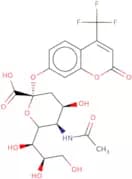
Degré de pureté :Min. 95%Masse moléculaire :572.51 g/mol4-Trifluoromethylumbelliferyl a-D-N-acetylneuraminic acid
CAS :4-Trifluoromethylumbelliferyl a-D-N-acetylneuraminic acid is a fluorescent chemiluminescent substrate that is used in the detection of beta-galactosidase activity. Beta-galactosidase catalyzes the hydrolysis of 4-trifluoromethylumbelliferyl a-D-N-acetylneuraminic acid to form 4-trifluoromethylumbelliferone and D-galactose, which emits light at approximately 480 nm. This reaction can be detected by fluorescence spectrophotometry using a fluorometer or photometer. 4TFUNA is not toxic, does not inhibit enzymes, and has been tested for toxicity and mutagenicity using bacteria and mammalian cells.
Degré de pureté :Min. 95%Masse moléculaire :521.39 g/mol