Oligosaccharides
Les oligosaccharides sont des glucides composés d'un petit nombre d'unités monosaccharidiques liées par des liaisons glycosidiques. Ces molécules jouent des rôles importants dans divers processus biologiques, notamment la reconnaissance cellulaire, la signalisation et les réponses immunitaires. Dans cette section, vous trouverez une large sélection d'oligosaccharides essentiels pour la recherche en glycosciences, biochimie et biologie moléculaire. Ces composés sont essentiels pour étudier les structures complexes des glucides, leurs fonctions et leurs interactions avec d'autres biomolécules. Chez CymitQuimica, nous proposons des oligosaccharides de haute qualité pour répondre à vos besoins en recherche et développement, garantissant des résultats précis et fiables dans vos expériences.
Sous-catégories appartenant à la catégorie "Oligosaccharides"
- Aminoéthyl Glycosides, Aminopropyl Glycosides(14 produits)
- Glycanes liant les Asn(33 produits)
- Oligosaccharides biotinées(13 produits)
- Groupes sanguins et antigènes de Lewis(11 produits)
- Oligosaccharides du groupe sanguin(13 produits)
- Cellooligosaccharides(1 produits)
- Cyclodextrines(183 produits)
- Disaccharides(192 produits)
- Oligosaccharides d'épitopes(19 produits)
- Fructooligosaccharides(2 produits)
- Oligosaccharides fonctionnels(554 produits)
- Oligosaccharides fonctionnalisés(1 produits)
- Galactosamine(41 produits)
- Galactoses(261 produits)
- Galb (1-3) GalNAc(21 produits)
- Série Ganglio(11 produits)
- Séries Globo et Isoglobo(17 produits)
- Glucosamine(128 produits)
- Acides glucuroniques(51 produits)
- Glycoprotéines, Glycopeptides(59 produits)
- Glycosaminoglycane(26 produits)
- Oligosaccharides du lait maternel(22 produits)
- O-Glycanes marqués(9 produits)
- Oligosaccharides marqués(36 produits)
- LacNAc(53 produits)
- Séries Lacto et Néolacto(14 produits)
- Lacto-N-biose(10 produits)
- Lactooligosaccharides(7 produits)
- Liaison attachée aux oligosaccharides(19 produits)
- Maltooligosaccharides(6 produits)
- Oligosaccharides du lait(31 produits)
- N-Glycanes(149 produits)
- Glycosides naturels(177 produits)
- Oligosaccharides naturels(103 produits)
- O-Glycane(18 produits)
- Building Blocks d’Oligosaccharides(7 produits)
- Remplacement des oligosaccharides(2 produits)
- Oligosaccharides par composant Sucre(225 produits)
- Oligoses(24 produits)
- Autres Oligosaccharides(14 produits)
- Oligomères de PEG(33 produits)
- Sucres phosphatés(17 produits)
- Sucres protégés(526 produits)
- Réactifs pour la synthèse d'oligosaccharides(254 produits)
- Glycanes de liaison Ser, Thr(9 produits)
- Oligosaccharides sialylés(3 produits)
- Sphingoglycolipides(42 produits)
- Acides aminés de sucre, Peptides de sucre(20 produits)
- Antigènes de sucre(31 produits)
- Building Blocks Sucrés par Oligosaccharides Cibles(225 produits)
- Conjugués de sucre(100 produits)
- Sucres sulfatés(16 produits)
- Tétrasaccharides(34 produits)
- Trisaccharides et autres(95 produits)
- Xylooligosaccharides(5 produits)
Affichez 47 plus de sous-catégories
2278 produits trouvés pour "Oligosaccharides"
Trier par
Degré de pureté (%)
0
100
|
0
|
50
|
90
|
95
|
100
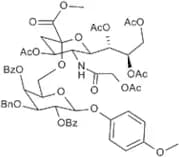
4-Methoxyphenyl 2,4-di-O-benzoyl-3-O-benzyl-6-O-[methyl 5-(acetoxyacetamido)-4,7,8,9-tetra-O-acetyl-3,5-dideoxy-D-glycero-alpha-D-ga lacto-2-nonulopyranosylonate]-beta-D-galactopyranoside
<p>The methylation of a glycosylation is an organic chemistry technique that can be used to modify the chemical structure of a carbohydrate. A glycosylation is the reaction between an alcohol and a sugar, which produces a glycoside. The addition of methyl groups at specific positions on the sugar molecule can lead to improved properties such as increased stability, increased solubility, or increased uptake by cells. This process has been shown to produce compounds with more desirable pharmacological properties than their parent compounds. Click chemistry is a versatile and powerful method for modifying carbohydrates. It involves the use of copper-catalyzed azide-alkyne cycloaddition reactions to form carbon-nitrogen bonds in place of conventional amide linkages in peptides and proteins. Carbohydrates are modified using this method by attaching small molecules such as fluorine atoms onto one or more carbons in the carbohydrate structure. This process can be used to create novel sugars with improved properties including high purity, high stability</p>Formule :C56H61NO23Degré de pureté :Min. 95%Masse moléculaire :1,116.08 g/molG-NGA2 N-Glycan
CAS :<p>G-NGA2 N-glycan is a custom synthesis and modification of the carbohydrate. This product contains a fluorination, methylation, and monosaccharide. The average molecular weight is 1257. G-NGA2 N-Glycan is a saccharide that is synthesized from glucose by glycosyltransferase. It can be modified with a click reaction to form an oligosaccharide or polysaccharide. G-NGA2 N-Glycan has been assigned the CAS number 103584-68-5 and molecular weight of 1257 Da.</p>Formule :C56H94N4O41Degré de pureté :Min. 95%Masse moléculaire :1,479.35 g/molXyloglucan octasaccharide
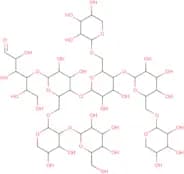
CAS :<p>Xyloglucan octasaccharide is a carbohydrate with eight monosaccharide units. The molecule has been shown to be capable of scavenging active oxygen, which is a reactive oxygen species that can lead to tissue damage. Xyloglucan octasaccharide has also been shown to stimulate the germination rate of wheat seeds.</p>Degré de pureté :Min. 95%3,6-Di-O-(3,4,6-tri-O-acetyl-b-D-mannopyranosylethylidyne)-1,2-O-ethylidene-b-D-mannopyranose
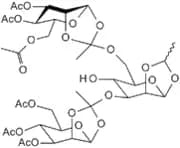
CAS :<p>3,6-Di-O-(3,4,6-tri-O-acetyl-b-D-mannopyranosylethylidyne)-1,2-O-ethylidene-b-D-mannopyranose is a synthetic glycoside that is used as an intermediate in the production of other compounds. It has been modified with fluorine to give it increased stability. This product is also known as 3,6:3',4',6'-di(1,2:1') ethylidene-.beta.-D-.mannopyranose and has CAS number 230963–26–5.</p>Formule :C37H52O23Degré de pureté :Min. 95%Masse moléculaire :864.79 g/mol6-O-[2-Acetamido-2-deoxy-4-O-(b-D-galactopyranosyl)-b-D-glucopyranosyl]-D-galactopyranose
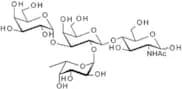
CAS :<p>The 6-O-[2-acetamido-2-deoxy-4-O-(b-D-galactopyranosyl)-b-D-glucopyranosyl]-D-galactopyranose is a disaccharide carbohydrate that can be found in the blood group H. This particular carbohydrate is an example of a sialic acid, which plays an important role in the immune system and other biological processes. Lectins are proteins that bind to carbohydrates and are often used as probes to study glycan structures. Lectin binding assays have been used to characterize this molecule as well as oligosaccharides, glycans, and biohazards.</p>Formule :C20H35NO16Degré de pureté :Min. 95%Couleur et forme :SolidMasse moléculaire :545.49 g/molTrifluoroacetamidopropyl b-D-lactose
<p>Trifluoroacetamidopropyl b-D-lactose is a modification of the sugar, b-D-lactose. It is synthesized by methylation and glycosylation. Trifluoroacetamidopropyl b-D-lactose has high purity and can be used as a monosaccharide or polysaccharide to make other carbohydrates. Trifluoroacetamidopropyl b-D-lactose can be modified by fluorination or saccharide modifications to produce other products. The CAS number for trifluoroacetamidopropyl b-D-lactose is 87890-36-6.</p>Degré de pureté :Min. 95%A1 N-Glycan
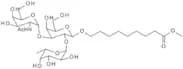
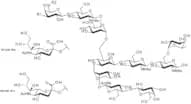
CAS :<p>A1 N-glycan is a custom synthesis, complex carbohydrate that is an oligosaccharide and polysaccharide. It is modified with saccharides, methylation, glycosylation, and fluorination. A1 N-Glycan has high purity and is custom synthesized to order.</p>Formule :C73H121N5O54Degré de pureté :Min. 95%Couleur et forme :PowderMasse moléculaire :1,932.74 g/molBlood Group A trisaccharide-(CH2)8COOMe derivative
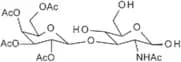
CAS :<p>Blood group antigen derivative with spacer arm</p>Formule :C30H53NO17Degré de pureté :Min. 95%Masse moléculaire :699.74 g/mol2-Acetamido-3-O-(2,3,4,6-tetra-O-acetyl-b-D-galactopyranosyl)-2-deoxy-D-glucopyranose
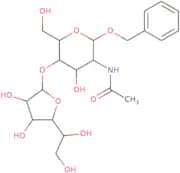
CAS :<p>2-Acetamido-3-O-(2,3,4,6-tetra-O-acetyl-b-D-galactopyranosyl)-2-deoxy-D-glucopyranose is a custom synthesis of an oligosaccharide. It is fluorinated at the 2 position and methylated on the 3 position. This glycosylation product has been shown to be resistant to degradation by enzymes that hydrolyze glycosidic bonds.</p>Formule :C22H33NO15Degré de pureté :Min. 95%Masse moléculaire :551.5 g/molBenzyl 2-acetamido-2-deoxy-4-O-(b-D-galactopyranosyl)-a-D-glucopyranoside
CAS :<p>Benzyl 2-acetamido-2-deoxy-4-O-(b-D-galactopyranosyl)-a-D-glucopyranoside is a custom synthesis, complex carbohydrate. It is an Oligosaccharide, Polysaccharide that has been modified and glycosylated. It has a CAS number of 81243-70-1. This product's purity is high and it is fluorinated. The product is synthetic and contains sugar.</p>Formule :C21H31NO11Degré de pureté :Min. 95%Masse moléculaire :473.47 g/molNA4 N-Glycan
CAS :<p>NA4 is a n-glycan with an average molecular weight of about 3.5 kDa. NA4 is found in the blood and urine of human beings and other mammals, as well as in the milk from cows. It is a major component of mucus secreted by the respiratory tract, and it can be found in the outer layer of the skin. NA4 contains a single N-acetylglucosamine (NAG) residue at its reducing end.</p>Formule :C90H150N6O66Degré de pureté :Min. 95%Couleur et forme :PowderMasse moléculaire :2,372.15 g/molGM1-Lysoganglioside sodium
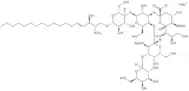
CAS :<p>GM1-Lysoganglioside (sodium salt) has the core tetrasaccharide structure (Galβ1,3GalNAcβ1,4Galβ1,4Glc) with sialic acid linked α2,3 to the inner galactose residue and sphingosine linked β to position 1 on the reducing terminal glucose residue (Ledeen, 2009). GM1 lysoganglioside has been shown that it is capable of binding amyloid-β proteins and can act as a seed for amyloid fibril formation, in early stages of Alzheimerâs disease (Chiricozzi, 2020).</p>Formule :C55H97N3O30·xNaDegré de pureté :Min. 95%Couleur et forme :White PowderMasse moléculaire :1,280.36 g/molA1F Glycan, 2-AB labelled
<p>2-AB labelled A1F Glycan is a complex carbohydrate. It is custom synthesized and high purity. The CAS number for this compound is 12863-00-8.</p>Degré de pureté :Min. 95%1,4-β-D-Glucosyl-D-mannobiose
CAS :<p>1,4-β-D-Glucosyl-D-mannobiose is a specialized carbohydrate substrate, which is derived from complex polysaccharides typically found in plant cell walls. It acts as a substrate for endo-1,4-β-mannanase, an enzyme that cleaves specific glycosidic bonds within mannans. This substrate facilitates the investigation of enzymatic activity by allowing the measurement of endo-1,4-β-mannanase efficiency and specificity under controlled conditions.In biochemical enzyme assays, 1,4-β-D-Glucosyl-D-mannobiose serves as a critical component for quantifying mannanase activity. It enables researchers to study the enzyme's role in various biological processes, including polysaccharide degradation. Additionally, this product is invaluable in in vitro diagnostic analyses where precise enzyme activity assessment is crucial for understanding pathological states or the functionality of industrial enzyme preparations. Its applications extend to biotechnology research, where it aids in the formulation of enzyme-based solutions and optimization of enzymatic reactions in diverse biological and industrial contexts.</p>Formule :C18H32O16Degré de pureté :Min. 95%Masse moléculaire :504.4 g/molLacDiNAc dimer ethylazide
LacDiNAc dimer ethylazide is a modified form of LacdiNAc that has been iodinated. It is synthesized by the reaction of two molecules of LacdiNAc with ethylazide. The product has an average molecular weight of 2,000 and is the most highly purified synthetic carbohydrate available. It can be used in a wide range of applications, including click chemistry, glycosylation reactions, and fluorination synthesis.Formule :C34H57N7O21Degré de pureté :Min. 95%Masse moléculaire :899.85 g/molNeocarratetraose-41-O-sulfate sodium salt
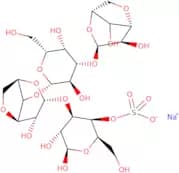
CAS :<p>Neocarratetraose-41-O-sulfate sodium salt is a high purity, synthetic oligosaccharide with a CAS number of 108321-78-4. It is an oligosaccharide that has been modified with methylation, saccharide, and Click modification. Neocarratetraose-41-O-sulfate sodium salt is used in the synthesis of complex carbohydrates and glycosylations. <br>Neocarratetraose-41-O-sulfate sodium salt is synthesized by reacting the sugar neocarratetraose with sulfuryl chloride to form the corresponding sulfonic acid chloride. The resulting compound is then treated with sodium hydroxide to produce its sodium salt form.</p>Formule :C24H37NaO22SDegré de pureté :Min. 95%Couleur et forme :PowderMasse moléculaire :732.59 g/molBlood Group B type II tetrasaccharide
CAS :<p>Blood Group B type II tetrasaccharide is a carbohydrate that is synthesized by custom synthesis. It is a complex carbohydrate with a molecular weight of 909890-21-7. It has the chemical formula C6H14O6 and CAS No. 909890-21-7. Blood group B type II tetrasaccharide can be modified, methylated, glycosylated, and fluorinated. It is an oligosaccharide with a monosaccharide repeating unit that can be found in the blood group B type II antigen on erythrocytes. This saccharide has six sugar units (three glucose and three galactose) connected in a chain by alpha 1-3 glycosidic linkages. The sugar units are attached to each other by beta 1-4 glycosidic linkages.</p>Formule :C26H45NO20Degré de pureté :Min. 95%Masse moléculaire :691.63 g/molA2F Glycan, 2-AB labelled
<p>A2F Glycan is an oligosaccharide that is synthesized from 2-AB labelled methylated saccharides. It can be used in the synthesis of polysaccharides and as a click modification. A2F Glycan has a CAS number, which allows for custom synthesis, and it is available in high purity. The glycosylation of this product can be modified to suit the needs of the customer. The fluorination of A2F Glycan helps with the synthesis process and provides a complex carbohydrate with few impurities.</p>Degré de pureté :Min. 95%k-Carraheptaose tetrasulfate tetrasodium salt
<p>k-carrageenan derived heptasaccharide tetrasulfate+(3-6 anhydrogalactose)</p>Formule :C42H62O45S4Na4Degré de pureté :Min. 95%Masse moléculaire :1,507.14 g/molRhodionin
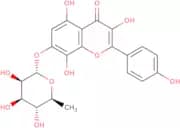
CAS :Rhodionin is a natural product that has been shown to be effective as a food preservative. It is produced through the extraction of usnic acid from Rhodiola rosea and has been used in the study of amyloid protein. Rhodionin is an extractant that has been shown to be able to control analysis of sodium citrate in food composition. The use of rhodionin for this purpose was found to be practical and effective, with no significant changes in the quality or quantity of citric acid. This extractant also shows promise as an analytical method for the detection of ganoderma lucidum, human liver cancer cells, and flavonol glycosides.Formule :C21H20O11Degré de pureté :Min. 95%Masse moléculaire :448.38 g/mol

![6-O-[2-Acetamido-2-deoxy-4-O-(b-D-galactopyranosyl)-b-D-glucopyranosyl]-D-galactopyranose](/_next/image/?url=https%3A%2Fstatic.cymitquimica.com%2Fproducts%2F3D%2Fthumb-webp%2FOA06816.webp&w=3840&q=75)