Colorants, teintes, teintures, imagerie fluorescente
Les colorants, teintures et solutions colorantes sont des outils essentiels en biologie moléculaire, cruciaux pour visualiser et étudier l'ADN, les chromosomes et les noyaux cellulaires. Ces composés permettent aux chercheurs de mettre en évidence des composants cellulaires spécifiques, facilitant ainsi l'observation et l'analyse détaillées au microscope. Dans cette catégorie, vous trouverez une large gamme de colorants et de teintures de haute qualité utilisés dans diverses techniques de coloration, y compris des colorants fluorescents pour l'analyse de l'ADN et des chromosomes, des colorants histologiques pour les échantillons de tissus et des colorants spécifiques pour les structures cellulaires. Ces outils sont indispensables en recherche génétique, cytologie, histologie et diagnostics, offrant clarté et contraste dans les échantillons biologiques. Chez CymitQuimica, nous proposons une sélection complète de colorants, teintures et solutions colorantes pour soutenir vos recherches en biologie moléculaire et garantir des résultats précis et fiables dans vos études.
Sous-catégories appartenant à la catégorie "Colorants, teintes, teintures, imagerie fluorescente"
- Colorants acides(49 produits)
- Azobenzènes(270 produits)
- Colorants azoïques(7 produits)
- Colorants de base(27 produits)
- Colorants de coumarine(71 produits)
- Colorants cyanine, colorants squarylium(53 produits)
- Colorants DCM(4 produits)
- Diarylethenes(12 produits)
- Colorants dipyrrométhéniques(26 produits)
- Colorants directs(17 produits)
- Colorants dispersés(2 produits)
- Sensibilisateurs de colorants(12 produits)
- Colorants(416 produits)
- Teintures et colorants(911 produits)
- Génération de colorants insolubles(14 produits)
- Génération de colorants solubles(11 produits)
- Hexaarylbiimidazole(4 produits)
- Indicateurs(575 produits)
- Colorants mordants(10 produits)
- Colorants dans le proche infrarouge (NIR)(28 produits)
- Colorants à l'huile(15 produits)
- Autres teintures et colorants(2 produits)
- Colorants au pérylène(17 produits)
- Colorants photochromiques(40 produits)
- Colorants phtalocyaniques, colorants porphyriniques(101 produits)
- Colorants à base de quinacridone(8 produits)
- Spiropyranes(16 produits)
- Réactifs colorés et colorants(243 produits)
- Réactifs colorés et colorants pour la microscopie(5 produits)
- Colorants de cuve(5 produits)
- Colorants xanthènes(65 produits)
Affichez 23 plus de sous-catégories
755 produits trouvés pour "Colorants, teintes, teintures, imagerie fluorescente"
Trier par
Degré de pureté (%)
0
100
|
0
|
50
|
90
|
95
|
100
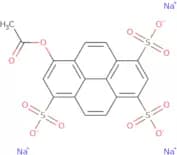
8-Acetoxypyrene-1,3,6-trisulfonic acid trisodium salt
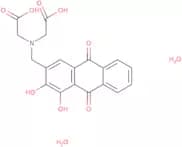
CAS :<p>Fluorogenic substrate for esterase; cell-permeable</p>Formule :C18H9Na3O11S3Degré de pureté :Min. 98.0 Area-%Couleur et forme :PowderMasse moléculaire :566.42 g/molAlizarin complexone dihydrate
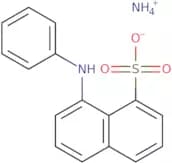
CAS :<p>Alizarin complexone dihydrate reacts with Lanthanum or Cesium(III) ions to form a red chelate, which, in turn, reacts with fluoride ions to give a blue ternary complex (Alizarin Fluorine Blue); to detect fluoride.</p>Formule :C19H15NO8·2H2OCouleur et forme :PowderMasse moléculaire :421.35 g/mol8-Anilinonaphthalene-1-sulfonic acid ammonium salt
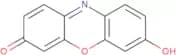
CAS :<p>Fluorophore used to study molecular assemblies of surfactants and amphiphiles</p>Formule :C16H16N2O3SDegré de pureté :Min. 98 Area-%Couleur et forme :PowderMasse moléculaire :316.4 g/molResorufin
CAS :<p>The substructure resorufin is a fluorescent dye that changes color from orange to bright pink; excitation/emission maxima = 563/587 nm.</p>Formule :C12H7NO3Degré de pureté :Min. 95 Area-%Couleur et forme :Purple PowderMasse moléculaire :213.19 g/molThymol blue
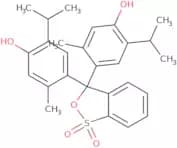
CAS :<p>pH indicator</p>Formule :C27H30O5SDegré de pureté :Min. 95%Couleur et forme :Red Clear LiquidMasse moléculaire :466.59 g/molWST-8
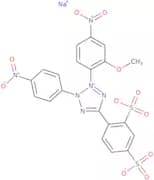
CAS :<p>WST-8 is a key substrate that serves as a sensitive chromogenic indicator for NADH. WST-like substrates have been applied to measure activity of dehydrogenase enzyme activity and the oxidation of NADH using NADH oxidase.</p>Formule :C20H13N6NaO11S2Degré de pureté :Min. 90 Area-%Couleur et forme :Off-White PowderMasse moléculaire :600.47 g/mol5(6)-Carboxyeosin diacetate
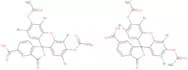
CAS :<p>Brominated analog of carboxyfluorescein; singlet oxygen generator</p>Formule :C25H12Br4O9Degré de pureté :Min. 95%Couleur et forme :PowderMasse moléculaire :775.97 g/mol5-(6)-Carboxytetramethylrhodamine
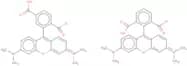
CAS :<p>5-(6)-Carboxytetramethylrhodamine (TAMRA) is a fluorescent dye that is used as a probe for DNA-based analysis. It binds to the 5' end of dsDNA, forming an intrastrand duplex. The fluorescence of TAMRA increases when it binds to dsDNA and can be used as a measure of the amount of DNA in a sample. TAMRA has been shown to be useful in the diagnosis of bowel disease and in the investigation of gene expression during body formation. This dye is also used as a marker for covalent linkages and high molecular weight proteins such as cyclin D2.</p>Formule :C25H22N2O5Degré de pureté :Min. 95 Area-%Couleur et forme :Red PowderMasse moléculaire :430.45 g/molLuminol HCl
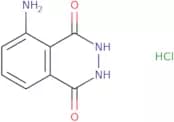
CAS :<p>Chemiluminescence detection of biological residues</p>Formule :C8H7N3O2·HClDegré de pureté :(Hplc) Min. 98.0%Couleur et forme :White PowderMasse moléculaire :213.62 g/mol5-Carboxytetramethylrhodamine
CAS :<p>5-Carboxytetramethylrhodamine - (TAMRA) is a widely employed fluorescent dye (orange/red) that is suitable for different uses. In PCR applications, it has been used as both a reporter at the 5â or as a quencher at the 3â end. TAMRA-labelled oligonucleotides have been used to study interactions with DNA or DNA/protein interactions. It is an excellent fluorescent acceptor for FRET applications with a suitable dye pair. It is used as a protein/antibody labelling agent for structural studies, immunochemistry and flow cytometry. Bioconjugation is generally performed through coupling of the carboxylic acid to a primary amine at the N-terminus of a protein, on lysine side chains or amino-modified oligonucleotide.</p>Formule :C25H22N2O5Degré de pureté :Min. 95 Area-%Couleur et forme :Green PowderMasse moléculaire :430.45 g/molWST-1
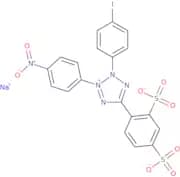
CAS :<p>WST-1 is a water soluble cell permeable dye. Upon NADH-dependent enzymatic cleavage by cellular mitochondrial dehydrogenases, formazan is released, which can be quantified by colorimetric detection at 450 nm.</p>Formule :C19H11IN5NaO8S2Degré de pureté :Min. 95 Area-%Couleur et forme :PowderMasse moléculaire :651.35 g/molNucleic Acid Dye Green I - solution in DMSO (6.11 mg/ml)
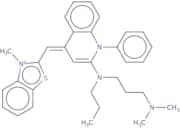
CAS :<p>Nucleic Acid Dye Green I is a DNA-staining dye that has found application in various high resolution assays for the detection of microbial or viral contaminant DNA.</p>Formule :C32H37N4SDegré de pureté :Min. 95%Couleur et forme :Clear LiquidMasse moléculaire :509.73 g/mol3-Bodipy-propanoic acid
CAS :<p>Reactive fluorescent labeling reagent</p>Formule :C14H15BF2N2O2Couleur et forme :Red PowderMasse moléculaire :292.09 g/molThiazolyl blue tetrazolium bromide
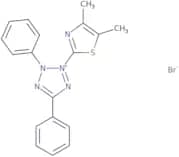
CAS :<p>Thiazolyl blue tetrazolium bromide, also called 3-(4,5-dimethylthiazol-2-yl)-2,5-diphenyl-2H-tetrazolium bromide and methylthiazolyldiphenyl-tetrazolium bromide, and mainly known as MTT, is employed in the so-called MTT reduction or colorimetric assay. The MTT assay is used to determine the metabolic activity of living cells and the viable cell number in proliferation and cytotoxicity studies. The assay is based on the enzymatic reduction of the yellow MTT to the purple-blue water-insoluble formazan catalysed by mitochondrial dehydrogenases of living cells. The amount of formazan produced is directly proportional to the number of viable cells and can be quantified by measuring absorbance at 570nm. The MTT assay is broadly employed in cell biology because it is rapid and economical. MTT is also used as enzyme substrates in studies of nicotinamide adenine dinucleotide phosphate (NADP)-dependent dehydrogenases.</p>Formule :C18H16BrN5SDegré de pureté :Min. 97 Area-%Couleur et forme :Yellow PowderMasse moléculaire :414.32 g/mol6-NBDG
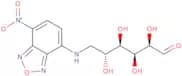
CAS :<p>Nonhydrolyzable fluorescent glucose analog used to monitor glucose uptake</p>Formule :C12H14N4O8Degré de pureté :Min. 95%Couleur et forme :PowderMasse moléculaire :342.26 g/mol8-(4-Anilino) bodipy
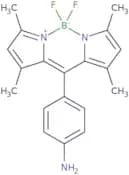
CAS :<p>Fluorescent probe</p>Formule :C19H20BF2N3Degré de pureté :Min. 90 Area-%Couleur et forme :PowderMasse moléculaire :339.19 g/molLuminol sodium salt
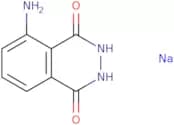
CAS :<p>Chemiluminescence detection of biological residues</p>Formule :C8H6N3O2NaDegré de pureté :Min. 98 Area-%Couleur et forme :White PowderMasse moléculaire :199.14 g/molRuthenium red
CAS :<p>Ruthenium red is a potent inhibitor of the channel that mediates the release of Ca2+ from the endoplasmic reticulum into the cytosol. It also inhibits neuronal death induced by receptor activity. Ruthenium red has been shown to have inhibitory properties against p-nitrophenyl phosphate, an activator of protein kinase C and a stimulator of mitochondrial permeability transition. Ruthenium red has also been shown to inhibit dinucleotide phosphate-dependent phosphohydrolases and ryanodine receptors. Furthermore, it binds to nuclear DNA in prokaryotic cells and affects gene transcription.</p>Formule :H42Cl6N14O2Ru3Degré de pureté :Min. 98%Couleur et forme :PowderMasse moléculaire :786.35 g/mol4-Dimethylaminocinnamaldehyde
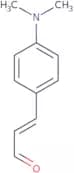
CAS :<p>4-Dimethylaminocinnamaldehyde (DMAC) is a metabolite of the herbicide paraquat. It has been studied as an anticancer agent that inhibits the proliferation of human carcinoma cell lines and induces apoptosis. DMAC also binds to DNA, inhibiting transfer reactions and preventing the synthesis of unsymmetrical dyes and procyanidins. DMAC has been shown to inhibit inflammation in mice by blocking the production of prostaglandins and leukotrienes. The anti-inflammatory activity is due to its ability to inhibit cyclooxygenase (COX) enzymes, thereby preventing the formation of prostaglandins from arachidonic acid.</p>Formule :C11H13NOCouleur et forme :Yellow PowderMasse moléculaire :175.23 g/molWST-5
CAS :<p>WST-5 is a colourless compounds which become coloured when reduced to WST-5 formazan forming a blue colour. Traditionally used as an indicator of cell metabolism in eukaryotes and prokaryotes, WST-5 functions as an artificial electron acceptor and thus detects dehydrogenase activities. The production of coloured formazan is irreversible and can be quantified using spectrophotometry.</p>Formule :C52H46N12O16S6•Na2Degré de pureté :Min. 95%Couleur et forme :PowderMasse moléculaire :1,333.37 g/mol