Colorants, teintes, teintures, imagerie fluorescente
Les colorants, teintures et solutions colorantes sont des outils essentiels en biologie moléculaire, cruciaux pour visualiser et étudier l'ADN, les chromosomes et les noyaux cellulaires. Ces composés permettent aux chercheurs de mettre en évidence des composants cellulaires spécifiques, facilitant ainsi l'observation et l'analyse détaillées au microscope. Dans cette catégorie, vous trouverez une large gamme de colorants et de teintures de haute qualité utilisés dans diverses techniques de coloration, y compris des colorants fluorescents pour l'analyse de l'ADN et des chromosomes, des colorants histologiques pour les échantillons de tissus et des colorants spécifiques pour les structures cellulaires. Ces outils sont indispensables en recherche génétique, cytologie, histologie et diagnostics, offrant clarté et contraste dans les échantillons biologiques. Chez CymitQuimica, nous proposons une sélection complète de colorants, teintures et solutions colorantes pour soutenir vos recherches en biologie moléculaire et garantir des résultats précis et fiables dans vos études.
Sous-catégories appartenant à la catégorie "Colorants, teintes, teintures, imagerie fluorescente"
- Colorants acides(49 produits)
- Azobenzènes(270 produits)
- Colorants azoïques(7 produits)
- Colorants de base(27 produits)
- Colorants de coumarine(71 produits)
- Colorants cyanine, colorants squarylium(53 produits)
- Colorants DCM(4 produits)
- Diarylethenes(12 produits)
- Colorants dipyrrométhéniques(26 produits)
- Colorants directs(17 produits)
- Colorants dispersés(2 produits)
- Sensibilisateurs de colorants(12 produits)
- Colorants(416 produits)
- Teintures et colorants(911 produits)
- Génération de colorants insolubles(14 produits)
- Génération de colorants solubles(11 produits)
- Hexaarylbiimidazole(4 produits)
- Indicateurs(575 produits)
- Colorants mordants(10 produits)
- Colorants dans le proche infrarouge (NIR)(28 produits)
- Colorants à l'huile(15 produits)
- Autres teintures et colorants(2 produits)
- Colorants au pérylène(17 produits)
- Colorants photochromiques(40 produits)
- Colorants phtalocyaniques, colorants porphyriniques(101 produits)
- Colorants à base de quinacridone(8 produits)
- Spiropyranes(16 produits)
- Réactifs colorés et colorants(243 produits)
- Réactifs colorés et colorants pour la microscopie(5 produits)
- Colorants de cuve(5 produits)
- Colorants xanthènes(65 produits)
Affichez 23 plus de sous-catégories
755 produits trouvés pour "Colorants, teintes, teintures, imagerie fluorescente"
Trier par
Degré de pureté (%)
0
100
|
0
|
50
|
90
|
95
|
100
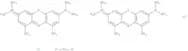
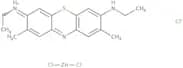
1,9-Dimethyl-methylene blue zinc chloride
CAS :<p>1,9-Dimethyl-methylene blue zinc chloride double salt is a fluorescent dye that has been used in the study of hyaluronic acid and mesenchymal stem cells. The compound absorbs light at a wavelength of 580 nm, which is the same as the absorption wavelength for hyaluronic acid and mesenchymal stem cells. 1,9-Dimethyl-methylene blue zinc chloride double salt can be used to measure the amount of these compounds in tissues. This dye also shows sensitivity to artifacts such as hemolysis and lipemia, making it useful for research purposes.</p>Formule :(C18H22ClN3S)2•ZnCl2Degré de pureté :Min. 95%Couleur et forme :PowderMasse moléculaire :832.11 g/molBP Fluor 488 hydrazide
CAS :<p>Green fluorescent dye used for labelling aldehydes or ketones in polysaccharides or glycoproteins with an excitation peak at 499 nm and an emission peak at 520 nm. Frequently employed in microscopy and flow cytometry.</p>Formule :C21H16N4O10S2Masse moléculaire :548.51 g/molFluorescent Brightener 28
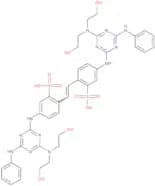
CAS :<p>Fluorescent Brightener 28 is a fluorescent dye that is used for the diagnosis of opportunistic fungal infections. It is also used as a marker for cell proliferation in tissue culture. Fluorescent Brightener 28 binds to the signal-peptide region of RNA polymerase II and can be detected using immunofluorescence microscopy. The fluorescent signal is observed in the nucleus, cytoplasm, or both. Fluorescent Brightener 28 has been shown to bind to human α1-acid glycoprotein (AAG) and α2-macroglobulin, which can affect drug interactions. This dye has no effect on fatty acid metabolism and does not interfere with the test results when testing samples such as blood or urine.</p>Formule :C40H44N12O10S2Degré de pureté :Min. 95%Couleur et forme :PowderMasse moléculaire :916.99 g/molVat green 9
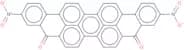
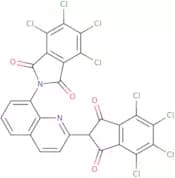
CAS :<p>Vat green 9 is a high-stability pigment that is used in many industries to add highlighting effects. It is also used as a dye for textiles, plastics, and paper. Vat green 9 has been shown to be toxic to daphnia when tested at long-term exposure levels. This chemical belongs to the class of silico compounds, which are chemicals that are ecotoxicological active. The experimental results show that this compound can cause an ecological imbalance in the environment and can lead to changes in the population of aquatic organisms.</p>Formule :C34H14N2O6Degré de pureté :Min. 95%Couleur et forme :PowderMasse moléculaire :546.48 g/molPigment Yellow 138;3,4,5,6-Tetrachloro-N-[2-(4,5,6,7-tetrachloro-2,3-dihydro-1,3-dioxo-1H-inden-2-yl)-8-Quinolyl]phthalimide
CAS :<p>Pigment Yellow 138 is a polycarboxylic acid with the chemical formula C8H6Cl4O2. Pigment Yellow 138 has a molecular weight of 434.07 and can be used as a yellow pigment in paint, plastics, and textiles. Pigment Yellow 138 has an acidic pH and can be prepared by reacting phthalic anhydride with sodium hydroxide in aqueous solution to produce the sodium salt of pigment yellow 138. Pigment Yellow 138 is also soluble in hydroxide solutions, which makes it an excellent cross-linking agent for polymers. The color of pigments depends on the size of their particles; pigments with larger particle sizes are more opaque than those with smaller particle sizes.</p>Formule :C26H6Cl8N2O4Degré de pureté :Strengh Min 95%.Masse moléculaire :693.96 g/molC.I.Solvent red 197
CAS :<p>C.I.Solvent Red 197 is a dye that is soluble in organic solvents and has a particle size of less than 10 microns. It is used in the textile industry as an extracellular dye and can be used for the production of polyols, uv irradiation, corrosion inhibitor, high concentrations, condensation products, high resistance, organic solvent, volatile oil, substrate film and polymerization initiator. The dye also exhibits affinity ligand properties which are used in microcapsules to bind to substances such as proteins or nucleic acids.</p>Formule :C23H19N5ODegré de pureté :Min. 85 Area-%Masse moléculaire :381.43 g/molBrilliant green
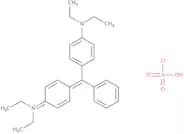
CAS :<p>Brilliant green is a polymerase chain reaction (PCR) reagent that is used to monitor the progress of DNA amplification. It has been shown to bind specifically to double-stranded DNA and prevent the RNA polymerase from binding, thereby preventing transcription and replication. This dye may be used as an antimicrobial agent in wastewater treatment, where it can inhibit the growth of Aerobacter aerogenes. The adsorption properties of Brilliant green have been studied using an electrochemical impedance spectroscopy and Langmuir adsorption isotherm techniques. The hydrophobic interactions between this dye and the anhydrous sodium surface have also been investigated by structural analysis.</p>Formule :C27H34N2O4SCouleur et forme :Green PowderMasse moléculaire :482.64 g/molNew methylene blue NX
CAS :<p>New methylene blue NX is a versatile building block that can be used in the synthesis of many different compounds. It can be used as a reagent to produce research chemicals or as a reactant for the production of high quality, useful intermediates. The compound is also a useful scaffold for the synthesis of complex compounds. New methylene blue NX has CAS number 6586-05-6 and is registered under the Chemical Abstracts Service (CAS).</p>Formule :C18H22N3S•(Cl2Zn)x•ClDegré de pureté :Min. 95%Couleur et forme :Brown SolidMasse moléculaire :832.1Indigo
CAS :<p>Indigo is a dye that has been used for centuries in the textile industry for its unique blue color.</p>Formule :C16H10N2O2Degré de pureté :Min. 95%Couleur et forme :Blue PowderMasse moléculaire :262.26 g/molAmyloid Dan Protein (1-34) (reduced) trifluoroacetate salt
CAS :<p>Please enquire for more information about Amyloid Dan Protein (1-34) (reduced) trifluoroacetate salt including the price, delivery time and more detailed product information at the technical inquiry form on this page</p>Formule :C185H270N48O51S2Degré de pureté :Min. 95%Masse moléculaire :4,046.55 g/molPigment Red 52:1
CAS :<p>6-Fluoro-3-indoxyl-beta-D-galactopyranoside is a potent antituberculosis drug that falls under the class of rifamycins. It is highly effective in treating tuberculosis infections due to its bactericidal activity. This active compound works by inhibiting bacterial growth through binding to DNA-dependent RNA polymerase, which prevents transcription and replication. Its efficacy has been demonstrated through transcription-quantitative polymerase chain reactions and patch-clamp techniques on human erythrocytes. In terms of metabolism, it undergoes various transformations such as hydrolysis by esterases or glucuronidases, oxidation by cytochrome p450 enzymes, reduction by glutathione reductase, or conjugation with glucuronic acid. Additionally, 6-Fluoro-3-indoxyl-beta-D-galactopyranoside specifically targets markers expressed at high levels in Mycobacterium tuberculosis strains and inhibits their cell growth in culture</p>Degré de pureté :Min. 95%Direct black 38
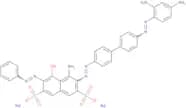
CAS :<p>Direct Black 38 (DB38) is a carbonate pigment with the chemical formula of Na2CO3. It has been used as a black pigment in paints, textiles, and plastics. DB38 has been shown to be genotoxic, meaning that it can cause mutations in cells by interacting with DNA. DB38 has also been shown to be toxic to animals and humans when ingested or inhaled at high concentrations. DB38 is not mutagenic, meaning that it does not cause genetic changes in cells or organisms. The toxicity of DB38 is dose-dependent: the higher the concentration of DB38, the more toxic it becomes.</p>Formule :C34H27N9O7S2·2NaDegré de pureté :Min. 95%Couleur et forme :Brown PowderMasse moléculaire :783.75 g/molPigment Red 13
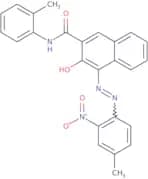
CAS :<p>Pigment Red 13 is a diazonium salt that is used as a cross-linking agent in the preparation of substrate film. It is also utilized as an electrophotographic developer for high detection of molecules and has a viscosity of 5,000 cps. Pigment Red 13 has a hydroxyl group with a diameter of 0.5 nm and low energy radiation with particle size of 25 nm. Pigment Red 13 contains functional groups such as carboxylic acid and amide, which are cationic surfactants.</p>Formule :C25H20N4O4Degré de pureté :Min. 95%Couleur et forme :PowderMasse moléculaire :440.45 g/molMethylene blue
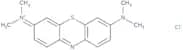
CAS :<p>Methylene blue is a basic dye that has been used as an antibacterial agent. It binds to DNA and inhibits the synthesis of proteins and cell division. Methylene blue has been shown to be effective against Gram-positive bacteria, including Bacillus subtilis and Staphylococcus aureus, but not Gram-negative bacteria. Methylene blue also has optical properties that allow it to be detected by an optical sensor. This dye is sensitive to water vapor and light, which may limit its effectiveness in humid environments. The rate constant for methylene blue's adsorption on the surface of bacterial cells was determined using x-ray diffraction data from squamous cell carcinomas in mice. The rate constant for methylene blue's antimicrobial activity was determined by measuring the concentration–time curve for inhibiting growth of Escherichia coli K12 bacteria in a synchronized fluorescence assay. Nitrite ion levels were found to correlate with methylene blue's antimicrobial activity</p>Formule :C16H18ClN3SDegré de pureté :Min. 95%Couleur et forme :Green PowderMasse moléculaire :319.85 g/molReactive black 39
CAS :<p>Reactive black 39 is a benzalkonium chloride molecule that penetrates bacterial cell walls and reacts with the hydroxy groups, resulting in the formation of a reactive intermediate. This intermediate interacts with other molecules on the surface of bacteria, leading to the production of oxygen radicals. The radical initiates reactions such as oxidation and nitration, which damage the DNA and proteins in the cell. Reactive black 39 is used as a conditioning agent for wastewater treatment because it can be used to remove organic matter and heavy metals from wastewater. It also has been shown to have interactive effects with methyl glycine when treating water contaminated with phenols.</p>Formule :C25H19ClN10O16S5•Na5Degré de pureté :Min. 95%Masse moléculaire :1,026.21 g/molDisperse red 277
CAS :<p>Please enquire for more information about Disperse red 277 including the price, delivery time and more detailed product information at the technical inquiry form on this page</p>Degré de pureté :Strength 100%±3%Couleur et forme :PowderDirect Blue 15
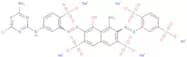
CAS :<p>Direct Blue 15 is a water-soluble organic dye that is used in electrochemical impedance spectroscopy for wastewater treatment. The high salt and physiological effects of Direct Blue 15 have been studied in dose groups of rats. Direct Blue 15 was not found to be carcinogenic to rats, but did cause liver lesions at high doses. However, it did not cause DNA damage or induce mutations in the calf-thymus DNA. The hydroxyl group on the molecule allows it to bind to amines, which may explain its toxicity and mutagenicity.</p>Formule :C34H24N6O16S4Na4Degré de pureté :Min. 95%Masse moléculaire :992.81 g/molPigment Red 48:1
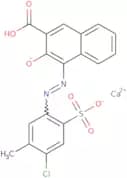
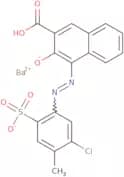
CAS :<p>Pigment Red 48:1 is a red pigment that is used in coatings, plastics, and inks. Pigment Red 48:1 is non-toxic to humans, and has been shown to be lightfast and resistant to pollution. The red pigment has been analysed for its potential to cause skin irritation. Pigment Red 48:1 does not cause skin irritation when tested on human volunteers. It was found that the pigment did not produce any irritation or sensitization reactions when applied to the skin of rabbits at a concentration of 0.5% for four weeks.</p>Formule :C18H11BaClN2O6SDegré de pureté :Min. 95%Couleur et forme :PowderMasse moléculaire :556.14 g/molMethylprednisolone EP impurity E
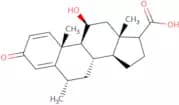
CAS :Produit contrôlé<p>Please enquire for more information about Methylprednisolone EP impurity E including the price, delivery time and more detailed product information at the technical inquiry form on this page</p>Formule :C21H28O4Degré de pureté :Min. 95%Couleur et forme :PowderMasse moléculaire :344.44 g/molC.I.Solvent Orange 45
CAS :<p>Please enquire for more information about C.I.Solvent Orange 45 including the price, delivery time and more detailed product information at the technical inquiry form on this page</p>Formule :C32H24CoN8O10•HDegré de pureté :Min. 95%Couleur et forme :PowderMasse moléculaire :740.52 g/mol