Composés organosiliciés
Sous-catégories appartenant à la catégorie "Composés organosiliciés"
4336 produits trouvés pour "Composés organosiliciés"
4-Difluoromethoxyphenylboronic acid pinacol ester
CAS :Please enquire for more information about 4-Difluoromethoxyphenylboronic acid pinacol ester including the price, delivery time and more detailed product information at the technical inquiry form on this page
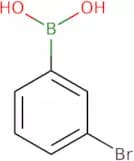
Formule :C13H17BF2O3Degré de pureté :Min. 95%Masse moléculaire :270.08 g/mol3-Bromophenyl boronic acid
CAS :3-Bromophenyl boronic acid is a group P2 molecule with functional groups of vibrational and cross-coupling. It has been shown to inhibit the activity of aryl boronic acids, which are commonly used in analytical methods. 3-Bromophenyl boronic acid is also capable of inhibiting the production of alizarin, which is a dye that is used for staining biological tissue. The molecular modeling study revealed that this molecule has an atomic orbital with electron density distribution around the central carbon atom. This distribution indicates that it is more stable than other molecules with similar structures.Formule :C6H6BBrO2Degré de pureté :Min. 95%Couleur et forme :PowderMasse moléculaire :200.83 g/molBoron carbide
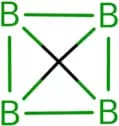
CAS :Produit contrôléBoron carbide is a chemical compound that belongs to the group of borides. It is used as a solid catalyst in wastewater treatment, which can remove organic contaminants and heavy metals from water. Boron carbide has shown chemical stability when exposed to sodium citrate and it has a low thermal expansion coefficient. The surface properties of this material are characterized by high surface area and high reactivity, which make it suitable for sample preparation and transport. Boron carbide is also resistant to radiation and exhibits good structural stability in particle form. This material has been shown to catalyze reactions with zirconium oxide, but its reaction mechanism is not yet well understood.Formule :B4CDegré de pureté :Min. 95%Masse moléculaire :55.25 g/mol2,2,2-Trifluoro-1-(3-Trimethylsilylphenyl)Ethanone
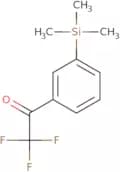
CAS :2,2,2-Trifluoro-1-(3-trimethylsilylphenyl)ethanone is a chemical that can be used as an acetylcholinesterase inhibitor. This agent is designed to inhibit the enzyme that breaks down acetylcholine, which is responsible for transmitting nerve impulses and controlling muscle contractions. The activity of 2,2,2-Trifluoro-1-(3-trimethylsilylphenyl)ethanone is reversible by hydrolysis and it has a low bioavailability due to its high lipophilicity. Acetylcholinesterase inhibitors are mainly used for the treatment of inflammatory diseases such as rheumatoid arthritis. br> The pharmacodynamics of 2,2,2-Trifluoro-1-(3-trimethylsilylphenyl)ethanone are not well understood. This drug also has side effect profilesFormule :C11H13F3OSiDegré de pureté :Min. 95%Masse moléculaire :246.3 g/mol(3,4,5-Trifluorophenyl)boronic acid
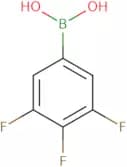
CAS :The trifluorophenylboronic acid is a boronic acid that has been used in the synthesis of vitamin B12. This compound is often used as a catalyst for the Suzuki coupling reaction. It can also be used to synthesize amides and synthons. The trifluorophenylboronic acid is soluble in water, ethanol, and acetone. The pH of the solution depends on the type of base added. For example, when an amine is added to the solution, it increases to approximately 8-9. When a p-hydroxybenzoic acid is added to the solution, it decreases to approximately 2-3.
Formule :C6H4BF3O2Degré de pureté :Min. 95%Couleur et forme :PowderMasse moléculaire :175.9 g/molTri-tert-butylphosphine tetrafluoroborate
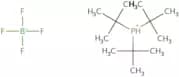
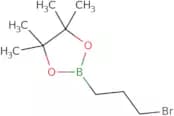
CAS :Tri-tert-butylphosphine tetrafluoroborate (TBPB) is a compound that inhibits tumor growth by inhibiting the activation of allyl carbonates. TBPB has been shown to inhibit tumor growth in vivo and to have an inhibitory effect on the growth of cancer cells in vitro. This drug has been shown to be effective against multiple types of cancer, including breast, prostate, leukemia, and lymphomas. TBPB also inhibits the activity of protein kinase C (PKC), which may play a role in tumorigenesis. It is believed that this drug works by binding to PKC and preventing its activation.Formule :C12H28BF4PDegré de pureté :Min. 95%Couleur et forme :White PowderMasse moléculaire :290.13 g/mol3-Bromopropylboronic acid pinacol ester
CAS :Please enquire for more information about 3-Bromopropylboronic acid pinacol ester including the price, delivery time and more detailed product information at the technical inquiry form on this pageFormule :C9H18BBrO2Degré de pureté :Min. 95%Masse moléculaire :248.95 g/molN-Methoxymethyl-N-(trimethylsilylmethyl)benzylamine
CAS :N-Methoxymethyl-N-(trimethylsilylmethyl)benzylamine is a chiral, electron deficient reagent that reacts with aldehydes and boronic esters to form products with high chemical yields. This compound can be used as a catalyst for acylation reactions, such as the synthesis of p-nitrophenol. N-Methoxymethyl-N-(trimethylsilylmethyl)benzylamine is synthesized by the reaction of trifluoroacetic acid and an amine, followed by chloroformate displacement. The product is then reacted with acylating agents in the presence of catalysts.Formule :C13H23NOSiDegré de pureté :Min. 95%Couleur et forme :Clear Colourless To Pale Yellow LiquidMasse moléculaire :237.41 g/mol[2-fluoro-4-(trifluoromethyl)phenyl]boronic Acid
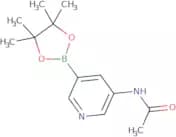
CAS :2-Fluoro-4-(trifluoromethyl)phenylboronic acid is a boron compound that can be used to synthesize a variety of target products. 2-Fluoro-4-(trifluoromethyl)phenylboronic acid occurs in the form of an oil and is an impurity in the target product, phenylboronic acid. This impurity can be removed by reacting with lithium benzotrifluoride. Lithiated 2-fluoro-4-(trifluoromethyl)phenylboronic acid is then reacted with phenylboronic acid to give lithiated phenylboronic ester in high yield. The lithiation reaction can be carried out under alkaline conditions or under a condition where the reactants are dissolved in water.Formule :C7H5BF4O2Degré de pureté :Min. 95%Masse moléculaire :207.92 g/molN-(5-(4,4,5,5-Tetramethyl-1,3,2-dioxaborolan-2-yl)pyridin-3-yl)acetamide
CAS :Please enquire for more information about N-(5-(4,4,5,5-Tetramethyl-1,3,2-dioxaborolan-2-yl)pyridin-3-yl)acetamide including the price, delivery time and more detailed product information at the technical inquiry form on this pageFormule :C13H19BN2O3Degré de pureté :Min. 95%Masse moléculaire :262.11 g/mol3-Pyridylboronic acid pinacol ester
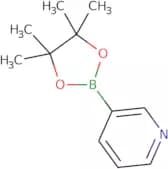
CAS :3-Pyridylboronic acid pinacol ester is a versatile reagent that can be used in the synthesis of polymers with reactive functionalities. This compound is a crosslinker, which means that it reacts with two or more other molecules to form a covalent bond. 3-Pyridylboronic acid pinacol ester has been shown to react with ring-opening methacrylate monomers and expand their polymer backbone, which leads to an increase in the number of reactive groups on the chain. The introduction of 3-pyridylboronic acid pinacol ester can also introduce fluorescent units into polymers for use as probes for biological systems. There are many possible applications for this versatile reagent, including its use in the synthesis of imidazopyridine ligands.
Formule :C11H16BNO2Degré de pureté :Min. 95%Couleur et forme :PowderMasse moléculaire :205.06 g/molBis (neopentylglycolato) diboron
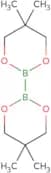
CAS :Bis (neopentylglycolato) diboron is a boronic acid that can be used in catalytic asymmetric synthesis. The compound is prepared by the reaction of neopentyl glycol with boric acid and NaOH, followed by purification by column chromatography. Bis (neopentylglycolato) diboron is soluble in non-polar solvents. It has been shown to have uptake in cells and has been used in the preparation of conjugates for the treatment of cancer.Formule :C10H20O4B2Degré de pureté :Min. 95%Couleur et forme :White Off-White PowderMasse moléculaire :225.89 g/mol4-Methoxybenzylboronic acid pinacolester
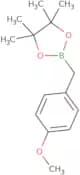
CAS :Please enquire for more information about 4-Methoxybenzylboronic acid pinacolester including the price, delivery time and more detailed product information at the technical inquiry form on this pageFormule :C14H21BO3Degré de pureté :Min. 95%Masse moléculaire :248.13 g/mol(3-Bromopropyl)trimethoxysilane
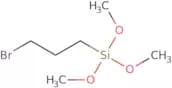
CAS :3-Bromopropyltrimethoxysilane is a divalent hydrocarbon that has been used as a model compound for the study of detection methods. It has been shown to have biocompatible properties and can be used as an immobilization template molecule. 3-Bromopropyltrimethoxysilane also reacts with pyridinium ions to form complexes that are highly stable. The stability of these complexes can be attributed to the functional groups on the pyridine ring, which are more susceptible to hydrolysis than those on the silica surface. 3-Bromopropyltrimethoxysilane is a substrate for nitrate reductase enzymes, resulting in inhibition of growth at concentrations low enough not to cause cytotoxicity.Formule :C6H15BrO3SiDegré de pureté :Min. 95%Masse moléculaire :243.17 g/molBiotinyl-epsilonAhx-omega-Conotoxin GVIA trifluoroacetate salt
CAS :Produit contrôléPlease enquire for more information about Biotinyl-epsilonAhx-omega-Conotoxin GVIA trifluoroacetate salt including the price, delivery time and more detailed product information at the technical inquiry form on this pageFormule :C136H207N41O46S7Degré de pureté :Min. 95%Masse moléculaire :3,376.81 g/molBobbitt's salt
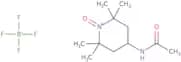
CAS :4-Acetamido-2,2,6,6-tetramethyl-1-oxopiperidinium tetrafluoroborate, most commonly known as Bobbitt's salt, is a cheap and benign oxidant. It’s an oxoamonium salt that is used in oxidative cleveage of C-C and C-O bonds. The most common application of Bobbitt's salts is as a catalyst for the synthesis of dimethylbenzoquinones or DMBQs.
Formule :C11H21BF4N2O2Degré de pureté :Min. 95%Couleur et forme :Red PowderMasse moléculaire :300.1 g/molGly-Amyloid b-Protein (15-25)-Gly-epsilon-aminocaproyl(-Lys)6
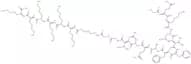
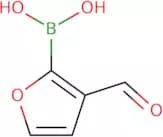
CAS :Please enquire for more information about Gly-Amyloid b-Protein (15-25)-Gly-epsilon-aminocaproyl(-Lys)6 including the price, delivery time and more detailed product information at the technical inquiry form on this pageFormule :C105H178N28O26Degré de pureté :Min. 95%Masse moléculaire :2,248.71 g/mol3-Formylfuran-2-boronic acid
CAS :3-Formylfuran-2-boronic acid is a molecule that can reversibly form an imine with primary amines. 3-Formyl group and fluorophore are the main features of this molecule. The fluorescent properties of 3-formyl group have been extensively studied by functional theory, structural studies and kinetic experiments. The study of these properties has led to the discovery of new fluorescent probes for use in biochemical studies. 3-Formyl furan also interacts with anthracene and other heterocycles by binding constants. These interactions were studied using quantum chemical calculations.
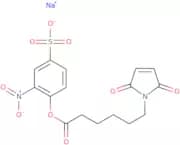
Formule :C5H5BO4Degré de pureté :Min. 95%Couleur et forme :PowderMasse moléculaire :139.9 g/molEpsilon-Maleimidocaproic acid-(2-nitro-4-sulfo)-phenyl ester·sodium salt
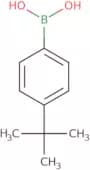
CAS :Epsilon-Maleimidocaproic acid-(2-nitro-4-sulfo)-phenyl ester·sodium salt (EMAP) is a crosslinker that belongs to the group of heterobifunctional reagents. It has been used to conjugate monoclonal antibodies with other molecules, such as toxins. EMAP is activated by the dianion generated by protonation of the nitro groups on the phenyl ring and reacts with free amines or thiols in proteins. EMAP can be used for labeling immunotoxins for diagnostic use, maximizing detection sensitivity, and crosslinking DNA molecules for use in molecular cloning experiments.Formule :C16H15N2NaO9SDegré de pureté :Min. 95%Masse moléculaire :434.35 g/mol4-tert-Butylphenylboronic acid
CAS :4-tert-Butylphenylboronic acid is an aromatic hydrocarbon that belongs to the class of phenoxy. It is a molecule with nitrogen atoms and a molecular weight of 144.17 g/mol. 4-tert-Butylphenylboronic acid has been shown to form a copper complex in the presence of sodium trifluoroacetate, which is used for cross-coupling reactions. This compound also reacts with hydrochloric acid to form 4-methoxyphenylboronic acid and trimethyl boronate, which can be used as reaction products in organic synthesis. The stability of this compound has been studied using electrochemical impedance spectroscopy (EIS) on thin films.
Formule :C10H15BO2Degré de pureté :Min. 95%Couleur et forme :White PowderMasse moléculaire :178.04 g/mol



![[2-fluoro-4-(trifluoromethyl)phenyl]boronic Acid](/_next/image/?url=https%3A%2Fstatic.cymitquimica.com%2Fproducts%2F3D%2Fthumb-webp%2FFF105416.webp&w=3840&q=75)