Électrophorèse
Dans cette section, vous trouverez tous les réactifs et matériaux nécessaires pour réaliser l'électrophorèse, une technique de laboratoire essentielle utilisée pour séparer les protéines en fonction de leur masse moléculaire et de leur charge. Cette technique est cruciale pour analyser la composition et la pureté des échantillons de protéines, ainsi que pour étudier les acides nucléiques et autres biomolécules. Notre sélection comprend des tampons d'électrophorèse, des gels, des colorants et des marqueurs de haute qualité, ainsi que des appareils et accessoires conçus pour garantir une séparation précise et efficace. Ces produits sont indispensables pour la recherche en biologie moléculaire, biochimie et génétique, fournissant des résultats fiables pour la caractérisation des protéines, l'analyse de l'expression génique et d'autres applications. Chez CymitQuimica, nous fournissons tout ce dont vous avez besoin pour réaliser l'électrophorèse, soutenant vos recherches avec précision et cohérence.
Sous-catégories appartenant à la catégorie "Électrophorèse"
298 produits trouvés pour "Électrophorèse".
Trier par
Degré de pureté (%)
0
100
|
0
|
50
|
90
|
95
|
100
1M Tris Hydrochloride Buffer (1M Tris HCl) pH-8.0 for molecular biology
Couleur et forme :Clear, Colourless, Liquid20X SSPE Buffer pH-7.4 suitable for molecular biology
The 20X SSC Buffer, with a pH between 6.9 and 7.1, is essential for in molecular biology, particularly for Southern and Northern hybridization techniques. This solution is sterilized through a 0.22 µm filter, making it suitable for direct use or for dilution based on experimental requirements. In parallel, 20X SSPE is available as a concentrated buffer intended for nucleic acid hybridizations and blot transfer processes. A significant feature of SSPE is its inclusion of EDTA, which chelates divalent metal ions like Mg²+. This property effectively inhibits DNase activity, helping to preserve the concentrations of probe and target DNA during Southern hybridization, thereby enhancing the accuracy of the results.Couleur et forme :Clear, Colourless, Liquid10X Tris-Tricine-SDS Buffer for molecular biology
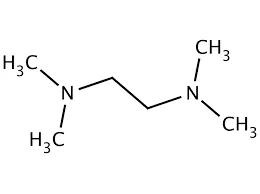
The Tris-Tricine-SDS Gel Running Buffer is specifically designed for separating proteins with molecular weights between 1 and 100 kDa, making it particularly effective for resolving proteins smaller than 30 kDa. This approach differs from traditional SDS-PAGE by substituting glycine (pK 9.6) with tricine (pK 8.15), which enhances the stacking and destacking of low molecular weight proteins and improves the resolution of smaller peptides due to the differing pK values. Incorporating urea into the stacking gel allows for the effective separation of two proteins that share the same molecular weight. Additionally, the lower acrylamide concentrations in Tricine gels facilitate the transfer of hydrophobic proteins during Western blotting. Tricine–SDS-PAGE is therefore commonly employed for the separation of lower molecular weight proteins.Couleur et forme :Clear, Colourless, LiquidN,N,N,N-Tetramethyl Ethylenediamine (TEMED) extrapure AR, ExiPlus, Multi-Compendial, 99%
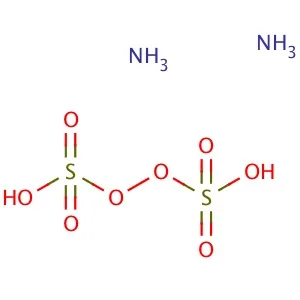
CAS :Formule :C6H16N2Degré de pureté :min. 99%Couleur et forme :Clear, Colourless, LiquidMasse moléculaire :116.21Ammonium Persulphate (APS) for electrophoresis, 99%
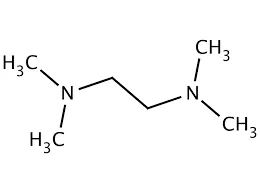
CAS :Formule :N2H8S2O8Degré de pureté :min. 99%Couleur et forme :White, Crystalline powder, Clear, ColourlessMasse moléculaire :228.20N,N,N,N-Tetramethyl Ethylenediamine (TEMED) for molecular biology, 99.5%
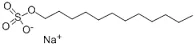
CAS :Formule :C6H16N2Degré de pureté :min. 99.5%Couleur et forme :Clear, Colourless, LiquidMasse moléculaire :116.21Sodium Lauryl Sulphate (SDS, SLS) ACS, 99%
CAS :Formule :C12H25SO4NaDegré de pureté :min.99%Couleur et forme :White, Crystalline powder, Clear, ColourlessMasse moléculaire :288.38Acrylamide 3x cryst. extrapure AR, 99.9%
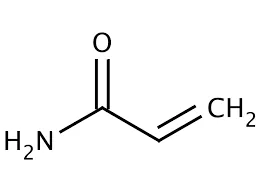
CAS :Produit contrôléFormule :C3H5NODegré de pureté :min. 99.9%Couleur et forme :White, Crystalline powder, Clear, ColourlessMasse moléculaire :71.0830% Acrylamide / Bis-acrylamide Mix Solution (Ratio 29:1)
SDS-PAGE is a method employed for separating proteins via electrophoresis, based on the principle that charged molecules migrate through a matrix in response to an applied electric field. The matrix utilized for this separation is polyacrylamide, which is derived from acrylamide, a compound that can be hazardous. Polyacrylamide is commonly used for the size-based separation of proteins and nucleic acids. The gel matrix forms through the free radical polymerization of acrylamide along with a crosslinking agent known as N, N-Methylenebisacrylamide. In this process, acrylamide monomers polymerize into long chains, initiated by a free radical-generating system, and these chains are linked by the cross-linker, resulting in a gel structure. This gel is crucial for effective electrophoretic separation, facilitating the analysis of biomolecules based on size.Couleur et forme :Clear, Colourless, LiquidN,N,N-Trimethylethylenediamine pure, 97%
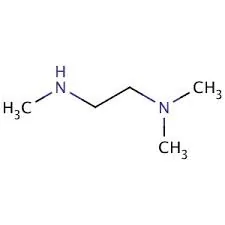
CAS :Formule :C5H14N2Degré de pureté :min. 97%Couleur et forme :Clear, Colourless, LiquidMasse moléculaire :102.18Cetyltrimethyl Ammonium Bromide (CTAB) for molecular biology, 99%
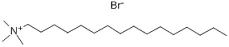
CAS :Formule :C19H42BrNDegré de pureté :min. 99.5%Couleur et forme :White, Crystalline powder, Clear, Colourless, Clear, ColourlessMasse moléculaire :364.45Ethidium Bromide extrapure, 95%
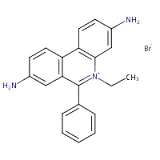
CAS :Formule :C21H20N3BrDegré de pureté :min.95%Couleur et forme :Red, Crystalline Powder, Clear, RedMasse moléculaire :394.32Cetyltrimethyl Ammonium Chloride (CTAC) for molecular biology, 99%
CAS :Formule :C19H42NClDegré de pureté :min. 99%Couleur et forme :White, Crystalline powder, Clear, ColourlessMasse moléculaire :320.00Ethidium Bromide Solution (10mg/ml)
Formule :C21H20N3BrCouleur et forme :Dark red, Clear, LiquidMasse moléculaire :394.32