Antibiotiques
Les antibiotiques sont des composés conçus pour détruire ou inhiber la croissance de divers microorganismes, jouant un rôle crucial dans le traitement des infections et la prévention de la propagation des maladies. Cette catégorie offre une gamme diversifiée d'ingrédients actifs spécifiquement destinés à la recherche dans le domaine biochimique. Ces composés sont des outils essentiels pour étudier les mécanismes bactériens, les modèles de résistance et le développement de nouveaux agents thérapeutiques. Les chercheurs peuvent explorer une large variété d'antibiotiques pour comprendre leurs effets, optimiser leur utilisation et développer de nouveaux traitements pour combattre les menaces microbiennes émergentes. La disponibilité d'un spectre aussi large d'antibiotiques soutient la recherche avancée et l'innovation en microbiologie et en sciences pharmaceutiques.
Sous-catégories appartenant à la catégorie "Antibiotiques"
- Antibiotiques macrolides(26 produits)
- Antibiotiques stéroïdiens(31 produits)
- Antibiotiques de type tétracycline(20 produits)
- antibiotiques β-lactames(11 produits)
4100 produits trouvés pour "Antibiotiques"
Trier par
Degré de pureté (%)
0
100
|
0
|
50
|
90
|
95
|
100
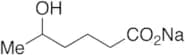
5-Hydroxyhexanoic Acid Sodium Salt
CAS :Produit contrôlé<p>Stability Hygroscopic<br>Applications A new constituent of bacterial polyhydroxyalkanoic acids.<br>References Bollard, M., et al.: Toxicol. Appl. Pharmacol., 204, 135 (2005), Slupsky, C., et al.: Anal. Chem., 79, 6995 (2007),<br></p>Formule :C6H11NaO3Couleur et forme :NeatMasse moléculaire :154.142,3-Bis[(acetyloxy)methyl]-1-oxoquinoxalin-1-ium-4(1H)-olate
CAS :Produit contrôlé<p>Applications 2,3-Bis[(acetyloxy)methyl]-1-oxoquinoxalin-1-ium-4(1H)-olate is an antibiotic.<br>References Marrero-Ponce, Yovani, et al.: Bioorg. & Med. Chem., 13(8), 2881-2899 (2005)<br></p>Formule :C14H14N2O6Couleur et forme :NeatMasse moléculaire :306.27Furazabol (1mg/ml in Acetonitrile)
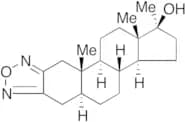
CAS :Produit contrôléFormule :C20H30N2O2Couleur et forme :Single SolutionMasse moléculaire :330.46(S)-(-)-Ofloxacin-d3 (N-methyl-d3)
CAS :Produit contrôlé<p>Applications (S)-(-)-Ofloxacin-d3 (N-methyl-d3) (CAS# 2208780-63-4) is a useful isotopically labeled research compound.<br></p>Formule :C18H17D3FN3O4Couleur et forme :NeatMasse moléculaire :364.39Biotinyl tobramycin amide
CAS :<p>Biotinyl tobramycin amide is a biotinylated form of the antibiotic tobramycin, which is derived from the actinobacterium Streptomyces tenebrarius. It features a tobramycin core, a potent aminoglycoside antibiotic, chemically linked to biotin. This modification allows for the specific attachment to avidin or streptavidin-labeled probes due to the strong biotin-streptavidin interaction, facilitating various labeling and detection techniques in research.</p>Formule :C28H51N7O11SDegré de pureté :Min. 95%Masse moléculaire :693.81 g/molOxacillin sodium
CAS :<p>Oxacillin sodium is a beta-lactam antibiotic with action on bacterial cell wall synthesis and is used for treating infections caused by penicillin-resistant Staphylococcus aureus.</p>Formule :C19H18N3NaO5SDegré de pureté :Min. 95%Couleur et forme :PowderMasse moléculaire :423.42 g/molLincomycin 2-palmitate hydrochloride
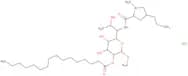
CAS :<p>Lincomycin 2-palmitate hydrochloride is a semi-synthetic antibiotic, derived from the natural antibiotic lincomycin through chemical modification. It is sourced from fermentative processes involving the bacterium *Streptomyces lincolnensis*. The compound exerts its action by inhibiting protein synthesis in susceptible bacteria. This occurs through its binding to the 50S subunit of the bacterial ribosome, thereby hindering peptide chain elongation and ultimately arresting bacterial growth.</p>Formule :C34H65ClN2O7SDegré de pureté :Min. 95%Masse moléculaire :681.41 g/molBiotinamidocaproate tobramycin amide
CAS :<p>Biotinamidocaproate tobramycin amide is a chemical conjugate, serving as an innovative antimicrobial agent derived from the integration of biotin with tobramycin, an aminoglycoside antibiotic. This product embodies the amalgamation of tobramycin’s robust antibacterial properties with biotin’s ability to guide compounds specifically to targets through biotin-avidin interactions.</p>Formule :C34H62N8O12SDegré de pureté :Min. 95%Masse moléculaire :806.97 g/molTyrothricin
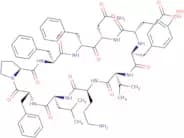
CAS :<p>Tyrothricin is a peptide antibiotic, which is derived from the bacterium Bacillus brevis. This compound comprises a mixture of polypeptides, primarily gramicidin and tyrocidine, both of which are instrumental in its antimicrobial activity. The mode of action of tyrothricin involves disrupting bacterial cell membranes, leading to cell lysis and death. Gramicidin increases the permeability of the bacterial membrane to ions, while tyrocidine promotes disruption of membrane integrity, which together exert bactericidal and bacteriostatic effects.</p>Formule :C65H85N11O13Degré de pureté :Min. 95%Masse moléculaire :1,228.44 g/molRifampicin, Antibiotic for Culture Media Use Only
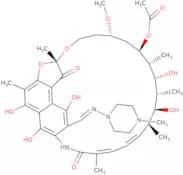
CAS :Rifampicin is a drug that inhibits protein synthesis in bacteria and is used to treat tuberculosis. Rifampicin binds to the beta subunit of the bacterial RNA polymerase, inhibiting transcription and translation. It has been shown to inhibit the acetylcholine receptor function in rats, which may be related to its antituberculosis activity. Histopathological studies have shown that rifampicin inhibits the growth of human tumors in mice, including lung cancer, breast cancer, and leukemia. The drug is also being studied for its potential use in treating Alzheimer's disease. The pharmacokinetics and oral bioavailability of rifampicin have been studied and Rifampicin has been shown to be an effective anti-tuberculosis drug.Formule :C43H58N4O12Degré de pureté :Min. 90.0 Area-%Masse moléculaire :822.94 g/molent NAP 226-90
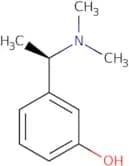
CAS :<p>ent NAP 226-90 is an organic compound functioning as an antibacterial agent, which is derived from a biologically active natural product. Its mode of action involves the inhibition of essential bacterial enzymes, leading to the disruption of cellular processes within susceptible microorganisms. This compound is particularly effective against a broad spectrum of gram-positive bacteria, making it valuable in medical microbiology research for understanding bacterial resistance mechanisms.</p>Formule :C10H15NODegré de pureté :Min. 95%Masse moléculaire :165.23 g/molHypothemycin
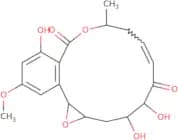
CAS :<p>Hypothemycin is a natural product that serves as a potent inhibitor of protein kinases. It is derived from the fungus Hypomyces subiculosus and belongs to the class of resorcylic acid lactones. Its mode of action involves binding covalently to the ATP-binding site of kinases, leading to the inhibition of their activity. This covalent modification is achieved through the formation of a Michael-type addition with a reactive ene-diene functionality within its structure. By targeting these critical enzymes, hypothemycin disrupts key signaling pathways that are essential for cell growth and proliferation.</p>Degré de pureté :Min. 95%Nafcilllin sodium monohydrate
CAS :<p>Nafcillin sodium monohydrate is a beta-lactam antibiotic, which is derived from the penicillin class of antimicrobials. It is specifically a semi-synthetic penicillin and is commonly sourced through chemical synthesis to enhance its stability and spectrum of activity. Nafcillin primarily exerts its bactericidal effects by inhibiting bacterial cell wall synthesis. It achieves this through its strong affinity for penicillin-binding proteins (PBPs), which are essential for maintaining the bacterial cell wall structure. By disrupting the formation of peptidoglycan cross-links, nafcillin effectively weakens the bacterial cell wall, leading to cell lysis and death, especially in gram-positive bacteria such as Staphylococcus aureus, including methicillin-sensitive strains (MSSA).</p>Formule :C21H21N2O5SNa·H2ODegré de pureté :Min. 95%Couleur et forme :White to off-white solid.Masse moléculaire :454.47 g/molTetracycline hydrochloride, Antibiotic for Culture Media Use Only
CAS :<p>Tetracycline hydrochloride is a broad-spectrum antibiotic and is an electron transfer agent. It has been shown to be effective against bacterial infections in humans and has been used in cultures for the prevention of bacterial contamination. As an electron transfer agent, it is used in electron microscopy to study the surface of biological cells. Tetracycline hydrochloride enters bacterial cells by diffusion and interacts with the cytoplasmic membrane, where it induces a redox reaction that leads to cell death. The efficacy of tetracycline hydrochloride in treating candida albicans (yeast) was studied using in-vitro activity and showed that carboxymethyl chitosan nanoparticles were able to enhance the treatment efficiency.</p>Formule :C22H25ClN2O8Degré de pureté :Min. 88.0 Area-%Masse moléculaire :480.90 g/molRef: 3D-T-1961
1kgÀ demander5kgÀ demander10kgÀ demander25kgÀ demander2500gÀ demander-Unit-kgkgÀ demanderVirginiamycin M1
CAS :<p>Inhibitor of protein synthesis; streptogramin</p>Formule :C28H35N3O7Degré de pureté :Min. 95%Masse moléculaire :525.59 g/molDequalinium chloride
CAS :<p>Dequalinium chloride is a novel, broad spectrum antimicrobial agent with a mechanism of action that inhibits the mitochondria-dependent respiratory chain. Studies have shown that it inhibits the growth of resistant microorganisms in cell-based experiments and in bacterial infections. Dequalinium chloride also has cytopathic effects on thp-1 cells, which are specific for Mycobacterium tuberculosis. In addition to inhibiting mitochondria-dependent respiration, this compound also increases acetylcholine receptor sensitivity in A549 lung cancer cells. Dequalinium chloride is a quaternary ammonium cation and has been shown to be effective against clinical isolates and inhibitory concentrations of a variety of virus species, including human rhinovirus (HRV) and Coxsackie virus type B4 (CoxB4).</p>Formule :C30H40Cl2N4Degré de pureté :Min. 95.0 Area-%Masse moléculaire :527.57 g/molSulfadiazine
CAS :<p>Sulfadiazine is a sulfonamide antibiotic with action on bacterial folate synthesis inhibition and is used for treating toxoplasmosis and urinary tract infections.</p>Formule :C10H10N4O2SDegré de pureté :Min. 95%Couleur et forme :PowderMasse moléculaire :250.28 g/molCefacetrile sodium
CAS :<p>Cefacetrile sodium is a broad-spectrum antibiotic belonging to the cephalosporin class. It is a semi-synthetic derivative sourced from cephalosporin C, a naturally occurring compound derived from the Acremonium fungus. Its mode of action involves the inhibition of bacterial cell wall synthesis. This occurs by binding to penicillin-binding proteins within the bacterial cell membrane, ultimately leading to cell lysis and death due to the inability to synthesize peptidoglycan, a critical component of the bacterial cell wall.</p>Formule :C13H13N3NaO6SDegré de pureté :Min. 95%Masse moléculaire :362.31 g/mol10, 11-Dehydrocurvularin
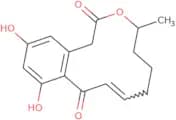
CAS :<p>10, 11-Dehydrocurvularin is a fungal phytotoxin with heat shock response and immune-modulatory activitie. Curvularins inhibit the expression of the inducible nitric oxide synthase (iNOS), thereby acting as anti-inflammatory agents and immune system modulators</p>Degré de pureté :Min. 95%Couleur et forme :Powder

![2,3-Bis[(acetyloxy)methyl]-1-oxoquinoxalin-1-ium-4(1H)-olate](/_next/image/?url=https%3A%2Fstatic.cymitquimica.com%2Fproducts%2FTR%2Fthumb-webp%2FB325620.webp&w=3840&q=75)