Antibiotiques
Les antibiotiques sont des composés conçus pour détruire ou inhiber la croissance de divers microorganismes, jouant un rôle crucial dans le traitement des infections et la prévention de la propagation des maladies. Cette catégorie offre une gamme diversifiée d'ingrédients actifs spécifiquement destinés à la recherche dans le domaine biochimique. Ces composés sont des outils essentiels pour étudier les mécanismes bactériens, les modèles de résistance et le développement de nouveaux agents thérapeutiques. Les chercheurs peuvent explorer une large variété d'antibiotiques pour comprendre leurs effets, optimiser leur utilisation et développer de nouveaux traitements pour combattre les menaces microbiennes émergentes. La disponibilité d'un spectre aussi large d'antibiotiques soutient la recherche avancée et l'innovation en microbiologie et en sciences pharmaceutiques.
Sous-catégories appartenant à la catégorie "Antibiotiques"
- Antibiotiques macrolides(26 produits)
- Antibiotiques stéroïdiens(31 produits)
- Antibiotiques de type tétracycline(20 produits)
- antibiotiques β-lactames(11 produits)
4100 produits trouvés pour "Antibiotiques"
Trier par
Degré de pureté (%)
0
100
|
0
|
50
|
90
|
95
|
100
Tigecycline hydrate
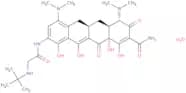
CAS :<p>Inhibitor of protein synthesis; glycylcycline class</p>Formule :C29H39N5O8Degré de pureté :Min. 95%Masse moléculaire :585.65 g/mol25-O-Deacetyl rifabutin
CAS :<p>25-O-Deacetyl rifabutin is an antibiotic derivative, which is sourced from the semi-synthetic modification of rifabutin, a compound originally derived from the fermentation of the bacterium Amycolatopsis mediterranei. This derivative works by inhibiting bacterial RNA synthesis. It achieves this by specifically targeting the DNA-dependent RNA polymerase enzyme, which is essential for bacterial transcription. The mechanism involves binding to the beta-subunit of the polymerase, thereby blocking the elongation of the RNA chain, which ultimately leads to the death of the bacterial cell.</p>Formule :C44H60N4O10Degré de pureté :Min. 95%Couleur et forme :Purple PowderMasse moléculaire :804.97 g/mol(10E)-10,11-Didehydro-11-deoxy-6-O-methylerythromycin
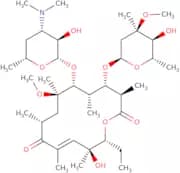
CAS :<p>(E)-10,11-Didehydro-11-deoxy-6-O-methylerythromycin is a semisynthetic macrolide antibiotic, which is derived from erythromycin, a natural product obtained from the bacterium *Saccharopolyspora erythraea*. This compound functions as an inhibitor of protein synthesis by binding to the 50S ribosomal subunit of bacteria, thus preventing the growth and proliferation of susceptible bacterial strains. The alteration in its chemical structure, notably the methylation at the 6-O position, enhances its stability and improves its pharmacokinetic profile compared to the parent compound, erythromycin.</p>Formule :C38H67NO12Degré de pureté :Min. 95%Masse moléculaire :729.94 g/mol(10E)-3-O-De(a-L-cladinose)-10-dehydro-11-dehydroxy-6-O-methyl-erythromycin
CAS :Erythromycin derivativeFormule :C30H53NO9Degré de pureté :Min. 95%Masse moléculaire :571.74 g/molDoxycycline hydrochloride hemiethanolate hemihydrate, Antibiotic for Culture Media Use Only
CAS :<p>Doxycycline is an antibiotic that inhibits bacterial growth by inhibiting protein synthesis, respiratory chain, DNA gyrase, DNA topoisomerase IV. Doxycycline inhibits papaverine by blocking the expression of both cytochrome P450 and epoxide hydrolase. Doxycycline is commonly found in studies for bacterial infections, drug therapy, histopathological studies, cell culture and chemometric analysis.</p>Formule :C22H24N2O8·HClH2OC2H6ODegré de pureté :Min. 97.0 Area-%Masse moléculaire :512.90 g/mol7-epi-Clindamycin
CAS :<p>7-epi-Clindamycin is a clindamycin derivative, which is a semisynthetic antibiotic derived from the bacterium *Streptomyces lincolnensis*. Its mode of action involves binding to the 50S subunit of the bacterial ribosome, thereby inhibiting protein synthesis. This results in the suppression of bacterial growth, making it effective against certain Gram-positive bacteria and anaerobic species.</p>Formule :C18H34Cl2N2O5SDegré de pureté :Min. 95%Couleur et forme :White To Off-White SolidMasse moléculaire :461.44 g/molAlamethacin
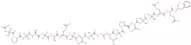
CAS :<p>Alamethacin is a peptide antibiotic, which is derived from the soil fungus Trichoderma viride. This compound consists of a sequence of amino acids that form a helical structure, enabling its interaction with lipid membranes. Alamethacin functions by inserting itself into cellular membranes and forming voltage-dependent ion channels. As a result, it alters membrane permeability, causing ion imbalance and leading to cell death.</p>Formule :C92H150N22O25Degré de pureté :Min. 95%Couleur et forme :SolidMasse moléculaire :1,964.31 g/molOligomycin B
CAS :<p>Oligomycin B is an antibiotic compound, which is derived from Streptomyces species. It is an inhibitor of the mitochondrial ATP synthase complex, specifically targeting the F₀ subunit of ATP synthase. This action obstructs the proton channel, preventing the flow of protons across the mitochondrial membrane. As a result, Oligomycin B effectively halts ATP synthesis by oxidative phosphorylation, which is crucial for the survival of aerobic organisms.</p>Formule :C45H72O12Degré de pureté :Min. 95%Couleur et forme :PowderMasse moléculaire :805.05 g/mol7-O-Demethyl rapamycin
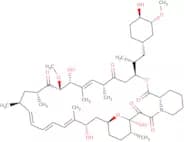
CAS :<p>7-O-Demethyl rapamycin is a macrolide compound, which is a derivative of rapamycin, originally sourced from the bacterial species *Streptomyces hygroscopicus*. This compound operates by binding to the FK506-binding protein 12 (FKBP12), forming a complex that inhibits the mammalian target of rapamycin (mTOR) pathway. This inhibition interferes with cellular processes such as cell growth, proliferation, and survival by altering the phosphorylation state of downstream targets.</p>Formule :C50H77NO13Degré de pureté :80%MinMasse moléculaire :900.15 g/molPeplomycin sulfate
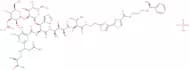
CAS :<p>Peplomycin sulfate is an anticancer antibiotic, which is a derivative of the bleomycin family of glycopeptide antibiotics produced by the bacterium *Streptomyces verticillus*. This antibiotic operates through a mode of action that involves the induction of DNA strand breaks by forming a complex with iron and oxygen, leading to the generation of free radicals. These radicals cleave DNA strands, thereby inhibiting DNA synthesis and inducing apoptosis in cancerous cells.</p>Formule :C61H90N18O25S3Degré de pureté :Min. 95%Masse moléculaire :1,571.67 g/molClindamycin 4-phosphate
CAS :<p>Clindamycin 4-phosphate is a semi-synthetic antibiotic, which is a derivative of the natural antibiotic lincomycin. It is specifically synthesized from Streptomyces lincolnensis cultures. The mode of action of Clindamycin 4-phosphate involves inhibiting bacterial protein synthesis by binding to the 50S subunit of the bacterial ribosome, thus preventing peptide chain elongation and subsequent bacterial growth.</p>Formule :C18H34ClN2O8PSDegré de pureté :Min. 95%Masse moléculaire :504.96 g/mol1,3''-Di-HABA kanamycin A
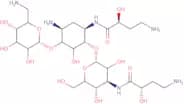
CAS :<p>1,3''-Di-HABA kanamycin A is a chemically modified antibiotic derivative. It is derived from kanamycin A, a well-known aminoglycoside antibiotic that is originally sourced from the bacterium *Streptomyces kanamyceticus*. The modification with 1,3''-Di-HABA alters its pharmacodynamic properties, potentially influencing its specificity and interaction with biological targets.</p>Formule :C26H50N6O15Degré de pureté :Min. 95%Masse moléculaire :686.71 g/molTelavancin
CAS :<p>Telavancin is a lipoglycopeptide antibiotic, which is a semi-synthetic derivative of vancomycin. Its source is derived through modifications of the glycopeptide antibiotic, specifically aimed to enhance antibacterial activity. Telavancin functions by inhibiting cell wall synthesis in Gram-positive bacteria, including methicillin-resistant Staphylococcus aureus (MRSA). It does this by binding to the D-alanyl-D-alanine terminus of cell wall precursors, disrupting peptidoglycan polymerization and, consequently, cell wall integrity. Additionally, Telavancin increases membrane permeability and disrupts membrane potential, further enhancing its bactericidal activity.</p>Formule :C80H106Cl2N11O27PDegré de pureté :Min. 95%Masse moléculaire :1,755.64 g/molL-Carnitine fumarate
CAS :<p>L-Carnitine fumarate is a compound that functions as a dietary supplement, which is synthesized by combining L-carnitine, an amino acid derivative naturally found in the body, with fumaric acid. This product is primarily sourced from fermentation or chemical synthesis processes to produce L-carnitine, which is then reacted with fumaric acid to form the fumarate salt. This combination enhances the stability and bioavailability of L-carnitine.</p>Formule :C7H15NO3·C4H4O4Degré de pureté :Min. 95%Masse moléculaire :277.27 g/molCyclosporin L
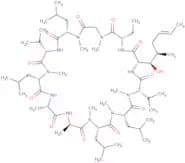
CAS :<p>Cyclosporin L is an immunosuppressive agent, which is a cyclic polypeptide derived from the soil fungus Tolypocladium inflatum. It primarily functions by inhibiting the activity of calcineurin, a key phosphatase involved in the activation of T-cells. This inhibition prevents the transcription of interleukin-2 and other cytokines critical for T-cell proliferation.</p>Formule :C61H109N11O12Degré de pureté :90%MinMasse moléculaire :1,188.59 g/molAmikacin B Sulfate
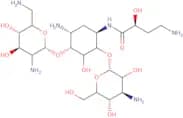
CAS :<p>Inhibitor of protein synthesis; aminoglycoside</p>Formule :C22H44N6O12xH2so4Degré de pureté :Min. 95%Masse moléculaire :584.62 g/mol3'-N-Desmethyl-3'-N-tosyl azithromycin
CAS :<p>3'-N-Desmethyl-3'-N-tosyl azithromycin is a semi-synthetic macrolide antibiotic analog, which is a derivative of azithromycin, a well-known member of the macrolide class of antibiotics. This compound is synthesized through chemical modifications of the parent molecule, azithromycin, to potentially enhance its pharmacokinetic and pharmacodynamic properties.</p>Formule :C44H76N2O14SDegré de pureté :Min. 95%Masse moléculaire :889.15 g/molTunicamycin
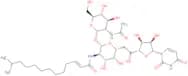
CAS :<p>Inhibitor of N-glycosylation in eukaryotes</p>Formule :C37H60N4O16Degré de pureté :Min. 95%Couleur et forme :PowderMasse moléculaire :816.89Cefadroxil monohydrate, Antibiotic for Culture Media Use Only
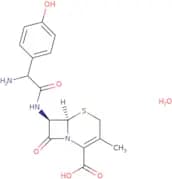
CAS :Cefadroxil is a broad-spectrum bactericidal antibiotic that belongs to the cephalosporin family. It is a semi-synthetic penicillin and inhibits bacterial cell wall synthesis through binding to one or more of the penicillin-binding proteins (PBPs). Cefadroxil monohydrate is used as an antibiotic for culture media and has been proven to be effective against methicillin-resistant Staphylococcus aureus (MRSA). In addition, the drug has been shown to have no significant effect on blood tests or microscopic studies.Formule :C16H19N3O6SDegré de pureté :Min. 97.0 Area-%Masse moléculaire :381.40 g/molDeacetylanisomycin
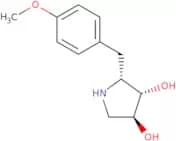
CAS :<p>Deacetylanisomycin is a bacterial metabolite, which is derived from the soil bacterium Streptomyces griseolus. It acts as an inhibitor of protein synthesis by binding to the 60S ribosomal subunit, thus interfering with peptide bond formation during translation. This mode of action is key to its effectiveness in studying the mechanisms of protein synthesis interruption.</p>Formule :C12H17NO3Degré de pureté :Min. 95%Couleur et forme :White To Off-White SolidMasse moléculaire :223.27 g/mol