Antibiotiques
Les antibiotiques sont des composés conçus pour détruire ou inhiber la croissance de divers microorganismes, jouant un rôle crucial dans le traitement des infections et la prévention de la propagation des maladies. Cette catégorie offre une gamme diversifiée d'ingrédients actifs spécifiquement destinés à la recherche dans le domaine biochimique. Ces composés sont des outils essentiels pour étudier les mécanismes bactériens, les modèles de résistance et le développement de nouveaux agents thérapeutiques. Les chercheurs peuvent explorer une large variété d'antibiotiques pour comprendre leurs effets, optimiser leur utilisation et développer de nouveaux traitements pour combattre les menaces microbiennes émergentes. La disponibilité d'un spectre aussi large d'antibiotiques soutient la recherche avancée et l'innovation en microbiologie et en sciences pharmaceutiques.
Sous-catégories appartenant à la catégorie "Antibiotiques"
- Antibiotiques macrolides(26 produits)
- Antibiotiques stéroïdiens(31 produits)
- Antibiotiques de type tétracycline(20 produits)
- antibiotiques β-lactames(11 produits)
4100 produits trouvés pour "Antibiotiques"
Trier par
Degré de pureté (%)
0
100
|
0
|
50
|
90
|
95
|
100
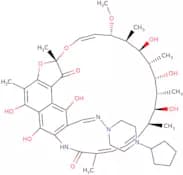
N-Desisobutyl-N-propyl rifabutin
CAS :<p>N-Desisobutyl-N-propyl rifabutin is a synthetic derivative of rifabutin, which is an antibiotic belonging to the rifamycin class. This compound is sourced from modifications of the parent molecule rifabutin, itself derived from the rifamycin family produced by the bacterium Amycolatopsis, traditionally used for its antimicrobial properties. The mode of action involves the inhibition of bacterial RNA polymerase, effectively preventing the transcription process necessary for bacterial replication and protein synthesis. This disruption of RNA synthesis provides potent antimicrobial activity.</p>Formule :C45H60N4O11Degré de pureté :Min. 95%Masse moléculaire :832.98 g/molVancomycin aglycon
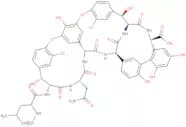
CAS :<p>Vancomycin aglycon is a glycopeptide antibiotic, which is a derivative of vancomycin. It is sourced from the fermentation products of certain Amycolatopsis species, a genus of actinobacteria. The mode of action of vancomycin aglycon involves the inhibition of bacterial cell wall synthesis. It specifically binds to the D-Ala-D-Ala terminus of nascent peptidoglycan chains, thereby preventing the cross-linking that is crucial for maintaining cell wall integrity.</p>Formule :C53H52Cl2N8O17Degré de pureté :Min. 95%Masse moléculaire :1,143.93 g/molN-Biotinyl-12-aminododecanoyltobramycin amide
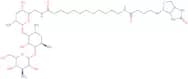
CAS :<p>N-Biotinyl-12-aminododecanoyltobramycin amide is a synthetic bioconjugate, which is derived from the aminoglycoside antibiotic tobramycin. This compound is chemically modified by the addition of a biotin moiety linked through a 12-aminododecanoyl spacer. The source of this product is rooted in the conjugation of biotin to tobramycin, allowing for targeted delivery and potential hybrid applications in both therapeutic and diagnostic fields.</p>Formule :C40H74N8O12SDegré de pureté :Min. 95%Masse moléculaire :891.13 g/molSitafloxacin
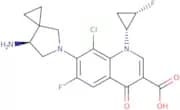
CAS :<p>Sitafloxacin is an antibacterial agent belonging to the fluoroquinolone class of antibiotics, which is synthetically derived from chemical processes involving fluorinated quinolones. Its mode of action involves the inhibition of bacterial DNA gyrase and topoisomerase IV, enzymes crucial for bacterial DNA replication and transcription. By interfering with these enzymes, Sitafloxacin effectively hampers bacterial DNA synthesis, leading to the eventual demise of the bacterial cell.</p>Formule :C19H18ClF2N3O3Degré de pureté :Min. 95%Couleur et forme :SolidMasse moléculaire :409.81 g/molCefazolin, Antibiotic for Culture Media Use Only
CAS :Cefazolin is a semi-synthetic, non-beta lactam antibiotic used for the treatment of a variety of bacterial infections. It inhibits cell wall synthesis by binding to one or more of penicillin-binding proteins (PBPs), which are bacterial transpeptidases that crosslink peptidoglycan strands. Cefazolin binds to PBPs present on the surface of all Gram-negative bacteria as well as many Gram-positive bacteria. It is not effective against methicillin-resistant staphylococcus and MRSA unless combined with another antibiotic such as vancomycin or flucloxacillin. A study showed that cefazolin can decrease inflammation and tumor necrosis factor-beta levels in pregnant women with systemic inflammatory disease. It has been tested in the development of an anti-inflammatory agent for use in patients with autoimmune diseases such as rheumatoid arthritis and lupus erythe.Formule :C14H14N8O4S3Masse moléculaire :454.51 g/molTulathromycin B - 95%
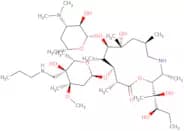
CAS :<p>Inhibitor of protein synthesis; macrolide class</p>Formule :C41H79N3O12Degré de pureté :Min. 95%Masse moléculaire :806.08 g/mol25-Desacetyl rifapentin
CAS :<p>25-Desacetyl rifapentin is a derivative of rifapentin, an antibiotic belonging to the rifamycin class, sourced from the bacterial species *Amycolatopsis rifamycinica*. This compound functions by inhibiting bacterial DNA-dependent RNA polymerase, which is crucial for transcription in susceptible bacterial strains. By inhibiting this enzyme, 25-Desacetyl rifapentin effectively hampers RNA synthesis, ultimately leading to bacterial cell death.</p>Formule :C45H62N4O11Degré de pureté :Min. 95%Couleur et forme :PowderMasse moléculaire :834.99 g/molImipenem Monohydrate, Antibiotic for Culture Media Use Only
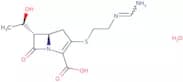
CAS :Imipenem acts as an antimicrobial through inhibiting cell wall synthesis of various gram-positive and gram-negative bacteria. It remains very stable in the presence of beta-lactamase (both penicillinase andcephalosporinase) produced by some bacteria, and is a strong inhibitor of beta-lactamases from some gram-negative bacteria that are resistant to most beta-lactam antibiotics.Formule :C12H19N3O5SDegré de pureté :Min. 98.0 Area-%Masse moléculaire :317.36 g/molTrovafloxacin mesylate
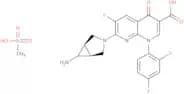
CAS :<p>Trovafloxacin mesylate is a synthetic antibiotic belonging to the fluoroquinolone class, which is derived from chemical synthesis processes rather than natural sources. The mode of action of trovafloxacin mesylate involves the inhibition of bacterial enzymes DNA gyrase and topoisomerase IV. These enzymes are essential for DNA replication, repair, and transcription within the bacterial cell. By inhibiting these enzymes, trovafloxacin mesylate disrupts bacterial DNA processes, leading to cell death and exerting its antibacterial effects.</p>Formule :C21H19F3N4O6SDegré de pureté :Min. 95%Masse moléculaire :512.46 g/molMitomycin D
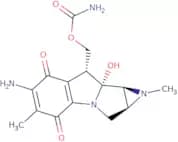
CAS :<p>Mitomycin D is an antibiotic and chemotherapeutic agent known for its ability to inhibit DNA synthesis, making it a potent antitumor agent. It is derived from the bacterium *Streptomyces caespitosus*. Mitomycin D functions as a DNA crosslinking agent by alkylating the DNA strands, which interferes with DNA replication and transcription. This mechanism leads to the cessation of cellular division and ultimately induces apoptosis in rapidly dividing cells.</p>Formule :C15H18N4O5Degré de pureté :Min. 95%Masse moléculaire :334.33 g/molNigericin sodium
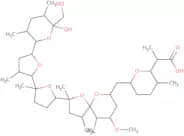
CAS :<p>Nigericin transports cations across the membrane of the cell and it is used to study anion transport. It can be used as a buffer to control pH value inside of the cell.</p>Formule :C40H67NaO11Degré de pureté :Min. 95%Masse moléculaire :746.94 g/molPolymyxin B nonapeptide hydrochloride
CAS :<p>Polymyxin B nonapeptide hydrochloride is a potent antibiotic compound derived from the bacterium *Bacillus polymyxa*. As a cationic polypeptide, it exhibits its antibacterial activity by interacting with the lipopolysaccharides and phospholipids in the bacterial cell membrane, leading to increased permeability and ultimately causing cell lysis. The compound is specifically effective against a broad range of Gram-negative bacteria, making it crucial in studying antibiotic resistance mechanisms.</p>Formule :C43H74N14O11•(HCl)xDegré de pureté :Min. 95%Masse moléculaire :963.14 g/mol6,11-Di-O-methyl erythromycin
CAS :<p>6,11-Di-O-methyl erythromycin is a semi-synthetic derivative of erythromycin, which is a macrolide antibiotic originally sourced from the bacterium *Saccharopolyspora erythraea*. This compound is produced through chemical modification of the natural antibiotic to improve its pharmacokinetic properties, such as stability and absorption.</p>Formule :C39H71NO13Degré de pureté :Min. 95%Masse moléculaire :761.98 g/molTigemonam
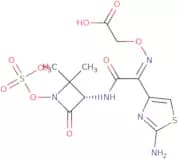
CAS :<p>Tigemonam is a synthetic beta-lactam antibiotic, which is derived from chemical synthesis processes. This compound operates by inhibiting bacterial cell wall synthesis, specifically targeting the penicillin-binding proteins (PBPs). The disruption of the cell wall synthesis ultimately leads to cell lysis and death of the bacteria, making it effective primarily against gram-negative bacterial infections.</p>Formule :C12H15N5O9S2Degré de pureté :Min. 95%Masse moléculaire :437.41 g/molClarithromycin - EP
CAS :<p>A macrolide, broad-spectrum antibiotic that targets cytochrome P4503A4 (CYP3A4). Clarithromycin has been used to potentiate the pharmacological effects of some drugs that are metabolised by the cytochrome P450.</p>Formule :C38H69NO13Degré de pureté :Min. 95%Masse moléculaire :747.95 g/mol7-Deazaadenosine, Antibiotic for Culture Media Use Only
CAS :7-Deazaadenosine is a chemical compound used as an antibiotic for culture media, which is a synthetic nucleoside analog derived from adenosine. Its structure is modified by replacing a nitrogen atom in the purine ring with a carbon atom, thus altering its biological interactions. The primary mode of action of 7-Deazaadenosine involves its incorporation into nucleic acids, where it acts as an inhibitor of nucleic acid-processing enzymes. This interference can effectively impede processes like DNA and RNA synthesis.Formule :C11H14N4O4Degré de pureté :Min. 97.0 Area-%Masse moléculaire :266.25 g/molRef: 3D-W-203540
1gÀ demander100mgÀ demander250mgÀ demander500mgÀ demander2500mgÀ demander-Unit-ggÀ demanderErythromycin, Antibiotic for Culture Media Use Only
CAS :Erythromycin, Antibiotic for Culture Media Use Only, is a macrolide antibiotic derived from the bacterium *Saccharopolyspora erythraea*. It functions by inhibiting protein synthesis, specifically targeting the 50S ribosomal subunit in susceptible bacteria. This action results in the prevention of peptide chain elongation, effectively halting bacterial growth and proliferation.Formule :C37H67NO13Degré de pureté :Min. 93.0 Area-%Masse moléculaire :733.93 g/molRef: 3D-E-3250
1kgÀ demander100gÀ demander250gÀ demander500gÀ demander2500gÀ demander-Unit-ggÀ demanderColistin sulfate, Antibiotic for Culture Media Use Only
CAS :<p>Antibacterial agent with the ability to permeate bacterial membranes and cause cell death. Colistin is a cationic peptide also known as polymyxin E. Colistin is effective in multidrug resistant Gram-positive bacteria such as P. aeruginosa, A. baumannii and K. pneumoniae.</p>Formule :C53H102N16O17SMasse moléculaire :1,266.73 g/molRef: 3D-Q-200890
1kgÀ demander5kgÀ demander10kgÀ demander25kgÀ demander2500gÀ demander-Unit-kgkgÀ demanderAclacinomycin HCl
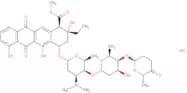
CAS :<p>Aclacinomycin HCl is a cytotoxic antibiotic that inhibits the growth of tumor cells. It has been shown to induce apoptosis in human leukemia cells by altering the transmembrane potential and inhibiting cell proliferation. Aclacinomycin HCl also induces DNA damage response, which leads to caspase activities and cell death. This drug is highly selective for tumor cells, with no effect on normal cells. It has been shown to be effective against primary liver cancer in animal models, as well as developmental disorders such as autism spectrum disorder (ASD).</p>Formule :C42H53NO15·HClDegré de pureté :Min. 95%Couleur et forme :Orange PowderMasse moléculaire :848.33 g/molAscomycin
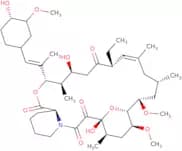
CAS :<p>Ascomycin is an immunosuppressant macrolide lactone, which is derived from the soil bacterium *Streptomyces hygroscopicus*. It functions primarily by inhibiting the T-cell activation pathway. The mechanism involves binding to the immunophilin FKBP-12, forming a complex that inhibits the calcium-dependent phosphatase, calcineurin. This inhibition prevents the dephosphorylation and subsequent translocation of nuclear factor of activated T cells (NFAT), which is crucial for the transcription of interleukin-2 and other cytokines. Consequently, this suppresses the activation and proliferation of T-cells, which are essential components of the adaptive immune response.</p>Formule :C43H69NO12Degré de pureté :Min. 95%Masse moléculaire :792.01 g/mol