Hétérocycles soufrés (S)
Ici, vous trouverez une classe de composés organiques contenant un atome de soufre dans l'anneau hétérocyclique. Les hétérocycles contenant du soufre sont cruciaux dans le développement de produits pharmaceutiques, agrochimiques et de matériaux en raison de leurs propriétés chimiques uniques et de leurs activités biologiques. Ces composés sont largement utilisés en chimie médicinale et en science des matériaux. Chez CymitQuimica, nous offrons une sélection variée d'hétérocycles contenant du soufre de haute qualité pour soutenir vos recherches et applications industrielles.
Sous-catégories appartenant à la catégorie "Hétérocycles soufrés (S)"
1000 produits trouvés pour "Hétérocycles soufrés (S)"
Trier par
Degré de pureté (%)
0
100
|
0
|
50
|
90
|
95
|
100
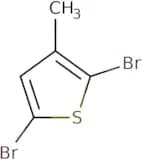
2,5-Dibromo-3-methylthiophene
CAS :<p>2,5-Dibromo-3-methylthiophene is a small molecule that has been shown to have anti-bacterial properties. It reacts with the bacterial cell membrane, disrupting the bacteria's ability to function and causing it to die. 2,5-Dibromo-3-methylthiophene can be used as an antibacterial agent in medicine or cosmetics. The chemical structure of 2,5-dibromo-3-methylthiophene is similar to that of oxadiazole and 5H-[1]benzothiazol[5,4,-d][1,2]oxazole and it has been shown that these compounds can also be used for antibacterial purposes. The anti-bacterial activity of 2,5-dibromo-3-methylthiophene is due to its functional groups which are reactive with metal ions such as Cu(II) and Fe(III).</p>Formule :C5H4Br2SDegré de pureté :Min. 95%Masse moléculaire :255.96 g/mol2,3,5,6-Tetrafluorothiophenol
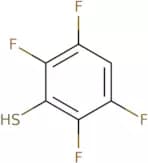
CAS :<p>2,3,5,6-Tetrafluorothiophenol is a backup chemical that can be used in place of the more expensive 2,4,5-trichlorophenol. It is a chemical intermediate that has been shown to react with fatty acids to form chromatographic products. FTIR spectroscopy and sample preparation techniques have been developed for this application. The light emission from FTIR spectroscopy can also be used as a means of controlling a microcontroller in telecommunications devices. A telecommunication company has successfully downloaded this information on their website. 2,3,5,6-Tetrafluorothiophenol has also been shown to inhibit the growth of Pseudomonas aeruginosa and Staphylococcus epidermidis bacteria by interfering with the synthesis of fatty acids and increasing the production of hydroxyl groups.END> Rifapentine is an anti-tuberculosis drug that</p>Formule :C6H2F4SDegré de pureté :Min. 95%Couleur et forme :Clear LiquidMasse moléculaire :182.14 g/molDibenzothiophene
CAS :<p>Dibenzothiophene is a chemical compound that has been used as a reagent for flow system and is characterized by its high chemical stability. Dibenzothiophene has been shown to be an effective inhibitor of bacterial growth in the presence of hydroxyl groups, such as in test samples. The reaction mechanism of dibenzothiophene with acetate extract is based on the enhancement of the activated surface methodology and light emission.</p>Formule :C12H8SDegré de pureté :Min. 95%Couleur et forme :PowderMasse moléculaire :184.26 g/mol2-(4-Fluorophenyl)-5-[(5-iodo-2-methylphenyl)methyl]thiophene
CAS :<p>Intermediate in the synthesis of canagliflozin</p>Formule :C18H14FISDegré de pureté :Min. 95%Masse moléculaire :408.27 g/molRITA
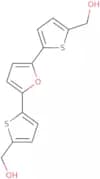
CAS :<p>RITA is a novel compound that has been shown to have anticancer activity in vivo in a rat model. RITA is a small molecule with high potency and low toxicity. It binds selectively to the α subunit of the enzyme topoisomerase II, which is involved in DNA replication and repair. RITA has been shown to induce apoptosis in cancer cells by pro-apoptotic proteins such as Bax and Bak. These proteins are known for their ability to induce apoptosis by increasing mitochondrial membrane permeability, inhibiting mitochondrial functions, or destabilizing the mitochondrial membrane potential. The compound class of RITA is not yet known, but it has been shown to be chemically stable at physiological pH levels and does not require metabolic activation for its cytotoxicity. The pharmacokinetics of this drug have also been studied in human liver cells and humans, indicating that this drug may be able to cross the blood-brain barrier.</p>Formule :C14H12O3S2Degré de pureté :Min. 95%Masse moléculaire :292.38 g/mol2-(4-Fluorophenyl)thiophene
CAS :<p>Intermediate in the synthesis of canagliflozin</p>Degré de pureté :Min. 95%1-(4-Chlorothiophen-2-yl)ethanone
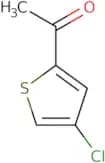
CAS :<p>1-(4-Chlorothiophen-2-yl)ethanone is an oxychloride that belongs to the family of thiourea derivatives. It is synthesized by reacting phosphorus oxychloride with 2,3-dichloroacetophenone in a solvent such as dioxane or acetonitrile. The final product is purified by means of vacuum distillation and recrystallization from diethyl ether, hexane, and chlorinated hydrocarbons.</p>Formule :C6H5ClOSDegré de pureté :Min. 95%Masse moléculaire :160.62 g/molBenzo[b]thiophene-2-carbonitrile
CAS :<p>Benzo[b]thiophene-2-carbonitrile is a naphthalene derivative with a catalytic backbones. It is a new synthetic method that provides the opportunity to access benzo[b]thiophene-2-carboxylic acid and 2,6-dibromo-benzo[b]thiophene in one step. This reaction has been found to be effective for the synthesis of various heterocycles, such as 3,4-dihydroquinoxaline, 2,6-dibromo-pyridine, and 6-(3'-chlorophenyl)-1H-[1']benzopyran. The optical properties of this compound have been investigated by UV/visible spectroscopy and shown to exhibit an intense blue color. Benzo[b]thiophene-2-carbonitrile can also act as an electron acceptor or donor in organic reactions with halogen substituents</p>Formule :C9H5NSDegré de pureté :Min. 95%Masse moléculaire :159.21 g/mol2-Thiophenecarboxaldehyde
CAS :<p>2-Thiophenecarboxaldehyde is a synthetic compound that has been shown to have in vitro antifungal activity. It has also been shown to inhibit the growth of bacteria and fungi, such as Candida albicans. The antimicrobial activity of 2-thiophenecarboxaldehyde has been demonstrated by in vitro studies using human serum, metal carbonyl complexes, and sodium salts. In addition, this compound inhibits the synthesis of proteins in animal cells infected with viruses or bacteria. It also has amoebicidal activity against Entamoeba histolytica and Leishmania donovani. This compound is used for the treatment of autoimmune diseases such as rheumatoid arthritis and multiple sclerosis.</p>Formule :C5H4OSDegré de pureté :Min. 95%Couleur et forme :Clear LiquidMasse moléculaire :112.15 g/mol2-Thiopheneethanol tosylate
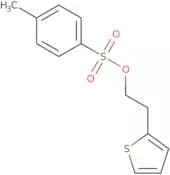
CAS :<p>2-Thiopheneethanol tosylate (2TEtOS) is an antitubercular agent that belongs to the class of thiopheneethanol esters. It is a potent inhibitor of Mycobacterium tuberculosis and other bacteria by blocking the transfer reactions that are required for bacterial growth. The molecular structure of 2TEtOS consists of a thiophene ring with an allyl group attached to it and a chiral sulfur atom in the center. This molecule can be derivatized with various ligands, which enables the control experiments to be performed. 2TEtOS has been shown to have redox potentials and diffraction properties that are similar to those of borohydride reduction agents, suggesting that 2TEtOS may also act as a reducing agent.</p>Formule :C13H14O3S2Degré de pureté :Min. 95%Masse moléculaire :282.38 g/mol3,7-Diamino-2,8-dimethyldibenzothiophene sulfone, contains 2,6-Dimethyl isomer
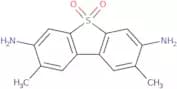
CAS :<p>3,7-Diamino-2,8-dimethyldibenzothiophene sulfone (contains 2,6-Dimethyl isomer) is a hydrophilic aromatic hydrocarbon that is used in the production of polymers. It is a copolymerization agent and monomer for epoxy resins and vulcanizates. The product contains impurities such as benzene and sulfur.</p>Formule :C14H14N2O2SDegré de pureté :Min. 95%Couleur et forme :Slightly Yellow PowderMasse moléculaire :274.34 g/mol4-Bromobenzo[b]thiophene
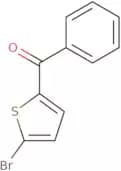
CAS :<p>Intermediate in the synthesis of brexpiprazole</p>Formule :C8H5BrSDegré de pureté :Min. 95%Masse moléculaire :213.1 g/mol2-Bromo-5-benzoylthiophene
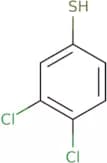
CAS :<p>2-Bromo-5-benzoylthiophene is a brominated hydrophobic compound. It has a catalytic activity and can be used as an antibacterial agent. The 9-oxime of 2-bromo-5-benzoylthiophene is more active than the free drug and is capable of inhibiting the growth of bacteria in vitro. This oxime also has a higher affinity for DNA gyrase and topoisomerase IV than other drugs in this class, which may be due to its hydrophobic nature or bromine substitution. Molecular modeling studies have shown that the chlorine atom in the 9-oxime plays an important role in stabilizing the complex formed with DNA gyrase or topoisomerase IV, which could explain its high activity against these enzymes.</p>Formule :C11H7BrOSDegré de pureté :Min. 95%Masse moléculaire :267.14 g/mol3,4-Dichlorothiophenol
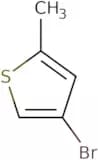
CAS :<p>3,4-Dichlorothiophenol is a chemical compound that belongs to the group of reactive compounds. It can be used as a chemical intermediate for the synthesis of other organic compounds. 3,4-Dichlorothiophenol is an inhibitor of methylating enzymes such as glyoxalase I and II and glyceraldehyde-3-phosphate dehydrogenase. This inhibition leads to the accumulation of methylglyoxal and 3-deoxyglucosone in cells, which are potent inhibitors of protein glycosylation. 3,4-Dichlorothiophenol also inhibits nucleophilic attack on DNA by epoxide hydrolases such as epoxide hydrolase 1 and 2. This inhibition results in the accumulation of reactive metabolites that are covalently adducted with DNA bases.</p>Formule :C6H4Cl2SDegré de pureté :Min. 95%Masse moléculaire :179.07 g/mol4-Bromo-2-methylthiophene
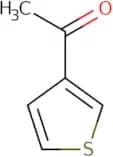
CAS :<p>4-Bromo-2-methylthiophene is a linker that is used in the synthesis of metal carbonyls. It has been shown to be an efficient cross-linking agent for the preparation of polymers. 4-Bromo-2-methylthiophene can be isomerized to 2,5-dimethylthiophene by heating it with hydroxylamine. 4-Bromo-2-methylthiophene can also catalyze the alkylation of nucleophiles such as ammonia and dimethyl sulfate, as well as nucleophilic attack on carboxylic acid derivatives. This compound is acidic, due to its chloride substituent, which can react with basic groups such as hydroxyl groups or amines.</p>Formule :C5H5BrSDegré de pureté :Min. 95%Couleur et forme :Clear LiquidMasse moléculaire :177.06 g/mol3-Acetylthiophene
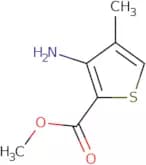
CAS :<p>3-Acetylthiophene is an organic compound with the chemical formula CH3C6H2S. It is a white solid that is soluble in water and alcohols, but not in ethers or chloroform. 3-Acetylthiophene has been shown to inhibit cell growth through competitive inhibition of the cationic surfactant cetrimide, which blocks the formation of micelles and destabilizes the cell membrane. This process causes DNA oxidation and leads to the production of reactive oxygen species such as hydrogen peroxide. 3-Acetylthiophene also inhibits metal ion-catalyzed reactions by competing with them for binding sites on functional groups.</p>Degré de pureté :Min. 95%Masse moléculaire :126.18 g/mol3-Amino-4-methyl-thiophen-2-carboxylic acid methyl ester
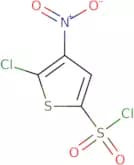
CAS :<p>3-Amino-4-methylthiophen-2-carboxylic acid methyl ester (3AMTC) is a novel compound that has been shown to have antihypertensive activity, as well as other pharmacological actions. 3AMTC is an allosteric modulator of α7 nicotinic acetylcholine receptors, which are found in the central and peripheral nervous system. The efficacy of 3AMTC was evaluated using magnetic resonance spectroscopy to measure the effects on mouse tumor cells. This compound showed no carcinogenic potential, which may be due to its inability to cross the blood brain barrier.</p>Degré de pureté :Min. 95%Masse moléculaire :171.22 g/mol5-Chloro-4-nitrothiophene-2-sulfonylchloride
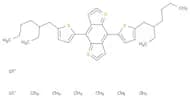
CAS :<p>Please enquire for more information about 5-Chloro-4-nitrothiophene-2-sulfonylchloride including the price, delivery time and more detailed product information at the technical inquiry form on this page</p>Formule :C4HCl2NO4S2Degré de pureté :Min. 95%Masse moléculaire :262.09 g/mol2,6-Bis(triMethyltin)-4,8-bis(5-(2-ethylhexyl)thiophen-2-yl)benzo [1,2-b
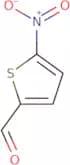
CAS :Formule :C40H58S4Sn2Degré de pureté :96%Couleur et forme :SolidMasse moléculaire :904.55055-Nitrothiophene-2-carboxaldehyde
CAS :<p>5-Nitrothiophene-2-carboxaldehyde (5NT) is a chemical compound that belongs to the class of dihedral molecules. It is commonly used as an antimicrobial agent and has been shown to have amoebicidal activity in tissue culture. 5NT also inhibits cell growth and proliferation in certain bacteria, such as Staphylococcus aureus strains, by interfering with DNA replication and protein synthesis. Although 5NT is not active against other types of bacteria, it has been shown to be effective against MRSA in laboratory studies. The biological properties of 5NT are still being studied.</p>Formule :C5H3NO3SDegré de pureté :Min. 95%Masse moléculaire :157.15 g/mol


![2-(4-Fluorophenyl)-5-[(5-iodo-2-methylphenyl)methyl]thiophene](/_next/image/?url=https%3A%2Fstatic.cymitquimica.com%2Fproducts%2F3D%2Fthumb-webp%2FFF34928.webp&w=3840&q=75)

![Benzo[b]thiophene-2-carbonitrile](/_next/image/?url=https%3A%2Fstatic.cymitquimica.com%2Fproducts%2F3D%2Fthumb-webp%2FFB143739.webp&w=3840&q=75)

![4-Bromobenzo[b]thiophene](/_next/image/?url=https%3A%2Fstatic.cymitquimica.com%2Fproducts%2F3D%2Fthumb-webp%2FFB57657.webp&w=3840&q=75)