Glycosciences
La glycosciences est l'étude des glucides et de leurs dérivés, ainsi que des interactions et des fonctions biologiques auxquelles ils participent. Ce domaine de recherche est crucial pour comprendre une grande variété de processus biologiques, y compris la reconnaissance cellulaire, la signalisation, la réponse immunitaire et le développement des maladies. La glycosciences a des applications importantes en biotechnologie, en médecine et dans le développement de nouveaux médicaments et thérapies. Chez CymitQuimica, nous proposons une large sélection de produits de haute qualité et pureté pour la recherche en glycosciences. Notre catalogue comprend des monosaccharides, des oligosaccharides, des polysaccharides, des glyconjugués et des réactifs spécifiques, conçus pour soutenir les chercheurs dans leurs études sur la structure, la fonction et les applications des glucides dans les systèmes biologiques. Ces ressources sont destinées à faciliter les découvertes scientifiques et les applications pratiques dans divers domaines des biosciences et de la médecine.
Sous-catégories appartenant à la catégorie "Glycosciences"
- Aminosucres(108 produits)
- Anticorps Glyco-Related(282 produits)
- Glycolipides(46 produits)
- Glycosaminoglycanes (GAGs)(55 produits)
- Glycosides(419 produits)
- Monosaccharides(6.624 produits)
- Oligosaccharides(3.682 produits)
- Polysaccharides(503 produits)
11046 produits trouvés pour "Glycosciences"
Trier par
Degré de pureté (%)
0
100
|
0
|
50
|
90
|
95
|
100
1,5-α-L-Arabinopentaose
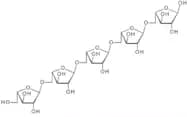
CAS :<p>1,5-α-L-Arabinopentaose is a sugar that is found in plants. It inhibits the growth of bacteria by sequencing and binding to the enzyme L-arabinose isomerase, which converts L-arabinose to D-xylulose. 1,5-α-L-Arabinopentaose has been shown to have inhibitory effects on the metabolism of sugars in plants. This sugar binds tightly to immobilized enzymes and can be used for immobilization processes.</p>Formule :C25H42O21Degré de pureté :Min. 95%Couleur et forme :Clear LiquidMasse moléculaire :678.59 g/mol1,2-O-Isopropylidene-b-L-apiose
CAS :<p>1,2-O-Isopropylidene-b-L-apiose is a carbohydrate with the molecular formula C8H10O4. It is a monosaccharide that is derived from D-mannose by methylation and glycosylation. 1,2-O-Isopropylidene-b-L-apiose has been synthetically modified to improve its properties. The chemical structure of this compound has been modified by fluorination, saccharide modification and glycosylation to increase its solubility in water.</p>Formule :C8H14O5Degré de pureté :Min. 95%Masse moléculaire :190.19 g/mol3-Deoxy-1,2:5,6-di-O-isopropylidene-a-D-glucofuranose
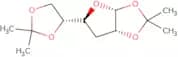
CAS :<p>3-Deoxy-1,2:5,6-di-O-isopropylidene-a-D-glucofuranose is an oligosaccharide that belongs to the group of polysaccharides. It is a methylated saccharide with a high degree of purity and can be custom synthesized for use as a carbohydrate in pharmaceuticals. 3-Deoxy-1,2:5,6-di-O-isopropylidene-a-D-glucofuranose is used in the synthesis of glycosylations and has been shown to have antiviral activity against Epstein Barr virus by inhibiting viral protein synthesis.</p>Formule :C12H20O5Degré de pureté :Min. 95%Masse moléculaire :244.29 g/molMethyl 2,3-di-O-benzyl-6-deoxy-a-D-glucopyranoside
CAS :<p>Methyl 2,3-di-O-benzyl-6-deoxy-a-D-glucopyranoside is a fluorinated monosaccharide that is synthesized by the glycosylation and polysaccharide modification of methyl 2,3-di-O-benzylglycosides. The fluorination process can be carried out on a variety of saccharides, including erythrose, threose, arabinose, and glucose. This product has been shown to have high purity and is suitable for use in research applications.</p>Formule :C21H26O5Degré de pureté :Min. 95%Masse moléculaire :358.18 g/mol3-Fucosyllactose-BSA
<p>3-Fucosyllactose is a high purity synthetic sugar that is custom synthesized to order. It has a click modification, fluorination and glycosylation. 3-Fucosyllactose is a monosaccharide with CAS No. 160159-69-2. 3-Fucosyllactose has the ability to be modified for glycoengineering and glycobiology studies. It can be used in the synthesis of complex carbohydrates, such as oligosaccharides and monosaccharides.</p>Degré de pureté :Min. 95%16a-Hydroxyestrone 16-b-D-glucuronide
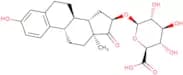
CAS :<p>16a-Hydroxyestrone 16-b-D-glucuronide is a conjugate of the hydroxyestrone and glucuronic acid. It is a metabolite of estradiol, which is the most potent estrogen produced by the human body. The compound has been found in urine, saliva, and breast milk. 16a-Hydroxyestrone 16-b-D-glucuronide is an inactive steroid that can be conjugated with glucuronic acid to form a water soluble molecule that can be excreted in the urine or bile.</p>Formule :C24H30O9Degré de pureté :Min. 95%Masse moléculaire :462.49 g/mol2,4-Di-O-acetyl-1,6-anhydro-3-O-benzyl-b-L-idopyranose
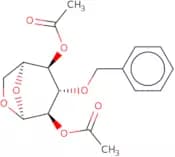
CAS :2,4-Di-O-acetyl-1,6-anhydro-3-O-benzyl-b-L-idopyranose is a synthetic carbohydrate that has been modified with a click reaction. The compound can be used as a building block for the synthesis of complex carbohydrates and oligosaccharides. It is also used in the production of high purity monosaccharides and glycosylates. 2,4-Di-O-acetyl-1,6-anhydro-3-O-benzylidopyranose is soluble in water and exhibits a melting point of ~170°C. It has an n D 25 value of 1.5381 at 20°C.Formule :C17H20O7Degré de pureté :Min. 95%Masse moléculaire :336.34 g/mol4-Chlorophenyl 2-acetamido-2-deoxy-b-D-glucopyranoside
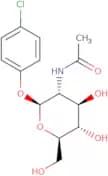
CAS :<p>4-Chlorophenyl 2-acetamido-2-deoxy-b-D-glucopyranoside is a molecule that belongs to the class of acid molecules and has been implicated in the metabolism of corynebacterium. The metabolic pathway for this molecule has been studied using databases and datasets, with population simulations and profile data being generated to help identify potential strategies for its positioning in the market. This molecule is also related to death, which may be related to its positioning.</p>Formule :C14H18ClNO6Degré de pureté :Min. 95%Masse moléculaire :331.75 g/molPentaerythritol dibromide b-D-glucuronide
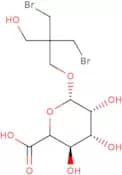
CAS :Pentaerythritol dibromide b-D-glucuronide is a high purity, custom synthesis, oligosaccharide with many potential applications. It is a complex carbohydrate that can be used for glycosylation and polysaccharide modifications. The fluorination of this compound allows for the synthesis of a wide variety of sugars including: monosaccharides, disaccharides, and polysaccharides. This product is available in powder form and has been shown to have excellent solubility in water.Formule :C11H18Br2O8Degré de pureté :Min. 95%Masse moléculaire :438.06 g/molG-NGA2F N-Glycan
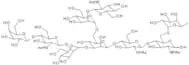
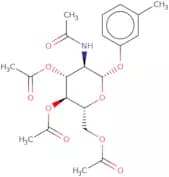
CAS :<p>G-NGA2F N-Glycan is a methylated, saccharide containing oligosaccharide. It is a custom-synthesized, high purity carbohydrate and sugar that can be modified with fluorination. G-NGA2F N-Glycan has been shown to have complex carbohydrate properties with a CAS No. of 84825-26-3.</p>Formule :C62H104N4O46Degré de pureté :Min. 95%Couleur et forme :SolidMasse moléculaire :1,641.49 g/mol3-Methylphenyl 2-acetamido-3,4,6-tri-O-acetyl-2-deoxy-b-D-glucopyranoside
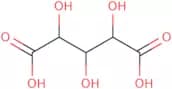
CAS :<p>3-Methylphenyl 2-acetamido-3,4,6-tri-O-acetyl-2-deoxy-b-D-glucopyranoside is a synthetic chemical compound. It has been shown to have antiviral activity and inhibit the growth of bacteria.</p>Formule :C21H27NO9Degré de pureté :Min. 95%Masse moléculaire :437.44 g/molPentaric acid
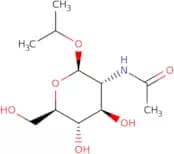
CAS :<p>Pentaric acid is a crystalline, monocarboxylic acid with a hydroxyl group. It is used as an inhibitor of corrosion in metal and as a disinfectant. Pentaric acid can be found in urine samples and has been shown to be an effective inhibitor of the enzymatic reaction that produces azobenzene, which is associated with the development of bladder cancer. This compound also inhibits the growth of bacteria. Pentaric acid is used as an additive in some detergents and soaps because it can inhibit the growth of bacteria on surfaces. <br>Pentaric acid was first synthesized by German chemist Otto Wohlert in 1834. Hydrogen ions are released when pentaric acid dissolves in water, lowering the pH level and causing corrosion to metal surfaces. The corrosion inhibition properties of pentaric acid have been known since its discovery, but its anti-bacterial properties were not discovered until recently when researchers found that pentar</p>Formule :C5H8O7Degré de pureté :Min. 95%Masse moléculaire :180.11 g/molIsopropyl 2-acetamido-2-deoxy-b-D-glucopyranoside
CAS :<p>Isopropyl 2-acetamido-2-deoxy-b-D-glucopyranoside is a chromatographic agent used in liquid chromatography. It is a reaction product of polysaccharides and fatty acids, which are extracted from fruits. Isopropyl 2-acetamido-2-deoxy-b-D-glucopyranoside has been shown to inhibit the growth of typhimurium and other viruses in cell culture. The safety profile of this compound has not been established in humans and should be tested before use in vivo.</p>Formule :C11H21NO6Degré de pureté :Min. 95%Masse moléculaire :263.29 g/molMethyl L-rhamnopyranoside
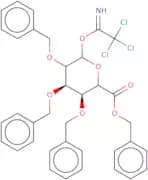
CAS :<p>Methyl L-rhamnopyranoside is a sugar that is the product of the reaction between l-rhamnose and acetone. This compound has been used as a chiral building block for the synthesis of other sugars, such as D-arabinose and D-lyxose. The yield of this reaction depends on the concentration of potassium thioacetate and temperature. This compound can be obtained in two forms: (1) anomeric form, which is an intermediate in the synthesis of carbohydrates and (2) crystalline form, which is a white solid with melting point at 157.3°C. The anomeric form has a stereogenic center at carbon atom 3, whereas the crystalline form does not have any stereogenic centers. Methyl L-rhamnopyranoside also reacts with chlorination reagents to produce chlorinated derivatives, such as 2-chloro-3-(3′,4′-dimeth</p>Formule :C7H14O5Degré de pureté :Min. 95%Couleur et forme :PowderMasse moléculaire :178.18 g/mol2,3,4-Tri-O-benzyl-D-glucuronide benzyl ester trichloroacetimidate
The compound is a custom synthesis and modification of a complex carbohydrate. It has been synthesized by glycosylation, methylation, and click chemistry. The compound can be used as a building block for the synthesis of saccharides. It is also useful in the synthesis of polysaccharides, which are polymers consisting of long chains of sugars. The compound is a highly pure and fluorinated sugar that can be used in research as a standard or control.Formule :C36H34Cl3NO7Degré de pureté :Min. 95%Masse moléculaire :699.02 g/mol1,2,3,4,5,6-Hexa-O-acetyl-L-iditol
CAS :<p>1,2,3,4,5,6-Hexa-O-acetyl-L-iditol is a synthetic compound that is used as a reagent in the synthesis of oligosaccharides and polysaccharides. It is also used to modify the saccharide chains of complex carbohydrates. 1,2,3,4,5,6-Hexa-O-acetyl-L-iditol has been shown to react with both DNA and RNA. The methylation reaction can be achieved by treatment with formaldehyde or sodium cyanoborohydride. This compound has been modified by fluorination to create monosaccharides such as fluorohexitol and fluoroarabitol.</p>Formule :C18H26O12Degré de pureté :Min. 95%Masse moléculaire :434.4 g/molAllyl 3-O-benzyl-a-L-rhamnopyranoside
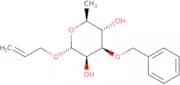
CAS :<p>Allyl 3-O-benzyl-a-L-rhamnopyranoside is an oligosaccharide that is a modification of the disaccharide, allyl 3-O-benzyl-a-D-galactopyranoside. Allyl 3-O-benzyl-a-L-rhamnopyranoside has been synthesized from D-(+)-glucose and L-(+)-rhamnose. The compound has a molecular weight of 756.40 g/mol. It is a white to off white powder that is soluble in water, but insoluble in ethanol at low concentrations. It can be used as a carbohydrate or sugar for research purposes.</p>Formule :C16H22O5Degré de pureté :Min. 95%Masse moléculaire :294.35 g/molMethyl 2-O-allyl-3,4-di-O-benzyl-a-D-mannopyranoside
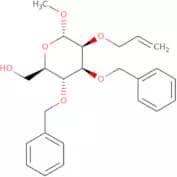
CAS :<p>Methyl 2-O-allyl-3,4-di-O-benzyl-a-D-mannopyranoside is an organic compound that belongs to the group of Modification. It is a modified oligosaccharide with a molecular weight of 690.3 g/mol. The modification is an Oligosaccharide, Carbohydrate, complex carbohydrate, Custom synthesis, Synthetic. CAS No. 210297-56-6, High purity, Monosaccharide, Methylation, Glycosylation and Polysaccharide. This molecule has a monosaccharide with the chemical formula C5H11NO5 and a molecular weight of 131.2 g/mol. The fluorination and saccharides are Fluorination and saccharides respectively.</p>Formule :C24H30O6Degré de pureté :Min. 95%Masse moléculaire :414.49 g/mol2-(4-Methoxybenzyl)phenyl6-O-(ethoxycarbonyl)-β-D-glucopyranoside
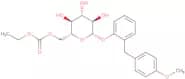
CAS :Canagliflozin is a type of antidiabetic agent that is used to treat patients with type 2 diabetes. This drug works by decreasing the reabsorption of glucose in the kidneys, which increases the excretion of glucose, and thus reduces blood sugar levels. Canagliflozin also lowers blood pressure and has been shown to reduce cholesterol levels. It is an inhibitor of SGLT-1, a transporter protein in the kidney that is responsible for renal glucose reabsorption. The use of canagliflozin has been studied in animal models, where it was found to significantly increase glomerular filtration rate (GFR) and decrease blood pressure. It is recommended that canagliflozin be taken together with other anti-diabetic medications, such as insulin or metformin, due to its potential side effects on GFR and blood pressure.Formule :C23H28O9Degré de pureté :Min. 95%Masse moléculaire :448.46 g/molFenofibryl b-D-glucuronide
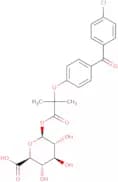
CAS :Fenofibryl b-D-glucuronide is a potential anticancer drug that has been shown to inhibit growth and induce apoptosis in human liver cancer cells. Fenofibryl b-D-glucuronide is also known to have the ability to react with covalent adducts, which may be due to its reactive nature. It is not currently known how this compound interacts with other drugs or how it affects body mass index in humans.Formule :C23H23ClO10Degré de pureté :Min. 95%Masse moléculaire :494.88 g/mol