Glycosciences
La glycosciences est l'étude des glucides et de leurs dérivés, ainsi que des interactions et des fonctions biologiques auxquelles ils participent. Ce domaine de recherche est crucial pour comprendre une grande variété de processus biologiques, y compris la reconnaissance cellulaire, la signalisation, la réponse immunitaire et le développement des maladies. La glycosciences a des applications importantes en biotechnologie, en médecine et dans le développement de nouveaux médicaments et thérapies. Chez CymitQuimica, nous proposons une large sélection de produits de haute qualité et pureté pour la recherche en glycosciences. Notre catalogue comprend des monosaccharides, des oligosaccharides, des polysaccharides, des glyconjugués et des réactifs spécifiques, conçus pour soutenir les chercheurs dans leurs études sur la structure, la fonction et les applications des glucides dans les systèmes biologiques. Ces ressources sont destinées à faciliter les découvertes scientifiques et les applications pratiques dans divers domaines des biosciences et de la médecine.
Sous-catégories appartenant à la catégorie "Glycosciences"
- Aminosucres(108 produits)
- Anticorps Glyco-Related(282 produits)
- Glycolipides(46 produits)
- Glycosaminoglycanes (GAGs)(55 produits)
- Glycosides(419 produits)
- Monosaccharides(6.624 produits)
- Oligosaccharides(3.682 produits)
- Polysaccharides(503 produits)
11046 produits trouvés pour "Glycosciences"
Trier par
Degré de pureté (%)
0
100
|
0
|
50
|
90
|
95
|
100
4-O-(2-O-Methyl-b-D-galactopyranosyl)-D-glucopyranose
CAS :4-O-(2-O-Methyl-b-D-galactopyranosyl)-D-glucopyranose is a disaccharide. The lacto-n-biose unit is a nonreducing sugar that contains an alpha, beta unsaturated 1,6 glycosidic bond and a lactose molecule. 4-O-(2-O-Methyl-b-D-galactopyranosyl)-D-glucopyranose has been found to stimulate the synthesis of galectin in vitro, which may be due to its ability to bind to lectins. This disaccharide can also cause denaturation at high temperatures.Formule :C13H24O11Degré de pureté :Min. 95%Masse moléculaire :356.32 g/mol1,2,3-Tri-O-acetyl-4,6-O-benzylidene-b-D-glucopyranose
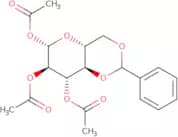
CAS :This is a glycosylation product of 1,2,3-Tri-O-acetyl-4,6-O-benzylidene-b-D-glucopyranose with methyl and acetate groups. It is a synthetic oligosaccharide that has been fluorinated at the 4' position to provide protection from degradation. This product is custom synthesized for customers. It contains saccharides that are related to polysaccharides and complex carbohydrates. The compound is of high purity and does not contain any impurities. Click modification of the glucose moiety provides protection against enzymatic degradation by enzymes such as aminoglycoside N′ acetyltransferase.Formule :C19H22O9Degré de pureté :Min. 95%Masse moléculaire :394.37 g/molGlycerone phosphate hemimagnesium salt hydrate
CAS :<p>Glycerone phosphate hemimagnesium salt hydrate is a substrate molecule that is used in the control analysis of dihydroxyacetone phosphate. Glycerone phosphate hemimagnesium salt hydrate is an optimum concentration for 3T3-L1 preadipocytes and has been shown to have an effect on energy metabolism. Glycerone phosphate hemimagnesium salt hydrate also has enzymatic activity, which can lead to neuronal death or skin cancer. This compound is a monosodium salt that can be found in cytosolic calcium, which is present in cells and helps regulate muscle contraction. Glycerone phosphate hemimagnesium salt hydrate can also be found in basic proteins that are vital for cell function.</p>Formule :C3H5O6P·xH2OMgDegré de pureté :Min. 95 Area-%Couleur et forme :PowderMasse moléculaire :180.19 g/molCarboxymethyl cellulose sodium - Viscosity 300-600 mPa·s
CAS :Food additive; soil suspension polymer in detergents; thickening agentDegré de pureté :Min. 95%2-Amino-2-deoxy-D-idose
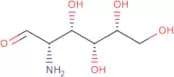
CAS :<p>2-Amino-2-deoxy-D-idose is a sugar that is found in the cell walls of bacteria. It has been shown to be an inhibitor of the enzymes that catalyze the acetylation and methylenecyclopropanes reactions, which are necessary for bacterial growth. 2-Amino-2-deoxy-D-idose binds to copper ions, preventing them from binding with the enzymes. This drug also chelates metals such as zinc, iron, and manganese to prevent their use by bacteria.</p>Formule :C6H13NO5Degré de pureté :Min. 95%Masse moléculaire :179.17 g/mol4-Chlorophenyl 2-acetamido-3,4,6-tri-O-acetyl-2-deoxy-b-D-glucopyranoside
CAS :<p>4-Chlorophenyl 2-acetamido-3,4,6-tri-O-acetyl-2-deoxy-β-D-glucopyranoside is a molecule that has been synthesized using the techniques of nucleic acid molecules. The fluorescence technique is used to measure the amount of this molecule in a sample. This molecule is used as a substrate for DNA and RNA synthesis and can be used to monitor enzyme activity in corynebacterium glutamicum. This compound can be expressed by transferring it into an expression vector and monitoring its progress with a light source at different temperatures.</p>Formule :C20H24ClNO9Degré de pureté :Min. 95%Masse moléculaire :457.86 g/molMethyl α-D-mannopyranoside 2,3,4,6-tetrasulfate potassium
CAS :<p>Methyl a-D-mannopyranoside 2,3,4,6-tetrasulfate potassium salt is a synthetic carbohydrate that is used in the synthesis of saccharides or glycosides. This compound is also used as an intermediate for the modification of saccharides and oligosaccharides. Methyl a-D-mannopyranoside 2,3,4,6-tetrasulfate potassium salt can be fluorinated to yield Methyl a-D-mannopyranoside 2,3,4,6,-pentafluorobenzoate potassium salt.</p>Formule :C7H14O18S4•K4Degré de pureté :Min. 95%Masse moléculaire :670.83 g/molMethyl 3,4-O-isopropylidene-D-lyxonate
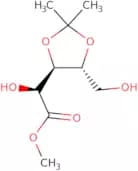
CAS :<p>Methyl 3,4-O-isopropylidene-D-lyxonate is a glycosylation product of L-xylose. It has been used in click chemistry as a fluorinated building block for the synthesis of polysaccharides and saccharides. Methyl 3,4-O-isopropylidene-D-lyxonate can be custom synthesized to any desired purity.</p>Formule :C9H16O6Degré de pureté :Min. 95%Masse moléculaire :220.22 g/mol1,2,3-Tri-O-acetyl-4,6-O-(4-methoxybenzylidene)-b-D-galactopyranose
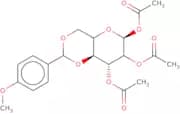
<p>1,2,3-Tri-O-acetyl-4,6-O-(4-methoxybenzylidene)-b-D-galactopyranose is a methylated sugar. It is also known as 4,6-O-(4-methoxybenzylidene)-beta-D-galactopyranoside. The chemical formula of this compound is C23H34O13 and it has a molecular weight of 432.5 g/mol. This product is soluble in water and insoluble in ethanol. The CAS number for 1,2,3-Tri-O-acetyl-4,6--O-(4--methoxybenzylidene)-b--D--galactopyranose is 587991–44–5.</p>Formule :C20H24O10Degré de pureté :Min. 95%Masse moléculaire :424.4 g/mol6-O-Benzoyl-3-O-triisopropylsilyl-D-galactal
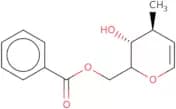
<p>This is a synthetic sugar that can be custom synthesized based on the customer's specifications. 6-O-Benzoyl-3-O-triisopropylsilyl-D-galactal is a monosaccharide and an oligosaccharide that can be modified with a click modification, methylation, and glycosylation. It is a complex carbohydrate that has been shown to have anti-inflammatory properties. The glycosylation of this sugar can also be customized for specific purposes. This product has CAS number 132702-24-2 and is available at 95% purity or higher.</p>Formule :C22H34O5SiDegré de pureté :Min. 95%Masse moléculaire :406.59 g/molEthyl 2,3,4,6-tetra-O-benzyl-b-D-galactopyranoside
<p>Ethyl 2,3,4,6-tetra-O-benzyl-b-D-galactopyranoside is a custom synthesis. It is a modification of the natural product 6-fluoro-3-indoxyl beta-D-galactopyranoside. The fluorine atoms on the sugar ring are substituted with methyl groups. This modification increases the stability of the molecule against hydrolysis by esterases and glutathione reductase. This compound has not been evaluated for safety or efficacy in humans.</p>Degré de pureté :Min. 95%2,3,4-Tri-O-acetyl-β-D-xylopyranosyl azide
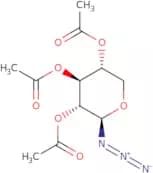
CAS :<p>2,3,4-Tri-O-acetyl-b-D-xylopyranosyl azide is a compound that has a linear range of 10 to 500 μM. It has been shown to inhibit the growth of bacteria such as C. perfringens and S. aureus. This compound inhibits the production of toxins in these bacteria by binding to the ribosomes and inhibiting protein synthesis. In addition, this compound has been shown to have high activity at salinity levels up to 15% NaCl and diffraction data was obtained from 2,3,4-tri-O-acetyl-b-D-xylopyranosyl azide crystals using XRD in order to quantify its molecular structure.</p>Formule :C11H15N3O7Degré de pureté :Min. 98 Area-%Couleur et forme :PowderMasse moléculaire :301.25 g/molEthyl 3-O-allyl-2-O-benzyl-4,6-O-benzylidene-b-D-thiogalactopyranoside
<p>Ethyl 3-O-allyl-2-O-benzyl-4,6-O-benzylidene-b-D-thiogalactopyranoside is a custom synthesized product that is used for the modification of saccharides. It is a white crystalline powder with a melting point of about 180°C. The CAS number for this product is [1]. Ethyl 3-O-allyl-2-O-benzyl-4,6 - O -benzylidene - b - D - thiogalactopyranoside reacts with glycosyl halides to form glycosides and methyl iodide to form methyl glycosides. This product also can be used in click chemistry reactions.<br>Methylation of the sugar moiety can be performed on this product too. It has high purity and fluorescence properties that may be useful in fluorescent labeling experiments.</p>Degré de pureté :Min. 95%4,7,8,9-Tetra-O-acetyl-N-acetyl-2-deoxy-2-fluoro-b-D-neuraminic acid allyl ester
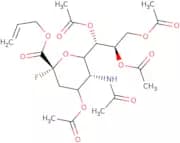
CAS :<p>4,7,8,9-Tetra-O-acetyl-N-acetyl-2-deoxy-2-fluoro-b-D-neuraminic acid allyl ester is a custom synthesized chemical that has been modified with fluorination and methylation. This product is an oligosaccharide, saccharide, and polysaccharide. The product also has a high purity.</p>Formule :C22H30FNO12Degré de pureté :Min. 95%Masse moléculaire :519.47 g/mol2-Cyclohexylethyl-4-O-(a-D-glucopyranosyl)-b-D-glucopyranoside
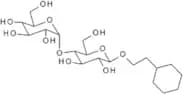
CAS :<p>Oroxylum indicum is a plant that belongs to the family Bignoniaceae. It has been used in traditional medicine for the treatment of cancer and has been shown to possess anti-inflammatory properties. The sequenced genome of Oroxylum indicum has provided a model system for understanding the molecular mechanisms underlying tumorigenesis. This plant contains a number of monoclonal antibodies, including one that is active against mouse monoclonal antibodies and inhibits tumor xenografts. The extract of this plant also inhibits influenza virus and polymerase chain reactions, which are important steps in protein synthesis. Oroxylum indicum may have therapeutic potential as an anti-cancer drug because it can inhibit solid tumours by interfering with protein synthesis.</p>Formule :C20H36O11Degré de pureté :Min. 95%Couleur et forme :PowderMasse moléculaire :452.49 g/molParomamine trihydrochloride
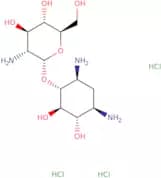
CAS :<p>Paromamine trihydrochloride is a Custom synthesis, Modification, Fluorination, Methylation, Monosaccharide, Synthetic, Click modification of the chemical compound. Paromamine trihydrochloride is an Oligosaccharide and saccharide that has been Glycosylated. The Carbohydrate complex is made up of a number of sugar units that are linked together to form a polysaccharide. This Polysaccharide can be found in many plants and animals.</p>Formule :C12H25N3O7•(HCl)3Degré de pureté :Min. 95%Couleur et forme :PowderMasse moléculaire :432.72 g/molLactose-sp-biotin
<p>Lactose-sp-biotin is a complex carbohydrate that has been modified with biotin. It is synthesized by the click modification of lactose and spacer arm, followed by glycosylation with biotin. Lactose-sp-biotin is soluble in water, which makes it suitable for use as a food additive. This product can also be used for labeling and identification of biomolecules in various fields such as fluorescence, immunoassay, or immunohistochemistry.</p>Formule :C31H54N4O14SDegré de pureté :Min. 95%Couleur et forme :PowderMasse moléculaire :738.85 g/molIsofagomine hydrochloride
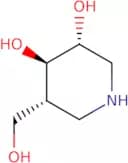
CAS :<p>Inhibitor of lysosomal acid β-glucosidase (GlcCerase/glucocerebrosidase) with IC50 in nanomolar range for wildtype and mutant enzyme. It behaves as pharmacological chaperon by binding to instable GlcCerase active site at neutral pH values and facilitating the protein folding. In acidic lysosomes, isofagomine gets release from the enzyme active site. This results in increased levels of functional glucocerebrosidase and brings therapeutic benefits to patients with Gaucher disease.</p>Formule :C6H13NO3·HClDegré de pureté :Min. 95%Couleur et forme :PowderMasse moléculaire :183.63 g/molm-Topolin-9-glucoside
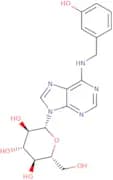
CAS :<p>M-topolin-9-glucoside is a synthetic sugar that has been modified by the introduction of fluorine atoms at C-2, C-3, and C-4. This sugar is used to study the interactions between carbohydrates and proteins. It is also used for the synthesis of oligosaccharides as well as for glycosylation and methylation reactions. M-topolin-9-glucoside is a monosaccharide that has been glycosylated and methylated. It can be used as a replacement for glucose in some reactions due to its stability and low cost.</p>Formule :C18H21N5O6Degré de pureté :Min. 95%Couleur et forme :PowderMasse moléculaire :403.39 g/mol6-(4-Azido-2-hydroxybenzamido)-6-deoxy-D-glucopyranose
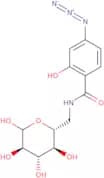
CAS :<p>6-(4-Azido-2-hydroxybenzamido)-6-deoxy-D-glucopyranose (AGB) is a potential photoaffinity label that can be used to identify and characterize the transporter. The photoaffinity label is synthesized by reacting 2,4-dinitrophenylhydrazine with 6-(4-azido-2-hydroxybenzamido)-6-deoxy-D-glucopyranose in the presence of sodium bicarbonate or potassium carbonate. The photolysis of AGB produces an azide radical cation that reacts with amino acid residues on the protein surface, forming a covalent bond. This labeling process is irreversible.</p>Formule :C13H16N4O7Degré de pureté :Min. 95%Masse moléculaire :340.29 g/mol