Antimicrobiens
Sous-catégories appartenant à la catégorie "Antimicrobiens"
- Antibiotiques(4.502 produits)
- Antifongiques(939 produits)
- Antiparasitaires(807 produits)
- Antiviraux(1.056 produits)
2643 produits trouvés pour "Antimicrobiens"
Lactoferrin
CAS :Lactoferrin is a multifunctional glycoprotein, which is primarily sourced from bovine milk, human milk, and other mammalian secretions. With its high affinity for iron, lactoferrin sequesters iron ions, which inhibits bacterial growth by depriving them of the iron necessary for proliferation. This mechanism enables lactoferrin to exhibit potent antimicrobial properties.Formule :C141H224N46O29S3Degré de pureté :Min. 95%Couleur et forme :PowderMasse moléculaire :3,123.8 g/molSulfadimethoxine sodium
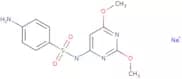
CAS :Sulfadimethoxine sodium is a sulfonamide antibiotic with action on bacterial folate synthesis inhibition and is used for treating respiratory and urinary tract infections in veterinary medicine.Formule :C12H13N4NaO4SDegré de pureté :Min. 95%Couleur et forme :White Off-White PowderMasse moléculaire :332.31 g/molDMDNA31
CAS :DMDNA31 is a synthetic nucleotide analog, which is a man-made compound designed to mimic the natural building blocks of DNA. It originates from advanced chemical synthesis processes, allowing precise control over its structure to mimic specific nucleotide sequences. DMDNA31 operates by integrating into DNA strands during replication, thereby enabling the study of genetic mutations and the mapping of genomic sequences.Formule :C50H62N4O13Degré de pureté :Min. 95%Masse moléculaire :927 g/molRetrocyclin-1 trifluoroacetate salt
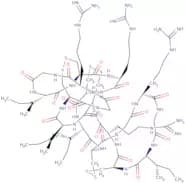
CAS :Retrocyclin-1 trifluoroacetate salt is a synthetic antimicrobial peptide, which is derived from humanized sequences based on the theta-defensin family, originally found in certain primates. Retrocyclin-1 is particularly notable for its circular structure which contributes to its stability and biological activity. The peptide is produced through a process of solid-phase peptide synthesis, designed to mimic the native cyclic conformation of natural theta-defensins.Formule :C74H128N30O18S6Degré de pureté :Min. 95%Masse moléculaire :1,918.4 g/molSancycline hydrochloride
CAS :Sancycline hydrochloride is a tetracycline antibiotic, which is derived from the natural fermentation process of Streptomyces bacteria. The mechanism of action involves the inhibition of protein synthesis by bindin directly to the 30S ribosomal subunit, thereby preventing the attachment of aminoacyl-tRNA to the A site of the ribosome. This action effectively halts the growth of bacteria by impeding protein production, making it bacteriostatic rather than bactericidal.Formule :C21H23ClN2O7Degré de pureté :Min. 95%Masse moléculaire :450.87 g/molMonensin
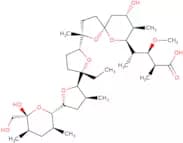
CAS :Monensin is a polyether ionophore antibiotic, which is derived from the fermentation of the bacterium *Streptomyces cinnamonensis*. It operates by disrupting ion transport across biological membranes, primarily by facilitating the exchange of sodium and potassium ions. This ionophore action alters the osmotic balance in target cells, leading to their destabilization and death, particularly in Gram-positive bacteria and certain protozoa.Formule :C36H62O11Degré de pureté :Min. 95%Masse moléculaire :670.87 g/molMaribavir
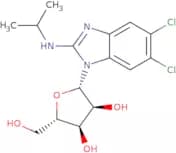
CAS :Potent antiviral against HCMV and Epstein-Barr virus (EBV)
Formule :C15H19Cl2N3O4Degré de pureté :Min. 95%Masse moléculaire :376.24 g/molFaropenem sodium hydrate
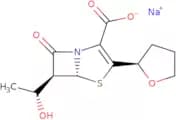
CAS :Faropenem sodium hydrate is a hydrated form of faropenem sodium with similar action and applications as faropenem sodium hemipentahydrate.Formule :C12H14NNaO5S·xH2ODegré de pureté :Min. 95%Couleur et forme :PowderMasse moléculaire :307.3 g/molAmpicillin-sulbactam
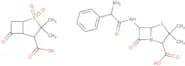
CAS :Ampicillin-sulbactam is a combination antibiotic, which is a pharmaceutical product derived from the penicillin class of beta-lactam antibiotics. Its source involves semi-synthetic processes, combining ampicillin with sulbactam. The mode of action of this compound is through the inhibition of bacterial cell wall synthesis. Ampicillin specifically binds to penicillin-binding proteins, thereby disrupting the cross-linking process essential for maintaining cell wall structural integrity, leading to bacterial lysis. Sulbactam functions as a beta-lactamase inhibitor, enhancing the efficacy of ampicillin by preventing its degradation by beta-lactamase enzymes produced by certain resistant bacterial strains.Formule :C25H31N3O9S2Degré de pureté :Min. 95%Masse moléculaire :581.7 g/molSapecin
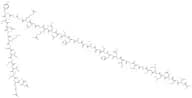
CAS :Sapecin is an antimicrobial peptide, which is derived from the hemolymph of the silk moth (Bombyx mori) with potent bactericidal action. The source of Sapecin is the immune system of the silk moth, where it acts as a natural defense mechanism against microbial infections. Its mode of action involves disrupting bacterial cell membranes, leading to cell lysis and death. The peptide achieves this by inserting itself into the lipid bilayer, creating pores that compromise the structural integrity of the membrane.Formule :C164H266N58O52S6Degré de pureté :Min. 95%Masse moléculaire :4,074.62 g/mol1-(6-Amino-3,5-difluoro-2-pyridinyl)-7-[3-[3-[[1-(6-amino-3,5-difluoro-2-pyridinyl)-3-carboxy-8-chloro-6-fluoro-1,4-dihydro-4-oxo-7- quinolinyl]amino]-2-hydroxypropoxy]-1-azetidinyl]-8-chloro-6-fluoro-1,4-dihydro-4-oxo-3-quinolinecarboxylic acid
CAS :1-(6-Amino-3,5-difluoro-2-pyridinyl)-7-[3-[3-[[1-(6-amino-3,5-difluoro-2-pyridinyl)-3-carboxy-8-chloro-6-fluoro-1,4-dihydro-4-oxo-7-quinolinyl]amino]-2-hydroxypropoxy]-1-azetidinyl]-8-chloro-6-fluoro-1,4-dihydro-4-oxo-3-quinolinecarboxylic acid is a fluoroquinolone antibiotic, engineered through synthetic chemistry. It is derived from chemical sources involving complex organic synthesis, highlighting its intricate molecular architecture. Its mode of action is distinctive, as it inhibits bacterial DNA gyrase and topoisomerase IV, enzymes crucial for DNA replication and transcription. This interference with bacterial DNA processes results in bactericidal effects, effectively eliminating susceptible bacterial strains.
Formule :C36H24Cl2F6N8O8Degré de pureté :Min. 95%Masse moléculaire :881.52 g/molKasugamycin
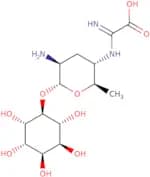
CAS :Kasugamycin is an aminoglycoside antibiotic, which is derived from the actinomycete Streptomyces kasugaensis. Its mode of action involves the inhibition of protein synthesis by interfering with the function of the 30S ribosomal subunit, ultimately preventing the growth and proliferation of sensitive organisms. In agricultural contexts, Kasugamycin is primarily utilized to control bacterial and fungal diseases in a variety of crops, including rice and fruit trees. It is particularly effective against Xanthomonas oryzae, which causes bacterial leaf blight in rice, and other pathogenic organisms detrimental to plant health. The application of Kasugamycin has been an important tool for integrated pest management programs focusing on sustainable agricultural practices. As a compound with a specific mode of activity, it helps to reduce the environmental impact typically associated with broader-spectrum antibiotics, while offering target-specific disease control. Its careful application supports the minimization of resistance development, ensuring continued efficacy in protecting crop yields.Formule :C14H25N3O9Degré de pureté :Min. 95%Masse moléculaire :379.36 g/molTenofovir alafenamide (free base)
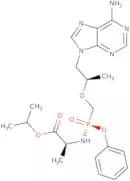
CAS :Tenofovir alafenamide (free base) is a prodrug of tenofovir with action on viral reverse transcriptase to block replication and is used for treating HIV/AIDS and chronic hepatitis B with improved safety profile.Formule :C21H29N6O5PDegré de pureté :Min. 97 Area-%Couleur et forme :PowderMasse moléculaire :476.47 g/molGramicidin S hydrochloride
CAS :Gramicidin S hydrochloride is a cyclic peptide antibiotic, which is a derivative of the naturally occurring antibiotic gramicidin S. It is sourced from Bacillus brevis, a type of soil bacterium. This peptide operates through a unique mode of action, whereby it disrupts bacterial cell membranes. By integrating into the lipid bilayer, it increases membrane permeability, leading to leakage of essential ions and molecules, and ultimately causing cell death.Formule :C60H92N12O10•(HCl)2Degré de pureté :90%MinMasse moléculaire :1,214.37 g/molFengycin
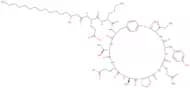
CAS :Fengycin is a cyclic lipopeptide from Bacillus subtilis acts as a biosurfactant and antifungal. As a fungicide, it has a mode of action that involves the formation of ion channels in the fungal lipid membrane, leading to membrane leakage This activity is negatively correlated to cholesterol levels, and may explain why mammalian cells, with higher cholesterol present, are not sensitive to fengycin.Formule :C72H110N12O20Degré de pureté :Min. 90 Area-%Couleur et forme :PowderMasse moléculaire :1,463.71 g/molOleandomycin
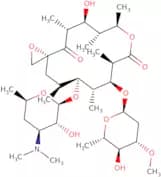
CAS :Oleandomycin is a macrolide antibiotic, which is derived from the bacterium *Streptomyces antibioticus*. This antibiotic functions by binding to the 50S subunit of the bacterial ribosome, thereby inhibiting protein synthesis. The interruption of this essential process ultimately leads to the cessation of bacterial growth and replication.
Formule :C35H61NO12Degré de pureté :Min. 95%Couleur et forme :White PowderMasse moléculaire :687.86 g/molCarumonam
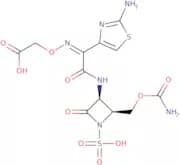
CAS :Carumonam is a synthetic monobactam antibiotic, which is derived from chemically modifying aztreonam to enhance its antimicrobial properties. Its source is entirely synthetic, allowing for precise structural modifications to target specific bacterial pathogens. The mode of action involves the inhibition of bacterial cell wall synthesis. Carumonam binds to penicillin-binding proteins (PBPs) on the surface of bacterial cell walls, disrupting the peptidoglycan cross-linking process necessary for cell wall strength and integrity. This action results in bacterial cell lysis and death, making it effective against a range of Gram-negative bacteria.Formule :C12H14N6O10S2Degré de pureté :Min. 95%Masse moléculaire :466.41 g/molGentamicin B
CAS :Gentamicin B is an aminoglycoside antibiotic, which is derived from the bacterium Micromonospora. This derivative exhibits its mode of action by binding to the 30S subunit of the bacterial ribosome, disrupting protein synthesis. As a result, it causes misreading of mRNA, ultimately leading to cell death, thereby exhibiting bactericidal effects.Formule :C19H38N4O10Degré de pureté :Min. 95%Masse moléculaire :482.5 g/molEconazole
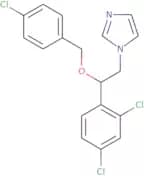
CAS :Econazole is an imidazole antifungal agent with action on fungal cell membrane disruption and is used for treating fungal skin infections like athlete's foot and ringworm.Formule :C18H15Cl3N2ODegré de pureté :Min. 98 Area-%Couleur et forme :White PowderMasse moléculaire :381.68 g/molPuberulic acid
CAS :Puberulic acid is a fungal metabolite that exhibits significant antimicrobial properties. It is derived from certain species of the Penicillium genus, a well-known source of various bioactive compounds. The mode of action of puberulic acid involves the disruption of microbial cell wall synthesis, leading to inhibited growth and eventual cell death of targeted microorganisms.Formule :C8H6O6Degré de pureté :Min. 95%Masse moléculaire :198.13 g/mol