Antimicrobiens
Sous-catégories appartenant à la catégorie "Antimicrobiens"
- Antibiotiques(4.502 produits)
- Antifongiques(939 produits)
- Antiparasitaires(807 produits)
- Antiviraux(1.056 produits)
2643 produits trouvés pour "Antimicrobiens"
Gramicidin S hydrochloride
CAS :Gramicidin S hydrochloride is a cyclic peptide antibiotic, which is a derivative of the naturally occurring antibiotic gramicidin S. It is sourced from Bacillus brevis, a type of soil bacterium. This peptide operates through a unique mode of action, whereby it disrupts bacterial cell membranes. By integrating into the lipid bilayer, it increases membrane permeability, leading to leakage of essential ions and molecules, and ultimately causing cell death.Formule :C60H92N12O10•(HCl)2Degré de pureté :90%MinMasse moléculaire :1,214.37 g/molPuberulic acid
CAS :Puberulic acid is a fungal metabolite that exhibits significant antimicrobial properties. It is derived from certain species of the Penicillium genus, a well-known source of various bioactive compounds. The mode of action of puberulic acid involves the disruption of microbial cell wall synthesis, leading to inhibited growth and eventual cell death of targeted microorganisms.Formule :C8H6O6Degré de pureté :Min. 95%Masse moléculaire :198.13 g/molOleandomycin
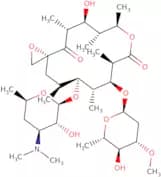
CAS :Oleandomycin is a macrolide antibiotic, which is derived from the bacterium *Streptomyces antibioticus*. This antibiotic functions by binding to the 50S subunit of the bacterial ribosome, thereby inhibiting protein synthesis. The interruption of this essential process ultimately leads to the cessation of bacterial growth and replication.
Formule :C35H61NO12Degré de pureté :Min. 95%Couleur et forme :White PowderMasse moléculaire :687.86 g/molFengycin
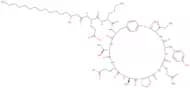
CAS :Fengycin is a cyclic lipopeptide from Bacillus subtilis acts as a biosurfactant and antifungal. As a fungicide, it has a mode of action that involves the formation of ion channels in the fungal lipid membrane, leading to membrane leakage This activity is negatively correlated to cholesterol levels, and may explain why mammalian cells, with higher cholesterol present, are not sensitive to fengycin.Formule :C72H110N12O20Degré de pureté :Min. 90 Area-%Couleur et forme :PowderMasse moléculaire :1,463.71 g/molQuinofumelin
CAS :Quinofumelin is a fungicide, which is synthetically derived with a novel mode of action targeting specific biochemical pathways in fungi. Its unique mechanism disrupts crucial cellular processes within pathogenic fungi, thereby halting their growth and spread. This fungicide has been meticulously developed through advanced chemical synthesis to ensure high efficacy and specificity against a broad spectrum of fungal pathogens affecting various crops.Formule :C20H16F2N2Degré de pureté :Min. 95%Masse moléculaire :322.4 g/molSebuthylazine-2-hydroxy
CAS :Sebuthylazine-2-hydroxy is a selective pre-emergent herbicide, which is a derivative of the sym-triazine compound family synthesized through chemical processes. It functions primarily as a soil-acting agent that inhibits photosynthesis by binding to the D1 protein in the photosystem II complex, thereby disrupting the electron transport chain. This biochemical action effectively curtails the growth of susceptible weed species by preventing their development, particularly annual grasses and broadleaf weeds.
Formule :C9H17N5ODegré de pureté :Min. 95%Masse moléculaire :211.26 g/mol(S)-HPMPA
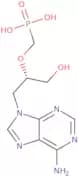
CAS :(S)-HPMPA is a nucleotide analogue, which is a chemically synthesized compound designed to mimic nucleotides. It acts as both an antiviral and an antitumor agent, sourced primarily through synthetic chemistry involving the modification of naturally occurring nucleotide structures. The mode of action of (S)-HPMPA involves mimicking natural substrates of various viral polymerases and cellular enzymes, thereby inhibiting viral DNA synthesis and disrupting the replication cycle of DNA viruses. Additionally, it can interfere with certain cellular pathways contributing to its antitumor effects.Formule :C9H14N5O5PDegré de pureté :Min. 95%Masse moléculaire :303.21 g/molAmicoumacin C
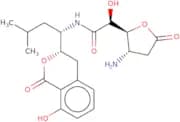
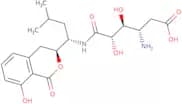
CAS :Amicoumacin C is a biological product derived from certain strains of the Bacillus species, specifically fermented by Bacillus subtilis. It is recognized as a potent antibiotic compound, noted for its ability to inhibit bacterial protein synthesis, primarily by interacting with the 30S ribosomal subunit, thereby hindering the translation process.Formule :C20H26N2O7Degré de pureté :Min. 95%Masse moléculaire :406.43 g/molTigecycline Impurity 8
Tigecycline Impurity 8 is a chemical impurity associated with Tigecycline, which is a glycylcycline antibiotic. This impurity is typically synthesized or isolated as a part of pharmaceutical development and quality control processes. Its source is inherently linked to the chemical synthesis of Tigecycline, where it may arise as a byproduct or degradation product.Formule :C29H37N5O8Degré de pureté :Min. 95%Masse moléculaire :583.65 g/molHalauxifen
CAS :Halauxifen is a synthetic herbicide, which is a product of chemical synthesis used in agricultural practices. Derived from advanced chemical research and development, its primary source is a laboratory setting where it is engineered to exhibit specific properties for plant management.
Formule :C13H9Cl2FN2O3Degré de pureté :Min. 95%Masse moléculaire :331.12 g/mol4-Hydroxyvoriconazole
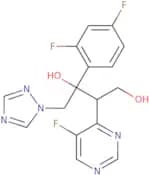
CAS :Metabolite of voriconazole; sterol 14?-demethylase inhibitorDegré de pureté :Min. 95%Bacitracin B1
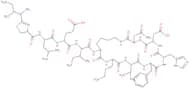
CAS :Bacitracin B1 is a polypeptide antibiotic and is used for the treatment of bacterial infections. Its mode of action is similar to bacitracin.
Formule :C65H101N17O16SDegré de pureté :90%MinCouleur et forme :PowderMasse moléculaire :1,408.67 g/molEnduracidin hydrochloride
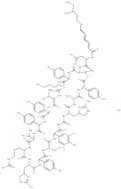
CAS :Enduracidin hydrochloride is an antimicrobial compound, which is a lipopeptide antibiotic derived from the genus Streptomyces, specifically Streptomyces fungicidicus or Streptomyces roseosporus. The compound exerts its antimicrobial activity by inhibiting the synthesis of bacterial cell walls, primarily targeting the lipid II cycle, a critical precursor in the peptidoglycan synthesis pathway. This inhibition disrupts the construction of peptidoglycan layers, ultimately leading to bacterial cell lysis and death.
Formule :C107H138Cl2N26O31HClDegré de pureté :Min. 95%Masse moléculaire :2,391.76 g/molPazufloxacin hydrochloride
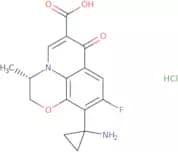
CAS :Pazufloxacin hydrochloride is a synthetic antibacterial agent, which is derived from the fluoroquinolone class of antibiotics with a broad-spectrum activity against various bacterial pathogens. This compound, sourced through chemical synthesis, functions primarily by inhibiting bacterial DNA gyrase and topoisomerase IV, which are critical enzymes for DNA replication, transcription, repair, and recombination. The inhibition of these enzymes leads to the disruption of bacterial DNA processes, ultimately resulting in bacterial cell death.
Formule :C16H15FN2O4•HClDegré de pureté :Min. 95%Masse moléculaire :354.76 g/molAmicoumacin B
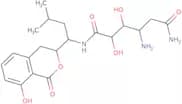
CAS :Amicoumacin B is a potent antibiotic, which is isolated from the bacterial species Bacillus pumilus. It acts by inhibiting protein synthesis, targeting the ribosomal 30S subunit and disrupting translational fidelity in bacterial cells. This interference in protein production leads to the effective elimination of various Gram-positive and certain Gram-negative bacteria.
Degré de pureté :Min. 95%2-Methyl-4-isothiazolin-3-one hydrochloride
CAS :Methyl-4-isothiazolin-3-one HCl, also known as MIT hydrochloride is often used as a preservative in personal care products and other industrial applications. The product has shown to act as an antimicrobial and antifungal agent.
Formule :C4H6ClNOSDegré de pureté :Min. 99 Area-%Masse moléculaire :151.62 g/molAmicoumacin A
CAS :Amicoumacin A is an antibiotic compound, which is derived from the bacterium Bacillus subtilis. This natural source is known for its production of a variety of biologically active compounds that contribute to its utility in numerous scientific contexts. The mode of action of Amicoumacin A involves the inhibition of bacterial protein synthesis by targeting the ribosomal subunit. Specifically, it interferes with the translation process, effectively disrupting the growth and proliferation of susceptible bacterial strains.
Amicoumacin A is primarily utilized in research settings to study bacterial resistance mechanisms, as well as to explore novel antibacterial therapies. Its application in scientific research extends to examining its potential synergistic effects with other antimicrobial agents, and it serves as a model compound for understanding ribosomal inhibition. The study of Amicoumacin A not only contributes to the broader field of antibiotic development but also offers insights into the molecular interactions that underlie bacterial protein synthesis and antibiotic resistance. This compound's unique properties make it an important subject of investigation for microbiologists and pharmacologists alike, emphasizing its relevance in the ongoing battle against antibiotic-resistant pathogens.Formule :C20H29N3O7Degré de pureté :Min. 95%Couleur et forme :PowderMasse moléculaire :423.46 g/molCarbenicillin monosodium salt
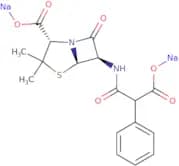
CAS :Inhibitor of bacterial cell wall biogenesis; penicillin class
Formule :C17H17N2NaO6SDegré de pureté :Min. 90 Area-%Couleur et forme :PowderMasse moléculaire :400.38 g/molAmoscanate
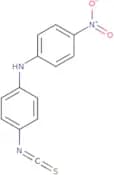
CAS :Amoscanate is an antiparasitic compound derived from synthetic chemical processes, which acts by disrupting the mitochondrial function of parasitic organisms. This compound intervenes in the energy metabolism of endoparasites, leading to their incapacitation and eventual death. Its action is selective for parasitic species, minimizing effects on the host organism.
Formule :C13H9N3O2SDegré de pureté :Min. 95%Masse moléculaire :271.3 g/molMeayamycin B
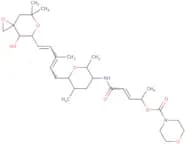
CAS :Meayamycin B is a synthetic macrolide, a complex organic compound, which is derived from the natural product FR901464. This compound functions as an antagonist of the spliceosome, the cellular machinery responsible for pre-mRNA splicing. By binding to specific components of the spliceosome, Meayamycin B disrupts the splicing process, leading to the accumulation of unspliced precursor mRNA. This action effectively induces apoptosis in cancer cells, making it a notable candidate for cancer therapy research.
Formule :C31H48N2O8Degré de pureté :Min. 95%Masse moléculaire :576.72 g/mol