Nucléotides
Les nucléotides sont des composés organiques qui servent de building blocks aux acides nucléiques, essentiels à la formation de l'ADN et de l'ARN. Chaque nucléotide est composé d'une base azotée, d'une molécule de sucre et d'un ou plusieurs groupes phosphate. Ces nucléotides s'assemblent pour former de longues chaînes, créant le matériel génétique qui porte et transmet l'information génétique dans tous les organismes vivants. Dans cette section, vous trouverez une large gamme de nucléotides essentiels pour la recherche en génétique, biologie moléculaire et biochimie. Ils sont fondamentaux pour étudier les processus génétiques, synthétiser des acides nucléiques et développer des outils diagnostiques et thérapeutiques. Chez CymitQuimica, nous proposons des nucléotides de haute qualité pour soutenir vos recherches scientifiques et applications, garantissant précision et fiabilité dans vos expériences.
Sous-catégories appartenant à la catégorie "Nucléotides"
2634 produits trouvés pour "Nucléotides"
Trier par
Degré de pureté (%)
0
100
|
0
|
50
|
90
|
95
|
100
Thymidine-3',5'-diphosphate sodium salt
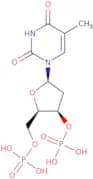
CAS :<p>Thymidine-3',5'-diphosphate sodium salt is a nucleoside that is used in the synthesis of oligonucleotides. It is an antiviral and anticancer agent. Thymidine-3',5'-diphosphate sodium salt has been shown to inhibit DNA synthesis, leading to cell death. It also has been shown to be effective against Hepatitis B virus and HIV-1.</p>Formule :C10H16N2O11P2·xNaDegré de pureté :Min. 98 Area-%Couleur et forme :White PowderMasse moléculaire :402.19 g/mol3'-Azido-3'-deoxyadenosine
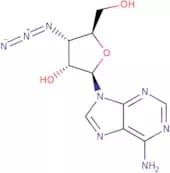
CAS :<p>3'-Azido-3'-deoxyadenosine is an initiator that can be used in oligoribonucleotide synthesis. It is stable, nonhydrolyzable and does not require any protecting groups for its use. 3'-Azido-3'-deoxyadenosine is efficient at initiating the synthesis of ribosomal RNA and has been shown to be a good substrate for biochemical studies. This compound is functionalized with a ribose group, which can be linked to other substances. The linkage of this compound to other substances allows it to be used as a building block for the production of oligoribonucleotides.</p>Formule :C10H12N8O3Degré de pureté :Min. 95%Couleur et forme :PowderMasse moléculaire :292.25 g/mol5-(Carboxymethyl)uridine
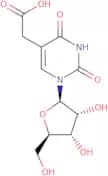
CAS :<p>5-(Carboxymethyl)uridine is an uridine compound that has been shown to inhibit protein synthesis in cultured cells. It binds to the ribosome and inhibits protein synthesis by inhibiting the formation of peptide bonds. 5-Carboxymethyl-uridine has been shown to be effective against two strains of bacteria, Escherichia coli and Staphylococcus aureus, in cell culture experiments. The inhibition of bacterial protein synthesis was shown to be dose-dependent for both strains. The mechanism of action is believed to be due to its binding to the ribosome and inhibiting the formation of peptide bonds.</p>Formule :C11H14N2O8Degré de pureté :Min. 95 Area-%Couleur et forme :White Off-White PowderMasse moléculaire :302.24 g/molN2-Phenylacetylguanosine
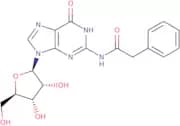
CAS :<p>N2-Phenylacetylguanosine is a novel, modified ribonucleoside with anticancer and antiviral activities. It can be used as a monophosphate or diphosphate. N2-Phenylacetylguanosine is synthesized from 2-phenylethylamine and guanosine using phosphoramidite chemistry. It has been shown to activate DNA synthesis and cell proliferation in vitro, which may lead to tumor growth inhibition.</p>Formule :C18H19N5O6Degré de pureté :Min. 99 Area-%Couleur et forme :PowderMasse moléculaire :401.37 g/mol[1,2,4]Triazolo[1,5-a]pyrimidine-2-carboxylic acid
CAS :<p>[1,2,4]Triazolo[1,5-a]pyrimidine-2-carboxylic acid is a heterocyclic compound made up of a pyrimidine ring and a triazole ring. It can be used in research applications</p>Formule :C6H4N4O2Degré de pureté :Min. 95%Couleur et forme :White PowderMasse moléculaire :164.12 g/mol9-(2',3',5'-Tri-O-acetyl-β-D-ribofuranosyl)-6-chloropurine
CAS :9-(2',3',5'-Tri-O-acetyl-b-D-ribofuranosyl)-6-chloropurine is an anticancer drug that belongs to the class of nucleosides. It is a modified nucleoside with a 2'-deoxyribose sugar and a 6-chloropurine base. The synthesis of 9-(2',3',5'-tri-O-acetyl-b-D-ribofuranosyl)-6-chloropurine can be achieved by phosphoramidite chemistry. Modified nucleosides have been found to have high antiviral and antitumour activities, as well as being promising for the treatment of HIV infections. 9-(2',3',5'-tri-O acetyl b D ribofuranosyl)-6 chloropurine has also been shown to inhibit the replication of RNA in cells infected with HIV, although it has not yet been used in humans.Formule :C16H17ClN4O7Degré de pureté :Min. 95%Couleur et forme :Yellow PowderMasse moléculaire :412.78 g/molN6-Benzoyl-5'-O-tert-butyldimethylsilyl-2'-deoxyadenosine
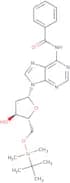
CAS :<p>N6-Benzoyl-5'-O-tert-butyldimethylsilyl-2'-deoxyadenosine is an anti-cancer drug that is used to inhibit the growth of cancer cells in vitro. It has been shown to induce apoptosis in human leukemia cells and may be a novel anticancer agent. This compound has also been shown to have antiviral activity against HIV, herpes simplex virus type 2, hepatitis B virus, and influenza A virus. N6-Benzoyl-5'-O-tert-butyldimethylsilyl-2'-deoxyadenosine is phosphoramidites are synthesized by treatment of 2'-deoxyadenosine with diphosphate in the presence of trimethylammonium tetrafluoroborate or hexafluoroantimonate. The final product contains a benzoyl moiety on the 6' position and a tertiary butyl group</p>Formule :C23H31N5O4SiDegré de pureté :Min. 97 Area-%Couleur et forme :White Off-White PowderMasse moléculaire :469.61 g/mol5-Carbamoylmethyluridine
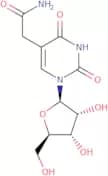
CAS :<p>5-Carbamoylmethyluridine is a nucleoside that is structurally related to uridine. It is synthesized from uridine by methyl esterification with carbamic acid and methoxycarbonyl chloride. 5-Carbamoylmethyluridine interacts with actin filaments and has been shown to alter the expression of messenger RNA in eukaryotes. 5-Carbamoylmethyluridine also acts as a competitive inhibitor of the formation of a ternary complex, which includes ATP, GTP, and UTP, at the level of ribonucleotide reductase. This inhibition leads to decreased synthesis of messenger RNA in cells.</p>Formule :C11H15N3O7Degré de pureté :Min. 95 Area-%Couleur et forme :White PowderMasse moléculaire :301.25 g/mol1-(2'-O-4-C-Methylene-b-D-ribofuranosyl)adenine
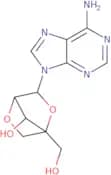
CAS :<p>1-(2'-O-4-C-Methylene-b-D-ribofuranosyl)adenine is an important compound in the field of nucleoside chemistry and has potential applications in research</p>Formule :C11H13N5O4Degré de pureté :Min. 95%Couleur et forme :White PowderMasse moléculaire :279.25 g/mol2'-Deoxy-2'-fluoroadenosine
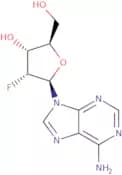
CAS :2’-Deoxy-2’-fluoro nucleosides and nucleotides have been shown to demonstrate anti-viral activity against influenza, SARS and HIV. More specifically the phosphonate of 2'-Deoxy-2'-fluoroadenosine has been evaluated as an inhibitor of Hepacivirus C (HCV).Formule :C10H12FN5O3Degré de pureté :Min. 95%Couleur et forme :White PowderMasse moléculaire :269.24 g/mol2'-Deoxy-5-methylcytidine HCl
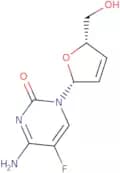
CAS :<p>2'-Deoxy-5-methylcytidine HCl is a cytidine derivative that is used in the synthesis of DNA. It has been shown to have anticancer and antiviral properties, as well as being a synthetic activator for RNA polymerase. The chemical name for 2'-deoxy-5-methylcytidine HCl is 5'-[(2-bromoacetyl)amino]-2'-deoxyuridine 5'-O-(1,3-dithiole-2-thiocarbonyl)-3',5' -diiodo-. It belongs to the class of deoxyribonucleosides. This product may be used in applications such as DNA synthesis, modification of DNA, and antiviral treatment.</p>Formule :C10H15N3O4·HClDegré de pureté :Min. 95%Couleur et forme :White PowderMasse moléculaire :277.7 g/mol5-Fluoro-1-(2',3'-dideoxy-2',3'-didehydro-b-D-arabinofuranosyl)-cytosine
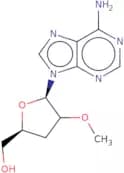
CAS :<p>5-Fluoro-1-(2',3'-dideoxy-2',3'-didehydro-b-D-arabinofuranosyl)-cytosine is an antiviral agent that can be used in combination with other drugs to treat HIV infection. It has been shown to inhibit the activity of p450 enzymes and to bind to receptor sites on cells, preventing the virus from replicating. 5-Fluoro-1-(2',3'-dideoxy-2',3'-didehydro-b-D-arabinofuranosyl)-cytosine has been tested in clinical studies for its ability to reduce levels of HIV in people infected with this virus. This compound also has immunomodulatory effects, which may be due to its ability to inhibit replication of the herpes simplex virus.</p>Formule :C9H10FN3O3Degré de pureté :Min. 95%Couleur et forme :PowderMasse moléculaire :227.19 g/mol3'-Deoxy-2'-O-methyladenosine
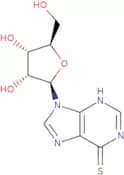
CAS :<p>3'-Deoxy-2'-O-methyladenosine is a nucleoside that has antiviral and anticancer activity. It is a novel chemical compound with a unique structure, which makes it highly reactive. 3'-Deoxy-2'-O-methyladenosine induces DNA synthesis and cell proliferation in cancer cells. It also inhibits the production of viral DNA and RNA in infected cells by inhibiting the enzyme ribonucleotide reductase, which converts ribonucleotides to deoxyribonucleotides. 3'-Deoxy-2'-O-methyladenosine can be used as an antiviral agent against herpes simplex virus type 1 (HSV1), herpes simplex virus type 2 (HSV2) and human cytomegalovirus (CMV).</p>Formule :C11H15N5O3Degré de pureté :Min. 95%Couleur et forme :Off-White PowderMasse moléculaire :265.27 g/mol6-Thioinosine
CAS :<p>6-Thioinosine is a nucleoside analog that is chemically related to 6-mercaptopurine. It inhibits the polymerase chain reaction and has been shown to inhibit aerobic metabolism in aerobacter aerogenes. It also inhibits the growth of hl-60 cells, which are derived from human leukemia cells. 6-Thioinosine has been shown to have anti-inflammatory properties, which may be due to its ability to inhibit prostaglandin synthesis. It also blocks the activity of certain receptors and has a disease activity against infectious diseases such as systemic candidiasis, bacterial endocarditis, and bowel disease.</p>Formule :C10H12N4O4SDegré de pureté :Min. 98 Area-%Couleur et forme :PowderMasse moléculaire :284.29 g/mol3'-O-Methyladenosine
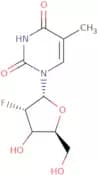
CAS :<p>3'-O-Methyladenosine (3'OMeA) is a monomethylated adenosine that belongs to the group of nucleosides. It has been found to inhibit the activity of adenosine receptors, which are important for the regulation of blood pressure and central nervous system function. 3'OMeA also inhibits virus replication in human lymphocytes. 3'OMeA is synthesized by reaction with methylamine and purification by column chromatography. The molecule is a potential therapeutic target for HIV/AIDS, as it can be used as a specific agonist in order to block viral entry into cells.</p>Formule :C11H15N5O4Degré de pureté :Min. 95%Couleur et forme :White PowderMasse moléculaire :281.27 g/mol1-(2'-Deoxy-2'-fluoro-a-L-arabinofuranosyl)-thymine
CAS :<p>1-(2'-Deoxy-2'-fluoro-α-L-arabinofuranosyl)-thymine (commonly abbreviated as L-FMAU) is a nucleoside analog. It contains an α-L-arabinofuranose sugar instead of the natural β-D-deoxyribose found in DNA.<br>A fluorine (F) substitution at the 2'-position enhances stability and resistance to enzymatic degradation. The thymine nucleobase allows it to mimic natural thymidine, potentially incorporating into DNA synthesis pathways. It can be research for its potential antiviral activity.</p>Formule :C10H13FN2O5Degré de pureté :Min. 95%Couleur et forme :White PowderMasse moléculaire :260.22 g/mol5-Methoxycarbonylmethyluridine
CAS :<p>5-Methoxycarbonylmethyluridine is a nucleoside that is a precursor in the synthesis of other nucleotides. It has been shown to have potential as a biomarker for various diseases, such as metabolic disorders and hepatic steatosis. 5-Methoxycarbonylmethyluridine also inhibits the activity of methyltransferases, which are enzymes that catalyze the transfer of methyl groups from S-adenosylmethionine to substrates. It is also used as a model system for polymerase chain reaction in cancer research, because it has been shown to inhibit DNA replication by blocking the incorporation of uracil into DNA.<br>5-Methoxycarbonylmethyluridine has been found at high levels in fetal bovine serum and eukaryotic cells, but not in prokaryotes or cancerous tissues.</p>Formule :C12H16N2O8Degré de pureté :Min. 95%Couleur et forme :PowderMasse moléculaire :316.26 g/mol1-(2'-Deoxy-2'-fluoro-b-D-arabinofuranosyl)-5-ethyluracil
CAS :<p>1-(2'-Deoxy-2'-fluoro-b-D-arabinofuranosyl)-5-ethyluracil is a nucleoside analog with modifications to alter its biological activity. It contains a β-D-arabinofuranose sugar instead of the standard β-D-deoxyribose in natural nucleosides and<br>the fluorine (F) at the 2'-position increases resistance to enzymatic degradation and alters its biological activity. The 5-ethyl modification on the uracil ring enhances its interaction with viral polymerases.</p>Formule :C11H15FN2O5Degré de pureté :Min. 95%Couleur et forme :White PowderMasse moléculaire :274.25 g/molCyclopentenyl cytosine
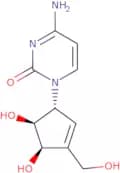
CAS :<p>Cyclopentenyl cytosine is a cytotoxic drug that inhibits the synthesis of DNA, RNA, and proteins. It is a nucleoside analogue that inhibits the enzyme activity of ribonucleotide reductase. Cyclopentenyl cytosine has significant cytotoxicity against hl-60 cells, as well as squamous carcinoma and MDA-MB-231 breast cancer cells. It also has significant activity against cyclopentenyl, dextran sulfate, and mitochondrial functions in vivo in human cells. Cyclopentenyl cytosine binds to the response element on the DNA strand, preventing transcription of genes for protein synthesis and cell division.</p>Formule :C10H13N3O4Degré de pureté :Min. 95%Couleur et forme :PowderMasse moléculaire :239.23 g/mol2'-Deoxy-5'-O-DMT-2'-fluorouridine
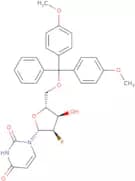
CAS :<p>2'-Deoxy-5'-O-DMT-2'-fluorouridine is a medicament that belongs to the group of antineoplastic agents and is used in cancer treatment. It inhibits the synthesis of DNA by inhibiting the enzyme thymidylate synthetase, which is required for the formation of thymine nucleotides. This drug has been shown to be effective against some cancer cells in vitro and in vivo, but not all. 2'-Deoxy-5'-O-DMT-2'-fluorouridine can also inhibit terminal growth phases and induce programmed cell death. Solid phase synthesis has been used to synthesize this molecule as a phosphoramidite.</p>Formule :C30H29FN2O7Degré de pureté :Min. 98 Area-%Couleur et forme :White PowderMasse moléculaire :548.57 g/mol

![[1,2,4]Triazolo[1,5-a]pyrimidine-2-carboxylic acid](/_next/image/?url=https%3A%2Fstatic.cymitquimica.com%2Fproducts%2F3D%2Fthumb-webp%2FNT57365.webp&w=3840&q=75)