Nucléosides
3569 produits trouvés pour "Nucléosides"
N6-Benzoyl-3’-deoxy-5'-O-DMT-3’- fluoroadenosine 2’-CE-phosphoramidite
N6-Benzoyl-3’-deoxy-5'-O-DMT-3’- fluoroadenosine 2’-CE-phosphoramidite is a novel and activator ribonucleoside with deoxyribonucleosides, diphosphate and phosphoramidites. It is an anti-cancer, antiviral, and antiinflammatory agent. N6-Benzoyl-3’-deoxy-5'-O-DMT-3’ -fluoro adenosine 2’ -CE phosphoramidite has a CAS no.Degré de pureté :Min. 95%Fmoc morpholino uridine monomer
Fmoc morpholino uridine monomer is a novel anticancer drug. It can inhibit the proliferation of cancer cells and induce cell apoptosis by interfering with the synthesis of DNA, RNA and protein. Fmoc morpholino uridine monomer has been shown to be active against viruses, such as human immunodeficiency virus (HIV), herpes simplex virus (HSV) and influenza A virus. This compound is also reported to have antiviral activity against HIV-1 in vitro and HSV-2 in vivo.Formule :C26H28ClN4O7PDegré de pureté :Min. 95%Masse moléculaire :574.13841L-Thymidine
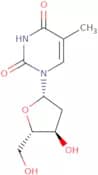
CAS :L-Thymidine is an antiviral drug that is used in the treatment of chronic hepatitis. It has been shown to be active against a range of viruses, including HIV, HSV, and HBV. L-Thymidine can also be used to treat patients with cancer as an anti-cancer agent. L-Thymidine is a prodrug that is converted into thymidine triphosphate (TTP), which inhibits viral DNA polymerase by competitive inhibition. The antiviral activity of L-Thymidine may be due to its ability to inhibit the synthesis of viral proteins required for viral replication by interfering with the protein production process or by inhibiting the formation of dsDNA during reverse transcription.Formule :C10H14N2O5Degré de pureté :Min. 95%Couleur et forme :PowderMasse moléculaire :242.23 g/mol5’(R)-C-Methyl-5-methyluridine
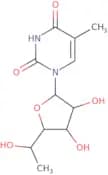
CAS :5’(R)-C-Methyl-5-methyluridine is an nucleoside and a ribonucleoside. It has antiviral, anticancer, and DNA modifying properties. This product is used in research to make phosphoramidites, diphosphates, and deoxyribonucleosides. 5’(R)-C-Methyl-5-methyluridine is also used in the production of modified oligonucleotides as well as other novel DNA compounds.
Degré de pureté :Min. 95%2'-O-Acetyl-3'-deoxy-3'-fluoro-5'-O-toluoyluridine
2′-O-Acetyl-3′-deoxy-3′-fluoro-5′-O-toluoyluridine is a novel, activator ribonucleoside. It is synthesized by the phosphoramidite method and modified with an acetyl group at the 2′ position and a toluoyl group at the 3′ position. This compound has been shown to be active against cancer cells in vitro and in vivo.Formule :C19H19FN2O7Degré de pureté :Min. 95%Masse moléculaire :406.36 g/mol2'-Deoxy-5'-O-DMT-uridine 3'-O succinate TEA
2'-Deoxy-5'-O-DMT-uridine 3'-O succinate TEA salt is a modified nucleoside that is an activator for DNA synthesis. It can be used to synthesize oligonucleotides for use in the treatment of cancer and antiviral agents. 2'-Deoxy-5'-O-DMT-uridine 3'-O succinate TEA salt has been shown to inhibit viral replication by inhibiting the function of reverse transcriptase, which is an enzyme that catalyzes the conversion of RNA into DNA. This product has a CAS number, high purity, and high quality.Degré de pureté :Min. 95%Adenine
CAS :Adenine is a nucleobase found in DNA and RNA. It is an essential component of the human body and is used in the production of phosphoramidites, which are chemical compounds that can be converted into phosphodiester bonds. Adenine has been shown to have anticancer properties, and it may function as a novel activator for other anticancer drugs. Adenine is also used as a monophosphate in some cases. The purity of this compound exceeds 99% and the molecular weight ranges from 162 to 166.5 Daltons.
Formule :C5H5N5Degré de pureté :Min. 98.0 Area-%Masse moléculaire :135.13 g/molN4-Benzoyl-2'-deoxy-5'-O-DMT-5-methylcytidine 3'-CE phosphoramidite
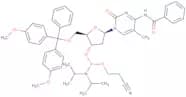
CAS :Nucleoside phosphoramidites are widely used as building blocks in the chemical synthesis of oligonucleotides. The use of a chemical synthesis rather than an enzymatic one allows bespoke oligonucleotides of a desired sequence to be obtained. 3’-Cyanoethyl phosphoramidites are typically modified by reaction with the 5’ hydroxyl of the next nucleoside in the desired sequence. The reaction is usually catalysed by 1H-tetrazole or 4,5-dicyanoimidazole in acetonitrile. N4-Benzoyl-2'-deoxy-5'-O-DMT-5-methylcytidine 3'-CE phosphoramidite, also called N4-Bz-5'-DMT-5-Me-dC phosphoramidite, is used in the synthesis of 2’-deoxy-5-methylcytidine-containing oligonucleotides as antisense drugs.Formule :C47H54N5O8PDegré de pureté :Min. 95%Couleur et forme :White PowderMasse moléculaire :847.93 g/mol2'-Deoxy-N2-DMF-5'-O-tritylguanosine
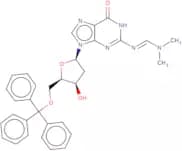
CAS :2'-Deoxy-N2-DMF-5'-O-tritylguanosine is a nucleoside that is used as a building block in the synthesis of oligonucleotides and other DNA analogues. It is a novel, synthetic nucleoside. The compound has antiviral and anticancer properties. It has been evaluated for use as an activator in antibody production and in the treatment of HIV infection and certain types of cancer. 2'-Deoxy-N2-DMF-5'-O-tritylguanosine is a phosphoramidite, which can be used to synthesize DNA or RNA. This product is available in high purity, diphosphate form and can be used to prepare Anticancer (CAS No. 40094-22-2) Novel Nucleosides (CAS No. 40094-22-2) Phosphoramidites (CAS No. 40094-22Formule :C32H32N6O4Degré de pureté :Min. 95%Masse moléculaire :564.65 g/molRiboflavin 5'-adenosine diphosphate disodium salt hydrate
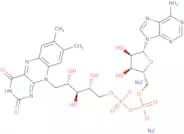
CAS :Riboflavin 5'-adenosine diphosphate disodium salt hydrate is a chemical compound that can be used as a substrate for nitrate reductase in the presence of molecular oxygen. It can be used to identify mollicutes and diagnose radiation-induced lesions. The reaction mechanism involves the conversion of riboflavin 5'-adenosine monophosphate to riboflavin 5'-adenosine diphosphate by an enzyme called nitrate reductase, which is present in the microorganism. This reaction is accompanied by the release of electrons, which are detected by a fluorescence detector. The rate constant for this reaction is k=1.5x10^-4/s at pH 7 and 37 degrees Celsius with an electrochemical detector and k=2.0x10^-3/s at pH 7 and 37 degrees Celsius with a carbonyl oxygens detector. Riboflavin 5'-Formule :C27H31N9Na2O15P2·xH2ODegré de pureté :(Uv) Min. 95%Couleur et forme :Yellow Orange PowderMasse moléculaire :829.51 g/mol1-(4’-Azido-2’-deoxy-2’-fluoro-b-D-arabinofuranosyl)N4-(n-docosanoyl)-cytosine
1-(4’-Azido-2’-deoxy-2’-fluoro-b-D-arabinofuranosyl)N4-(n-docosanoyl)-cytosine is a deoxyribonucleoside monophosphate with antiviral effects. It is a novel nucleotide analogue that contains an azido group and a 2,4,6-trifluorobenzene moiety. The 4′ position of the sugar is modified with an n-docosanoyl group. 1-(4’Azo-2′deoxy-2′fluoro-bDara)ribonucleosides are synthetic nucleotides that can be used to inhibit viral replication by inhibiting DNA polymerase and RNA polymerase.Degré de pureté :Min. 95%5’-O-DMT-3’-O-levulinyl-2’-deoxyadenosine
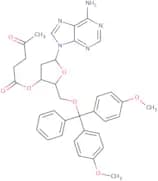
CAS :5’-O-DMT-3’-O-levulinyl-2’-deoxyadenosine is a monophosphate antiviral agent. It has been shown to inhibit the activity of DNA and RNA polymerases in vitro. The drug is novel, and its antiviral properties have not been tested in vivo. 5’-O-DMT-3’-O-levulinyl-2’-deoxyadenosine has been synthesized using phosphoramidites and was found to be of high quality and purity. It has also been modified at the 2' position with an acetyl group and at the 3' position with a levulinoyl group.Degré de pureté :Min. 95%2'-O-tert-Butyldimethylsilyl-5'-O-DMT-N3-methylcytidine 3'-CE phosphoramidite
2'-O-tert-Butyldimethylsilyl-5'-O-DMT-N3-methylcytidine 3'-CE phosphoramidite is a modified nucleoside that is synthesized by the reaction of 2'-deoxycytidine with bis(2,4,6-trichlorophenyl)carbonate in the presence of a base. 2'-O-tert-Butyldimethylsilyl-5'-O-DMT-N3 methylcytidine 3'-CE phosphoramidite has been shown to have anticancer activity and is used as an activator in the synthesis of oligonucleotides. This product is available as a white powder and can be used for research purposes only.Degré de pureté :Min. 95%2'-Deoxy-5-(2-iodoethyl)uridine
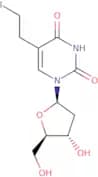
CAS :2'-Deoxy-5-(2-iodoethyl)uridine is a nucleoside analog with antiviral and anticancer activity. It has been shown to be an activator of DNA replication, as well as inhibiting the synthesis of deoxyribonucleotides. This drug also has a novel structure that is modified from the natural nucleosides found in DNA and RNA. 2'-Deoxy-5-(2-iodoethyl)uridine can be synthesized using phosphoramidites, which are activated by iodine and sulfurizing agents. The purity of this compound is high and it is available at high quality.Degré de pureté :Min. 95%5-Fluorocytidine
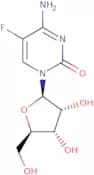
CAS :5-Fluorocytidine (5FC) is an antiviral drug that inhibits the synthesis of DNA. 5FC is a prodrug that is converted to cytosine in vivo, and then incorporated into viral DNA by polymerase chain reactions. The incorporation of 5FC into viral DNA prevents replication and transcription, which can lead to the death of cells infected with HIV. In addition, 5FC has been shown to be effective in treating chronic viral hepatitis and bowel diseases such as Crohn's disease. It also has potential use as a drug target for cancer treatments. 5FC has been shown to inhibit transcription activators in murine hepatoma cells and inhibit the growth of tumors in transfection experiments using human colon cancer cells. This antiviral agent has also been shown to have antimicrobial activity against Gram-positive bacteria, including Clostridium difficile, Staphylococcus aureus, Streptococcus pyogenes and Enterococcus faecFormule :C9H12FN3O5Degré de pureté :Min. 99 Area-%Couleur et forme :White PowderMasse moléculaire :261.21 g/molN4-Acetylcytidine
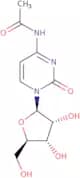
CAS :N4-Acetylcytidine is a modified nucleoside and endogenous urinary nucleoside product of the degradation of tRNA. N4-Acetylcytidine is a biological marker for various cancers with elevated concentrations present in urine. N4-Acetylcytidine is also a partially protected cytidine and therefore can be used as a synthetic building block to prepare further derivatized nucleosides such as 2’,3’-dideoxycytidine.Formule :C11H15N3O6Degré de pureté :Min. 95%Couleur et forme :White PowderMasse moléculaire :285.25 g/molInosine 5'-diphosphate disodium salt
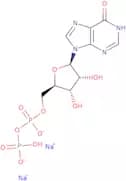
CAS :Inosine-5'-diphosphate disodium salt (IDPS) is a nitro compound that is used in the synthesis of antibacterial drugs. It is also used in the production of polymers and as a precursor to other organic compounds. IDPS has been shown to have antibacterial activity against halogeno bacteria, such as buprestidae, and many Gram-positive bacteria, including encapsulated strains. IDPS has been shown to be effective against both damaged cells and healthy cells in culture. The mechanism of action may involve inhibition of protein synthesis by blocking the ribosomes or by interfering with DNA replication. This drug also inhibits growth rate of japonica rice and heterocycles.Formule :C10H12N4Na2O11P2Degré de pureté :Min. 90.0 Area-%Couleur et forme :White PowderMasse moléculaire :472.15 g/mol2'-O-tert-Butyldimethylsilyl-5'-O-DMT-N2-isobutyrylguanosine 3'-CE phosphoramidite
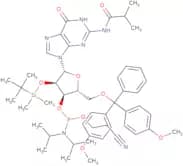
CAS :The 2'-O-tert-Butyldimethylsilyl-5'-O-DMT-N2-isobutyrylguanosine 3'-CE phosphoramidite is an oligomer with a modified nucleoside. The modification of the nucleoside has been shown to be more efficient than other modifications, such as fluorine or bromine substitutions. This product is used in the synthesis of DNA and RNA oligomers. The coupling efficiency is high and can be used for ligand binding studies.Formule :C50H68N7O9PSiDegré de pureté :Min. 98 Area-%Couleur et forme :White PowderMasse moléculaire :970.18 g/mol1-(2'-Deoxy-5'-O-DMT-2'-fluoro-β-D-arabinofuranosyl)thymine
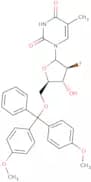
CAS :1-(2'-Deoxy-5'-O-DMT-2'-fluoro-b-D-arabinofuranosyl)thymine is a chemically modified nucleoside that contains a fluorinated sugar moiety and a thymine base, with a dimethoxytrityl (DMT) protecting group on the 5'-hydroxyl of the sugar.Formule :C31H31FN2O7Degré de pureté :Min. 95%Masse moléculaire :562.6 g/mol8-Azidoadenosine
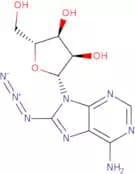
CAS :8-Azidoadenosine is an adenosine analogue conjugated with an azido group which can be used for oligonucleotide labelling. The azido group reacts with a terminal alkyne via a click reaction, forming the labelled nucleotide containing a triazole linker.
Formule :C10H12N8O4Degré de pureté :Min. 95%Couleur et forme :PowderMasse moléculaire :308.25 g/mol