Dérivés du Benzimidazole et de l’Imidazole
Le benzimidazole est un composé constitué d’un noyau benzénique fusionné à un noyau imidazole, une structure à cinq membres contenant deux atomes d’azote. Les dérivés du benzimidazole, comme l’albendazole, sont connus pour leur activité antiparasitaire et antifongique, utilisés dans le traitement des infections parasitaires et de certaines maladies parasitaires chez les animaux et les humains. L’imidazole, quant à lui, est une structure à cinq membres avec deux atomes d’azote, présente dans divers composés biologiquement actifs. Les dérivés de l’imidazole, comme le métronidazole, possèdent des propriétés antimicrobiennes et antiparasitaires. Ces composés sont également utilisés dans l’industrie pharmaceutique pour le traitement des infections bactériennes, des maladies parasitaires et de certaines infections fongiques, ainsi qu’en chimie organique comme catalyseurs.
Chez CymitQuimica, nous proposons des benzimidazoles et des imidazoles de haute pureté pour la recherche en chimie médicinale, pharmacologie et biotechnologie.
10375 produits trouvés pour "Dérivés du Benzimidazole et de l’Imidazole"
Trier par
Degré de pureté (%)
0
100
|
0
|
50
|
90
|
95
|
100
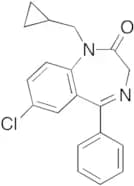
Prazepam
CAS :Produit contrôlé<p>Applications Prazepam, is a benzodiazepine derivative drug having anxiolytic, anticonvulsant, sedative and skeletal muscle relaxant properties.<br>References Shader R. I., et al.: Ciba. Found. Symp., (74), 141 (1979); Jacqmin, P., et al.: Neuropsychobiology, 19 (4), 186 (1988);<br></p>Formule :C19H17ClN2OCouleur et forme :Off-WhiteMasse moléculaire :324.804-Nitro-5-desnitro Tinidazole
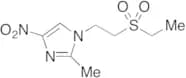
CAS :Produit contrôlé<p>Impurity Tinidazole EP Impurity B<br>Applications 4-Nitro-5-desnitro Tinidazole (Tinidazole EP Impurity B) is an impurity in the synthesis of Tinidazole (T443900), antiprotozoal (Trichomonas, Giardia); antiamebic; antibacterial.<br>References Miller, M.W., et al.: J. Med. Chem., 13, 849 (1970), Oderdea, G., et al.: Gut, 33, 1328 (1992),<br></p>Formule :C8H13N3O4SCouleur et forme :NeatMasse moléculaire :247.27Prazepam-d5
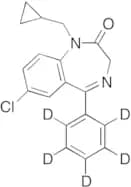
CAS :Produit contrôlé<p>Applications Prazepam-d5, is the labeled analogue of Prazepam (P702250), a benzodiazepine derivative drug having anxiolytic, anticonvulsant, sedative and skeletal muscle relaxant properties.<br>References Shader R. I., et al.: Ciba. Found. Symp., (74), 141 (1979); Jacqmin, P., et al.: Neuropsychobiology, 19 (4), 186 (1988);<br></p>Formule :C192H5H12ClN2OCouleur et forme :NeatMasse moléculaire :329.83Propyl Itraconazole
CAS :Produit contrôléFormule :C34H36Cl2N8O4Couleur et forme :NeatMasse moléculaire :691.61rac N-Demethyl Promethazine-d3 Hydrochloride
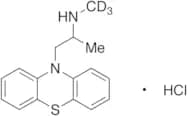
CAS :Produit contrôlé<p>Applications Labelled Promethazine (P757000) impurity.<br> Not a dangerous good if item is equal to or less than 1g/ml and there is less than 100g/ml in the package<br>References Keipert, S., et al.: Pharmazie, 31, 296 (1976),<br></p>Formule :C16H16D3ClN2SCouleur et forme :NeatMasse moléculaire :309.8710-Bromo-5H-dibenzo[b,f]azepine-5-carboxamide
CAS :Produit contrôlé<p>Impurity Carbamazepine EP Impurity G<br>Applications 10-Bromo-5H-dibenzo[b,f]azepine-5-carboxamide is a Carbamazepine (C175840(P)) impurity, which has been used in treatment of pain associated with trigeminal neuralgia. It is an anticonvulsant, neuroprotective & neuroresearch product.<br>References Cry, T., et. al.: J. Assoc. Official Anal. Chem., 70, 836 (1987); Stenger, E.G., et al.: Med. Exp., 11, 191 (1964); Pynnonen, S., et al.: Ther. Drug Monit., 1, 409 (1979); Sidebottom, A., et al.: J. Clin. Pharm. Ther., 20, 31 (1995)<br></p>Formule :C15H11BrN2OCouleur et forme :NeatMasse moléculaire :315.16Voriconazole-d3 N-Oxide (~90%)
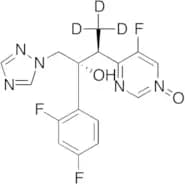
CAS :Produit contrôléFormule :C16D3H11F3N5O2Degré de pureté :~90%Couleur et forme :NeatMasse moléculaire :368.33(2Z)-2-[Cyano(2,3-dichlorophenyl)methylene]hydrazinecarboximidamide
CAS :Produit contrôléFormule :C9H7Cl2N5Couleur et forme :NeatMasse moléculaire :256.091,2-Bismethylenecyclohexane (~75%)
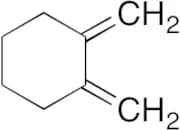
CAS :Produit contrôléFormule :C8H12Degré de pureté :~75%Couleur et forme :NeatMasse moléculaire :108.183-Hydroxy-1-methyl-1-Azoniabicyclo[2.2.2]octane Bromide
CAS :Produit contrôlé<p>Applications 3-Hydroxy-1-methyl-1-Azoniabicyclo[2.2.2]octane is an impurity in the synthesis of Clidinium Bromide (C576250), an anticholinergic. Used as an antispasmodic.<br>References Zhang, L., et al.: Pharm. Res., 25, 1902 (2008), Sanderson, H., et al.: Toxicol Lett., 187, 84 (2009),<br></p>Formule :C8H16BrNOCouleur et forme :NeatMasse moléculaire :222.12(alphaS)-N,N,α-Trimethyl-3-(4-nitrophenoxy)benzenemethanamine
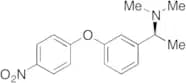
CAS :Produit contrôlé<p>Applications (αS)-N,N,α-Trimethyl-3-(4-nitrophenoxy)benzenemethanamine is an impurity of Rivastigmine Tartrate (R541000). Rivastigmine Tartrate is a brain selective acetylcholinesterase inhibitor.<br>References Rosler, M., et al.: Brit. Med. J., 318, 633 (1999); Enz, A., et al.: Prog. Brain Res., 98, 431 (1993)<br></p>Formule :C16H18N2O3Couleur et forme :OrangeMasse moléculaire :286.33Pantoprazole sulfone N-oxide
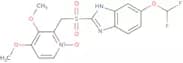
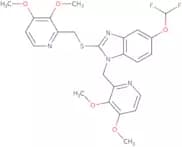
CAS :<p>Pantoprazole sulfone N-oxide is a prodrug that is converted to the active form pantoprazole in the stomach where it inhibits gastric acid secretion. Pantoprazole sulfone N-oxide has been shown to be genotoxic, and can cause polyvinyl chloride to degrade when stored together. Reconstituted solution of this drug should be used within 24 hours after reconstitution, as the chemical stability of this drug decreases rapidly. Validation studies have been conducted on different analytical methods for determining pantoprazole concentrations in reconstituted solutions, and these methods have been harmonized with those published by the United States Pharmacopeia (USP). The pump inhibitor activity of pantoprazole sulfone N-oxide has been demonstrated in dogs, and it is also useful for treating acid reflux disease in humans. Pantoprazole sulfone N-oxide is unstable at high temperatures (>25°C), so should not be refrigerated or</p>Formule :C16H15F2N3O6SDegré de pureté :Min. 95%Masse moléculaire :415.37 g/molAlbendazole impurity F
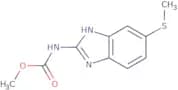
CAS :<p>Albendazole is an anti-helminthic drug that is structurally classified as a benzimidazole. It has been shown to be effective against a variety of helminths, including roundworms, pinworms, hookworms, and tapeworms. Albendazole impurity F is an analytical standard for the determination of albendazole in pharmaceutical products by HPLC. It also serves as a reference substance to establish the purity of drug products containing albendazole and its metabolites. Albendazole impurity F is not considered to be a metabolite of albendazole because it has been shown to be stable under acidic conditions and can be synthesized from other starting materials.</p>Formule :C10H11N3O2SDegré de pureté :Min. 95%Masse moléculaire :237.28 g/molLansoprazole impurity H
CAS :<p>Lansoprazole impurity H is a metabolite of lansoprazole, a proton pump inhibitor that inhibits the production of stomach acid. Lansoprazole impurity H is used in research and development as an analytical standard to measure lansoprazole concentrations in drug products. It is also used as an impurity standard for pharmacopoeia purposes. Lansoprazole impurity H is not known to be toxic, but it has not been evaluated for carcinogenicity or reproductive toxicity.</p>Formule :C23H16F3N5OSDegré de pureté :90%MinMasse moléculaire :467.47 g/mol2-Methoxy-5-methyl-γ-phenylbenzenepropanol
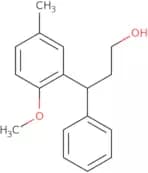
CAS :<p>2-Methoxy-5-methyl-gamma-phenylbenzenepropanol is a synthetic compound that is used as an intermediate in the synthesis of coumarin derivatives. Reaction with sulfonating agents produces sulfones, and reaction with borohydride reagents produces boronates. The synthesis of 2-methoxy-5-methyl-gamma-phenylbenzenepropanol can be accomplished by the reduction of diphenyl ethers with lithium aluminum hydride or borohydride. The reduction can also be carried out using lanthanum oxide and potassium borohydride. The reaction proceeds smoothly at room temperature in nonpolar solvents.<br>2-Methoxy-5-methyl-gamma-phenylbenzenepropanol reacts with chloride to produce the corresponding chlorides, which are useful intermediates for the synthesis of tolterodine tartrate, a drug used to treat urinary inc</p>Formule :C17H20O2Degré de pureté :Min. 95%Masse moléculaire :256.34 g/mol2-Hydroxy-5-methyl-γ-phenylbenzenepropanol
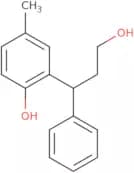
CAS :<p>2-Hydroxy-5-methylphenylbenzenepropanol is an aliphatic phenol that is used as a treatment for benzene poisoning. It is also used as a precursor to other compounds, such as the chlorides and alkylates of 2-hydroxy-5-methylphenylbenzenepropanol. This compound can be synthesized by reacting ethyl benzoylacetate with diisopropylamine in the presence of oxygen and chlorine gas. It is often immobilized using nutrients, l-tartaric acid, or cinnamic acid.</p>Formule :C16H18O2Degré de pureté :Min. 95%Masse moléculaire :242.31 g/molCarbamazepine impurity
CAS :<p>Carbamazepine is a drug that has been used to treat epileptic seizures and trigeminal neuralgia. Impurities in the drug are removed by using chromatographic methods, such as high-performance liquid chromatography (HPLC). The rotarod test is an animal model of motor coordination and balance that can be used to assess the effects of drugs on these functions. Carbamazepine impurities may cause depression and have an epileptic effect on animals. Chronic exposure to carbamazepine can lead to drug reactions and gene polymorphisms, which may alter the metabolism of the drug. Analytical methods for determining carbamazepine impurities include HPLC, gas chromatography mass spectrometry (GC-MS), and thin-layer chromatography (TLC).</p>Formule :C15H14N2ODegré de pureté :Min. 95%Masse moléculaire :238.28 g/mol(R,R)-Solifenacin succinate
CAS :<p>(R,R)-Solifenacin succinate is a pharmaceutical agent that acts as an antimuscarinic drug. It has been shown to be effective in wastewater treatment, where it was found to reduce the amount of solifenacin and optimised organic chemicals in the water. This drug has also been shown to have antagonist properties against the muscarinic receptor M3.</p>Formule :C23H26N2O2•C4H6O4Degré de pureté :Min. 95%Couleur et forme :PowderMasse moléculaire :480.55 g/molPantoprazole impurity
CAS :<p>Pantoprazole is a proton pump inhibitor. It is used in the treatment of gastroesophageal reflux disease and other conditions involving excessive stomach acid production. The chemical name for Pantoprazole impurity is (E)-1-(4-chlorophenyl)ethyl-3-[(pyrrolidin-2-yl)oxy]propanediol. This substance is an enantiomer of pantoprazole, which has been determined to be inactive. Pantoprazole impurity can be identified by its melting point, crystallizing habit, and optical rotation. Active carbon filtration can be used to remove this substance from the final product.</p>Formule :C24H24F2N4O5SDegré de pureté :Min. 95%Masse moléculaire :518.53 g/molAlbendazole sulfone
CAS :<p>Albendazole sulfone is a metabolite of the drug albendazole. It is used as an analytical standard to measure the concentration of albendazole in human plasma and urine samples. The concentration-time curve for albendazole sulfone can be determined using a nonlinear regression analysis, with the rate constant being calculated from the slope and intercept. This method has been shown to be accurate for predicting pharmacokinetic parameters in humans. Albendazole sulfone is also used as a probe in wastewater treatment studies, where it binds to colloidal gold particles that are used to visualize the removal of small particles by microorganisms.</p>Formule :C12H15N3O4SDegré de pureté :Min. 95 Area-%Couleur et forme :PowderMasse moléculaire :297.33 g/mol


![10-Bromo-5H-dibenzo[b,f]azepine-5-carboxamide](/_next/image/?url=https%3A%2Fstatic.cymitquimica.com%2Fproducts%2FTR%2Fthumb-webp%2FB683910.webp&w=3840&q=75)
![(2Z)-2-[Cyano(2,3-dichlorophenyl)methylene]hydrazinecarboximidamide](/_next/image/?url=https%3A%2Fstatic.cymitquimica.com%2Fproducts%2FTR%2Fthumb-webp%2FC979120.webp&w=3840&q=75)
![3-Hydroxy-1-methyl-1-Azoniabicyclo[2.2.2]octane Bromide](/_next/image/?url=https%3A%2Fstatic.cymitquimica.com%2Fproducts%2FTR%2Fthumb-webp%2FH946585.webp&w=3840&q=75)