Thé noir
Le thé noir est une boisson largement consommée, également appréciée pour ses bienfaits sur la santé en raison de sa riche teneur en polyphénols, en particulier les théaflavines et les catéchines. Ces composés sont étudiés pour leurs effets antioxydants, anti-inflammatoires et protecteurs cardiovasculaires. Chez CymitQuimica, nous proposons des extraits et des composés actifs de thé noir pour soutenir la recherche en chimie des produits naturels, nutrition et sciences de la santé.
7 produits trouvés pour "Thé noir".
Trier par
Degré de pureté (%)
0
100
|
0
|
50
|
90
|
95
|
100
Theaflavin-3-gallate
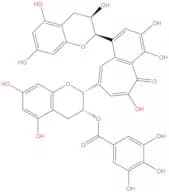
CAS :Theaflavin-3-gallate has anticancer and apoptotic effects in non-small cell lung carcinoma, it acts as prooxidants and induce oxidative stress, with carcinoma cells more sensitive than normal fibroblasts. Theaflavin-3-gallate can play a role in decreased intestinal cholesterol absorption via inhibition of micelle formation.Formule :C36H28O16Degré de pureté :95%~99%Masse moléculaire :716.604Theaflavin 3,3'-digallate
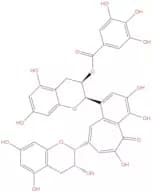
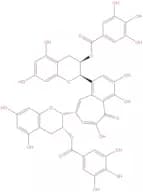
CAS :Theaflavin-3,3'-digallate(TF3), an inducer of oxidative stress, which has anti-inflammatory and cancer chemopreventive actions, it reduces tumor angiogenesis by downregulating HIF-1αand VEGF; suggests that TF3 might serve as a potential anti-angiogenic agent for cancer treatment. TF3 and lactic acid combinations can reduce Herpes Simplex Virus(HSV) infectivity.Formule :C43H32O20Degré de pureté :95%~99%Masse moléculaire :868.709Epitheaflagallin 3-O-gallate
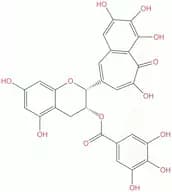
CAS :Formule :C27H20O13Degré de pureté :95%~99%Masse moléculaire :552.444Theaflavin
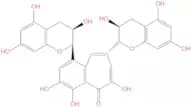
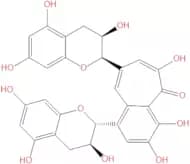
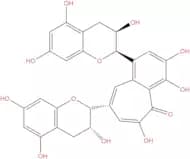
CAS :Theaflavins(TF) has antioxidant activity, the TF present in black tea possess at least the same antioxidant potency as catechins present in green tea, and that the conversion of catechins to TF during fermentation in making black tea does not alter significantly their free radical-scavenging activity.[1,2]Formule :C29H24O12Degré de pureté :95%~99%Couleur et forme :PowderMasse moléculaire :564.499