Substrats d'enzymes
Sous-catégories appartenant à la catégorie "Substrats d'enzymes"
1527 produits trouvés pour "Substrats d'enzymes"
4-Methylumbelliferyl 6-O-(N-acetylneuraminyl)-b-D-glucopyranoside
4-Methylumbelliferyl 6-O-(N-acetylneuraminyl)-b-D-glucopyranoside is a fluorescent substrate for the enzyme β-D-galactosidase. It is used in the detection of β-D-galactosidase activity in the diagnosis of various diseases, including celiac disease and AIDS. 4-Methylumbelliferyl 6-O-(N-acetylneuraminyl)-b-D-glucopyranoside can also be used as a chromogenic or fluorogenic substrate for chemiluminescent detection of β-D-galactosidase activity. The conjugate with horseradish peroxidase can be used to detect hydrogen peroxide in water samples, such as drinking water, wastewater, and surface waters. 4MUG has been shown to have high purity and is CAS No. 78761–35–4.Degré de pureté :Min. 95%Glycyl-glycine 7-amido-4-methylcoumarin hydrochloride
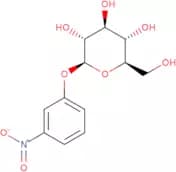
CAS :Glycyl-glycine 7-amido-4-methylcoumarin hydrochloride is a synthetic peptide substrate used as a fluorogenic substrate for aminopeptidase.Formule :C14H16ClN3O4Degré de pureté :Min. 95%Couleur et forme :PowderMasse moléculaire :325.75 g/mol3-Nitrophenyl β-D-glucopyranoside
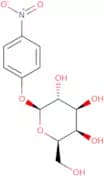
CAS :3-Nitrophenyl beta-D-glucopyranoside is a chromogenic enzyme substrate commonly used to assay for beta-glucosidase activity. Upon hydrolysis by the enzyme, it produces a yellow product that can be easily detected by spectrophotometry. This substrate is often used in the field of carbohydrate chemistry and biochemistry to study enzyme kinetics and inhibition in both in vitro and in vivo systems.Formule :C12H15NO8Degré de pureté :Min. 95%Couleur et forme :White Yellow PowderMasse moléculaire :301.25 g/mol4-Methylumbelliferyl cholin phosphate
CAS :4-Methylumbelliferyl phosphocholine, commonly known as 4-MUPC, is a synthetic phosphodiester used as an enzyme substrate for phospholipase enzymes. 4-MUPC is used as a fluorogenic substrate to measure the activity of phopholipases, which are important mediators of cell signalling.Formule :C15H20NO6PDegré de pureté :Min. 99.0 Area-%Masse moléculaire :341.30 g/molAldol® 484 beta-D-galactopyranoside, Biosynth Patent: EP 2427431 and US 8940909
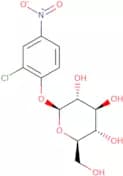
CAS :Aldol® 484 beta-D-galactopyranoside is a chromogenic enzyme substrate for beta-galactosidase activity. The colorless product is cleaved by lactose-utilizing bacteria in liquid or solid media, yielding intense red color. Aldol® 484 beta-D-galacto-pyranoside can also be used in beta-gal reporter gene assays or for identification of beta-gal positive transformants on agar. Aldol® 484 beta-D-galactopyranoside can be used under aerobic and anaerobic conditions.Formule :C26H24ClFN2O7Degré de pureté :Min. 95%Couleur et forme :PowderMasse moléculaire :530.93 g/mol2-Chloro-4-nitrophenyl β-D-glucopyranoside
CAS :2-Chloro-4-nitrophenyl β-D-glucopyranoside is a chromogenic substrate for beta-glucosidases. In biochemical enzyme assays and in vitro diagnostics analysis, the substrate is used to monitor the glycosyltransferase activity. When 2-chloro-4-nitrophenyl β-D-glucopyranoside is cleaved by beta-glucosidase, 2-chloro-4-nitrophenol is released and quantified.Formule :C12H14ClNO8Degré de pureté :Min. 95%Couleur et forme :White PowderMasse moléculaire :335.69 g/mol4-Methylumbelliferyl-beta-D-xylopyranoside
CAS :Fluorogenic substrate for β-D-xylosidase. Identification within the family of Enterobacteriaceae.Formule :C15H16O7Degré de pureté :Min. 99.0 Area-%Masse moléculaire :308.29 g/molL-Alanine-7-amido-4-methylcoumarin hydrochloride
CAS :L-Alanine-7-amido-4-methylcoumarin hydrochloride is a synthetic peptide substrate used as a fluorogenic substrate for alanine aminopeptidase.Formule :C13H14N2O3·HClDegré de pureté :Min. 90%Couleur et forme :PowderMasse moléculaire :282.72 g/mol4-Nitrophenyl-alpha-L-fucopyranoside
CAS :Chromogenic substrate yielding a soluble yellow chromophor for the colorimetric assay of α-L-fucosidase, especially in human serum.Formule :C12H15NO7Degré de pureté :Min. 98 Area-%Masse moléculaire :285.26 g/molLipase substrate
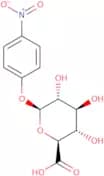
CAS :Synthetic chromogenic substrate for detection of lipase enzyme activity that produces a red coloured product, Suitable for use in serum of plasma matrices. This lipase substrate is commonly used in veterinary diagnostics for monitoring and detecting canine pancreatitis,Formule :C45H69NO8Masse moléculaire :752.03 g/mol4-Nitrophenyl-beta-D-glucuronic acid
CAS :Chromogenic β-glucuronidase substrate yielding a yellow solution upon cleavage. Used to detect E. coli contamination in food and drinking water due to their β-glucuronidase activity.Formule :C12H13NO9Degré de pureté :Min. 98.0 Area-%Masse moléculaire :315.24 g/molAc-DEVD-6-Amino-D-Luciferin
Caspases are a family of protease enzymes playing essential roles in programmed cell death and inflammation. The acronym caspase stands for Cysteine Aspartic Acid Specific Protease due to their specific cleavage of an aspartic acid residue, by mean of a cysteine in the catalytic site of the enzyme._x000D_About 11 or 12 different caspases are known in humans and 10 in mice, participating in numerous different cellular functions. Caspase deficiency, for example, has been identified as a cause of tumor development, while over-activation of some caspases such as caspase-3 can lead to excessive apoptosis that can be observed in several neurodegenerative diseases. Caspases cleave proteins at specific peptide recognition sequences. Ac-DEVD-6-Amino-D-Luciferin (Ac-Asp-Glu-Val-Asp-6-Amino-D-Luciferin, Cat.No_x000D_L-8282) is a synthetic chemiluminescent peptide for the determination of caspase-3 and caspase-7activity.
Formule :C31H37N7O13S2Masse moléculaire :779.79 g/molRef: 3D-L-8282
10mgÀ demander25mgÀ demander50mgÀ demander100mgÀ demander250mgÀ demander-Unit-ggÀ demander4-Nitrophenyl-beta-D-galactopyranoside
CAS :Chromogenic β-galactosidase substrate yielding a yellow solution upon cleavage. Can be used for the detection of coliforms due to their β-galactosidase activity.Formule :C12H15NO8Degré de pureté :Min. 98.0 Area-%Masse moléculaire :301.26 g/mol4-Methylumbelliferone
CAS :4-Methylumbelliferone is a coumarin derivative that inhibits the activity of enzymes such as p-nitrophenyl phosphate oxidase and aminopeptidase. It is used in vitro to study oxidative injury, which plays a role in the pathogenesis of inflammatory diseases, including primary sclerosing cholangitis and bone marrow transplantation. 4-Methylumbelliferone has been shown to induce apoptosis by increasing reactive oxygen species levels and activating toll-like receptor 4 (TLR4). It also has inhibitory effects on osteosarcoma cell proliferation in vitro.Formule :C10H8O3Masse moléculaire :176.17 g/molIsopropyl-β-D-thiogalactopyranoside, <5ppm dioxane, plant origin (ex peach gum)
CAS :A non-metabolizable allolactose analogue, widely used in molecular biology for overexpression of recombinant proteins from inducible systems under the control of lac promoter. IPTG binds to the LacI repressor and causes its release from the lac operator, allowing gene expression to take place. Present in vectors of pGEX, pGEM-T, pET, pRSET, pMAL class and others.Formule :C9H18O5SDegré de pureté :Min. 99.0 Area-%Masse moléculaire :238.30 g/molRef: 3D-I-8070
1kgÀ demander50gÀ demander100gÀ demander250gÀ demander500gÀ demander-Unit-ggÀ demanderCalcium 2-naphthylphosphate
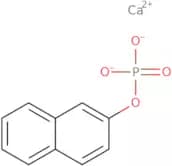
CAS :Calcium 2-naphthylphosphate, which is the calcim salt of 2-naphthylphosphate, is a chromogenic substrate to measure alkaline phosphatase activity. After enzymatic cleavage, the product yielded (2-naphthol) generates a red-colored complex upon reaction with a diazonium salt like Fast Blue RR or Fast Garnet GBC.
Degré de pureté :(%) Min. 95%Couleur et forme :PowderMasse moléculaire :282.24 g/molGlycine 7-amido-4-methylcoumarin hydrobromide
CAS :Glycine 7-amido-4-methylcoumarin hydrobromide is a chromogenic substrate that can be used for the detection of alkaline phosphatase. It reacts with the enzyme to produce a blue color, which can be measured spectrophotometrically. The product is also used as a ligand in cell culture media and as a diagnostic agent in environmental testing. It has been shown to be an excellent substrate for chemiluminescence reactions with luminol and luciferin, and bioluminescence reactions with luciferase. Glycine 7-amido-4-methylcoumarin hydrobromide is available from several suppliers at different prices, but we are able to offer it at a competitive price due to our high quality standards. The following product description was generated for 6-Fluoro-3-indoxyl-beta-D-galactopyranoside: RifFormule :C12H13BrN2O3Degré de pureté :Min. 98.0 Area-%Masse moléculaire :313.16 g/mol4-Methylumbelliferyl phosphate, disodium salt trihydrate
CAS :Sensitive fluorogenic substrate for fluorometric and UV-spectrophotometric assays of phosphatases.Formule :C10H13Na2O9PMasse moléculaire :354.16 g/mol4-Methylumbelliferyl-beta-D-glucuronic acid dihydrate
CAS :4-Methylumbelliferyl beta-D-glucuronide (MUG) is commonly used as a substrate for detecting beta-glucuronidase. MUG is used for identifying E. coli contamination in food, drinking water, clinical samples and for rapid bacterial identification in blood cultures. It is recommended in international normatives (ISO, DIN) as a fluorogenic substrate for detection of E. coli. MUG is also a tool assaying the glucuronidase gene in plants.Formule :C16H20O11Degré de pureté :Min. 99 Area-%Masse moléculaire :388.33 g/mol2-Fluoro-4-nitrophenyl b-D-galactopyranoside
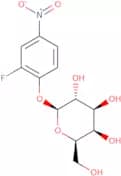
CAS :2-Fluoro-4-nitrophenyl b-D-galactopyranoside is a chromogenic substrate in enzymatic assays with β-galactosidase. Commonly abbreviated as PFONPG, it is a hydrophilic compound that can be dissolved in saline and blood samples, which makes it a suitable candidate for diagnostic applications as a gene reporter probe by simple analytic methodologies. 2-Fluoro-4-nitrophenyl b-D-galactopyranoside have been used to detect and monitor the growth of prostate tumor cells.Degré de pureté :Min. 95%Couleur et forme :PowderMasse moléculaire :319.24 g/mol