Substrats chromogènes
Les substrats chromogènes sont des composés qui produisent un changement de couleur visible lorsqu'ils sont métabolisés par des enzymes spécifiques. Ces substrats sont largement utilisés dans les tests diagnostiques, la recherche biochimique et les dosages immuno-enzymatiques (ELISA) pour détecter et quantifier l'activité enzymatique. Le changement de couleur permet une identification visuelle facile et rapide des réactions enzymatiques, faisant des substrats chromogènes des outils essentiels en analyse de laboratoire. Chez CymitQuimica, nous proposons une large sélection de substrats chromogènes de haute qualité pour soutenir vos applications de recherche et de diagnostic.
712 produits trouvés pour "Substrats chromogènes"
Trier par
Degré de pureté (%)
0
100
|
0
|
50
|
90
|
95
|
100
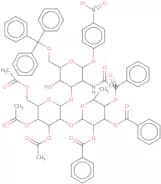
4-Nitrophenyl 2-acetamido-3-O-[2-O-(2,3,4-tri-O-benzoyl-a-L-fucopyranosyl)-3,4,6-tri-O-acetyl-D-galactopyranosyl]-2-deoxy-6-O-trityl -b-D-glucopyranoside
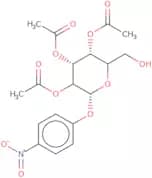
<p>4-nitrophenyl 2-acetamido-3-O-[2-O-(2,3,4-tri-O-benzoyl-a-L-fucopyranosyl)-3,4,6-tri-O-acetyl -D -galactopyranosyl]-2 deoxy 6 O trityl b D glucopyranoside is a chemiluminescent substrate that can be used in biochemical assays. It reacts with oxygen to produce light when it is excited by a UV or blue light source. This product has been tested for purity and quality by HPLC analysis and spectroscopy.</p>Degré de pureté :Min. 95%Masse moléculaire :1,331.33 g/mol4-Nitrophenyl 2,3,4-tri-O-acetyl-a-D-glucopyranoside
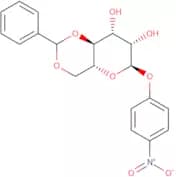
<p>4-Nitrophenyl 2,3,4-tri-O-acetyl-a-D-glucopyranoside is a high quality chemical used in the development of various diagnostic and research applications. It is also used in the production of enzymatic substrates for enzyme activity assays. 4NPTAG is a chromogenic substrate that produces chemiluminescence when it reacts with an oxidizing agent and has been shown to be very effective as a fluorogenic substrate for protein kinases. This compound has been shown to bind to ligands and can be used as a bioluminescent reporter for molecular biology applications. The CAS number for this product is 54973-14-0.</p>Degré de pureté :Min. 95%Masse moléculaire :427.36 g/mol4-Nitrophenyl 4,6-O-benzylidene-a-D-mannopyranoside
CAS :<p>4-Nitrophenyl 4,6-O-benzylidene-a-D-mannopyranoside is a chromogenic substrate for alpha-mannosidase and beta-glucosidase. It is used as a diagnostic tool for identifying the presence of these enzymes in certain bacteria. This product is also used in food testing, environmental testing, and bioluminescence.</p>Degré de pureté :Min. 95%Masse moléculaire :389.36 g/mol4-Nitrophenyl 4,6-benzylidene-3-O-(2,3,4,6-tetra-O-[4-methoxybenzyl]-a-D-glucopyranosyl)-a-D-glucopyranoside
<p>4-Nitrophenyl 4,6-benzylidene-3-O-(2,3,4,6-tetra-O-[4-methoxybenzyl]-a-D-glucopyranosyl)-a-D-glucopyranoside is a chemiluminescent substrate used for the detection of various enzymes. This substrate is commonly used in enzyme assays to measure the activity of β-galactosidase, α-amylase, and β-lactamase. The product can be used in diagnostic applications such as food testing and bacterial identification.</p>Degré de pureté :Min. 95%Masse moléculaire :1,088.02 g/mol5-Bromo-4-chloro-1H-indol-3-yl-b-D-glucuronide
CAS :<p>5-Bromo-4-chloro-3-indolyl β-D-glucuronide (BCIG) is an chromogenic enzyme substrate used to detect the presence of glucuronidase enzyme activity. The reaction occurs when BCIG reacts with the enzyme beta-glucuronidase yielding an intense blue color. It is used in a variety of biochemical and biomedical applications, such as the detection of pathogenic bacteria, the diagnosis of genetic disorders, and the isolation of recombinant proteins.</p>Formule :C14H13BrClNO7Degré de pureté :Min. 95%Masse moléculaire :422.61 g/mol2-Chloro-4-nitrophenyl b-D-lactoside
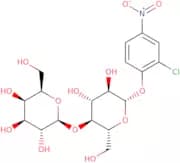
CAS :<p>2-Chloro-4-nitrophenyl b-D-galactopyranoside is a chromogenic enzyme substrate used to study the activity of beta-lactoside. It produces a yellow color when cleaved by the enzyme, making it a useful tool in enzyme assays and screening experiments.</p>Degré de pureté :Min. 95%Couleur et forme :PowderMasse moléculaire :497.83 g/mol4-Nitrophenyl 2-acetamido-2-deoxy-4-O-(a-L-fucopyranosyl)-b-D-glucopyranoside
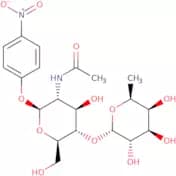
CAS :<p>4-Nitrophenyl 2-acetamido-2-deoxy-4-O-(a-L-fucopyranosyl)-b-D-glucopyranoside is a fluorescent substrate for beta-galactosidase that is used in diagnostics and research. The product has been shown to be an excellent substrate for beta-galactosidase and beta-glucuronidase, as well as other glycosidases. It can be used to detect the presence of these enzymes in any sample containing glycosides. This product is also used in food testing, environmental testing, and bioluminescence experiments. 4NPAFG is available in high purity with a conjugate group at the C4 position.</p>Degré de pureté :Min. 95%Masse moléculaire :488.44 g/molb-Naphthyl-b-maltotrioside
<p>b-Naphthyl-b-maltotrioside is a fluorogenic substrate that is used in enzymatic and chromogenic assays. It is a bifunctional substrate that reacts with enzymes to produce light. b-Naphthyl-b-maltotrioside can be used as a conjugate for immunoassays, such as ELISA. This substrate is also suitable for use in diagnostics, food testing, and environmental testing.</p>Degré de pureté :Min. 95%Masse moléculaire :630.59 g/mol2-Nitrophenyl 2,3,4,6-tetra-O-acetyl-b-D-galactopyranoside
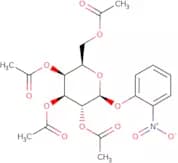
CAS :<p>2-Nitrophenyl 2,3,4,6-tetra-O-acetyl-b-D-galactopyranoside is a fluorescent substrate for β-galactosidase. It is used in food testing, environmental testing and diagnostics. This substrate is also used to detect the presence of β-galactosidase activity in cells and tissues.<br>2NPTABG provides a fluorescence signal that can be detected with an ultraviolet light or a luminometer. The luminescence intensity decreases when it reacts with β-galactosidase enzyme.<br>This product has a CAS number of 3053-17-6 and is available at high purity levels.</p>Degré de pureté :Min. 95%Masse moléculaire :469.4 g/mol4-Nitrophenyl 2-acetamido-3-O-acetyl-4,6-O-benzylidene-2-deoxy-a-D-glucopyranoside
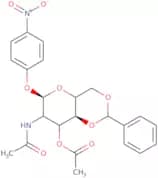
CAS :<p>4-Nitrophenyl 2-acetamido-3-O-acetyl-4,6-O-benzylidene-2-deoxy-aDglucopyranoside is a fluorogenic substrate that can be used for the detection of β-glucosidase activity. It is a water soluble substrate with an extinction coefficient of approximately 10,000 M−1 cm−1 at 420 nm. 4NPAABGDG is a chromogenic substrate that can be used to detect β-galactosidase activity. It has an extinction coefficient of approximately 1,700 M−1 cm−1 at 420 nm. The CAS number for 4NPAABGDG is 23262–56–8 and it is sold by Sigma Aldrich under catalog number L4959.</p>Degré de pureté :Min. 95%Masse moléculaire :472.44 g/molBCIP disodium salt sesquihydrate
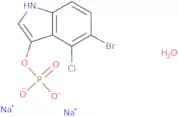
CAS :<p>BCIP is a dye that can be used as a substrate in a fluorometric assay to detect the presence of effector proteins. It is also used in analytical chemistry to detect phosphate, and as a reagent in diagnostic tests for mucin gene expression. BCIP has been shown to have transcriptional regulatory effects on genes encoding for proteins involved in antibody production. BCIP has been shown to act as an effector protein, which influences the amount of mRNA produced by the gene encoding for tissue culture cells. BCIP can also be used as a model system to study the regulation of transcription in vitro.<br>A hybridization technique using BCIP with DNA-dependent RNA polymerase II has been demonstrated and applied to analyze the mechanism of transcriptional control at the level of individual genes. The use of this technique allows for analysis at a single gene level and may allow for better understanding of transcriptional regulation.</p>Degré de pureté :Min. 95%Masse moléculaire :388.45 g/mol4-Nitrophenyl 6'-deoxy-6'-(2-pyridylamino)-a-D-penta-(1-4)-glucopyranoside
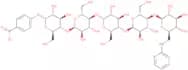
CAS :<p>4-Nitrophenyl 6'-deoxy-6'-(2-pyridylamino)-a-D-penta-(1-4)-glucopyranoside is a fluorescent substrate for the enzyme beta glucosidase. It is a chemiluminescent reagent that can be used to measure beta glucosidase activity. The substrate is an excellent high quality chemical and has been tested for environmental safety, heavy metal content and staining. 4-Nitrophenyl 6'-deoxy-6'-(2-pyridylamino)-a-D-penta-(1-4)-glucopyranoside is a chromogenic substrate that can be used in diagnostic testing, such as bioluminescence or fluorogenic assay. This product can also be used as a culture media additive or food testing agent.</p>Degré de pureté :Min. 95%Masse moléculaire :1,025.91 g/molAldol® 470 N-tosyl-L-alanine ester, Biosynth Patent: EP 2427431 and US 8940909
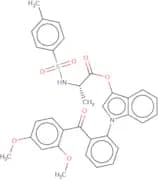
CAS :Produit contrôlé<p>Aldol® 470 N-tosyl-L-alanine ester is a fluorogenic substrate that is used in enzyme and chromogenic assays. It is a high purity, high quality, and highly soluble substrate for chemiluminescent reactions. Aldol® 470 N-tosyl-L-alanine ester can be used to detect the presence of bacteria in culture media and as an indicator of bacterial growth. It is also used to test for the presence of different types of enzymes that catalyze the oxidation of alcohols.</p>Formule :C33H30N2O7SDegré de pureté :Min. 90.0 Area-%Masse moléculaire :598.67 g/mol4-Nitrophenyl 4-O-(b-D-mannopyranosyl)-b-D-glucopyranoside
<p>4-Nitrophenyl 4-O-(b-D-mannopyranosyl)-b-D-glucopyranoside is a fluorogenic substrate that can be used for the detection of β-glucosidase activity in biological samples. It is an excellent substrate for the enzyme β-glucosidase, which catalyzes the hydrolysis of ester bonds in glycosides with release of glucose and formation of a phenolic product. The 4-nitrophenol group reacts with oxygen to produce light, making it useful as a chemiluminescent or bioluminescent substrate. The conjugate may also be used to detect β-glucosidase activity in culture media by adding the substrate to the culture medium and measuring its fluorescence.<br>4NP4OBG has been shown to have high purity, with only trace amounts of impurities detected such as benzaldehyde and 2,6-dinitro</p>Degré de pureté :Min. 95%Masse moléculaire :463.39 g/molAldol® 467 β-D-galactopyranoside, Biosynth Patent: EP 2427431 and US 8940909
CAS :<p>Aldol® 467 beta-D-galactopyranoside is a chromogenic and fluorogenic enzyme substrate used for detection of beta-galactosidase activity. The colorless product is cleaved by lactose-utilizing bacteria grown in liquid or solid media, yielding yellow coloration and green fluorescence. Aldol® 467 beta-D-galactopyranoside can also be used in beta-galactosidase gene reporter assays or immunoassay applications (ELISA). Aldol® 467 beta-D-galactopyranoside can be used under aerobic and anaerobic conditions.</p>Formule :C29H28ClNO9Degré de pureté :Min. 95.0 Area-%Masse moléculaire :570 g/molAldol® 544 β-D-galactopyranoside, Biosynth Patent: EP 2427431 and US 8940909
CAS :<p>Aldol 544 beta-D-galactopyranoside is a chromogenic substrate for the detection of beta-galactosidase activity in food testing and diagnostics. Aldol 544 beta-D-galactopyranoside is used as a conjugate to detect the presence of an enzyme, such as beta-galactosidase, in biological samples. It has been used in environmental testing and as a fluorogenic substrate for the detection of β-galactosidase activity.</p>Formule :C33H33ClN2O7Degré de pureté :Min. 95.0 Area-%Masse moléculaire :605.08 g/molAldol® 479 acetate, Biosynth Patent: EP 2427431 and US 8940909
CAS :Produit contrôlé<p>Aldol acetate is a chromogenic substrate that is used in food testing and diagnostics. Aldol acetate can be used in the detection of aminopeptidase and dipeptidyl peptidase activities, as well as in the determination of urinary proteins. Aldol acetate can also be used to detect anaerobic bacteria. This compound is conjugated with various ligands for use in immunoassays, such as beta-galactosidase, beta-glucuronidase, alpha-naphthyl phosphate ester, and phenyl phosphate ester. This product has been shown to be useful for chemiluminescent assays of DNA polymerases and reverse transcriptases in environmental samples. It has also been shown to be useful for bioluminescent assays of DNA polymerases and reverse transcriptases in environmental samples.</p>Formule :C25H22N2O3Degré de pureté :Min. 95.0 Area-%Masse moléculaire :398.45 g/molOctyl 4-nitrophenyl hexyl phosphonate
CAS :<p>Octyl 4-nitrophenyl hexyl phosphonate is a lipase suicide inhibitor that is a chromogenic substrate for lipases which upon enzymatic action, binds irreversibly to the lipase and inactivates it. The substrate can be used for the determination of active sites in lipases, especially in lipases preferring hydrophobic leaving groups.</p>Degré de pureté :Min. 95%Masse moléculaire :399.463-Indolyl b-D-cellotetraoside
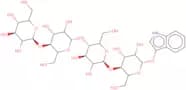
<p>3-Indolyl b-D-cellotetraoside is a chemiluminescent substrate that is used as an indicator in the detection of aminoglycosides. The ligand is a cell wall component that has been shown to bind specifically to the active site of bacterial β-lactamases, which are enzymes that catalyze the hydrolysis of β-lactam antibiotics. 3-Indolyl b-D-cellotetraoside can be used for bacterial identification and enumeration, food testing, and enzyme substrate for diagnostics. It fluoresces in response to electron excitation with a wavelength of about 590 nm.</p>Degré de pureté :Min. 95%Masse moléculaire :781.71 g/molAldol® 484 β-D-galactopyranoside, Biosynth Patent: EP 2427431 and US 8940909
CAS :<p>Aldol® 484 beta-D-galactopyranoside is a chromogenic enzyme substrate for beta-galactosidase activity. The colorless product is cleaved by lactose-utilizing bacteria in liquid or solid media, yielding intense red color. Aldol® 484 beta-D-galacto-pyranoside can also be used in beta-gal reporter gene assays or for identification of beta-gal positive transformants on agar. Aldol® 484 beta-D-galactopyranoside can be used under aerobic and anaerobic conditions.</p>Formule :C26H24ClFN2O7Degré de pureté :Min. 95.0 Area-%Masse moléculaire :530.93 g/mol

![4-Nitrophenyl 4,6-benzylidene-3-O-(2,3,4,6-tetra-O-[4-methoxybenzyl]-a-D-glucopyranosyl)-a-D-gluco…](/_next/image/?url=https%3A%2Fstatic.cymitquimica.com%2Fproducts%2F3D%2Fthumb-webp%2FEN04840.webp&w=3840&q=75)