Substrats chromogènes
Les substrats chromogènes sont des composés qui produisent un changement de couleur visible lorsqu'ils sont métabolisés par des enzymes spécifiques. Ces substrats sont largement utilisés dans les tests diagnostiques, la recherche biochimique et les dosages immuno-enzymatiques (ELISA) pour détecter et quantifier l'activité enzymatique. Le changement de couleur permet une identification visuelle facile et rapide des réactions enzymatiques, faisant des substrats chromogènes des outils essentiels en analyse de laboratoire. Chez CymitQuimica, nous proposons une large sélection de substrats chromogènes de haute qualité pour soutenir vos applications de recherche et de diagnostic.
712 produits trouvés pour "Substrats chromogènes"
Trier par
Degré de pureté (%)
0
100
|
0
|
50
|
90
|
95
|
100
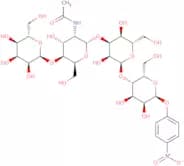
4-Nitrophenyl b-lacto-N-neotetraoside
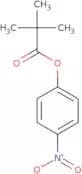
CAS :<p>4-Nitrophenyl b-lacto-N-neotetraoside is a potent antibiotic that inhibits bacterial growth by binding to the beta subunit of DNA gyrase. This drug has been shown to be effective against methicillin resistant Staphylococcus aureus (MRSA) and Clostridium perfringens, although is not active against acid-fast bacteria such as Mycobacterium tuberculosis or Mycobacterium avium complex. Gatifloxacin has shown anti-inflammatory properties, which may be due to its inhibition of prostaglandin synthesis.</p>Degré de pureté :Min. 95%Masse moléculaire :828.72 g/mol4-Nitrophenyl trimethylacetate
CAS :<p>4-Nitrophenyl trimethylacetate is a cytosolic proteinase inhibitor. It binds to the active site of trypsin and other enzymes that hydrolyze peptide bonds, thereby inhibiting the activity of these enzymes. 4-Nitrophenyl trimethylacetate has been shown to inhibit soybean trypsin, which has led to its use as a model system for studying enzyme inhibition. The binding site on 4-Nitrophenyl trimethylacetate is competitive with respect to substrate binding but not with respect to the enzyme's catalytic triad. This inhibitor also has a high buffer capacity and can be used in low pH systems.</p>Degré de pureté :Min. 95%Masse moléculaire :223.23 g/molAldol® 518 β-D-cellobioside, Biosynth Patent: EP 2427431 and US 8940909
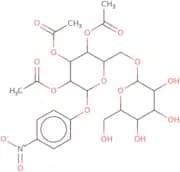
CAS :<p>Aldol® 518 beta-D-cellobioside is a chromogenic substrate for the detection of glycosidases. Aldol® 518 beta-D-cellobioside reacts with enzymes such as alpha-amylase, beta-galactosidase, and alpha-glucosidase to produce a fluorescent product. This product is detected by spectrophotometer, fluorometer, or luminometer. The fluorescence intensity is proportional to the concentration of the enzyme in the sample.<br>It has been shown that Aldol® 518 beta-D-cellobioside can be used as a substitute for conventional substrates in food testing and diagnostics, such as staining and culture media. It also has applications in environmental testing and enzyme substrate assays.</p>Formule :C35H39ClN2O12Degré de pureté :Min. 95 Area-%Masse moléculaire :715.15 g/mol4-Nitrophenyl 2,3,4-tri-O-acetyl-6-O-(a-D-glucopyranosyl)-a-D-glucopyranoside
<p>The 4-Nitrophenyl 2,3,4-tri-O-acetyl-6-O-(a-D-glucopyranosyl)-a-D-glucopyranoside is a fluorogenic substrate for β-galactosidase. This product has high purity and quality and is an enzyme substrate for β-galactosidase. The 4NPG2,3,4TRA can be used as a diagnostic tool in the diagnosis of bacterial infections. It is also used in the food testing industry and environmental testing industry. This product has CAS No.: 51743-71-1. This product is also a ligand that reacts with the enzyme β-galactosidase to produce light in chemiluminescence reactions. This product can be used for staining or bioluminescence applications.</p>Degré de pureté :Min. 95%Masse moléculaire :589.51 g/mol6-Bromo-2-naphthyl-α-D-mannopyranoside
CAS :<p>6-Bromo-2-naphthyl-alpha-D-mannopyranoside is a strong inhibitor of alpha-mannosidase. It has been shown to inhibit the growth of Mycobacterium tuberculosis and Streptococcus pneumoniae, which are both known to cause bacterial infections in humans. 6BNA inhibits the enzyme alpha-mannosidase, which hydrolyzes terminal α-(1,4)-linked mannose residues from oligosaccharides and glycoproteins. This drug has a high affinity for the active site of alpha-mannosidase and an IC50 value of 0.2 mM, making it an effective inhibitor.</p>Formule :C16H17BrO6Degré de pureté :Min. 98.0 Area-%Masse moléculaire :385.22 g/molAldol® 458 phosphate, disodium salt, Biosynth Patent: EP 2427431 and US 8940909
CAS :<p>Aldol® 458 phosphate is a chromogenic and fluorogenic enzyme substrate used for detection of phosphatase activity. The colorless enzyme substrate is cleaved by phosphatases secreted by bacteria grown in liquid media, yielding yellow color and green fluorescence. Aldol® 458 phosphate can also be used in assays involving phosphatase-coupled antibodies in immunoassay applications (ELISA). Aldol® 458 phosphate can be used under aerobic and anaerobic conditions.</p>Formule :C16H12NNa2O6PDegré de pureté :Min. 95.0 Area-%Masse moléculaire :391.22 g/mol[2-Methoxy-4-(2-nitrovinyl)phenyl] b-D-glucopyranoside
CAS :<p>[2-Methoxy-4-(2-nitrovinyl)phenyl] beta-D-galactopyranoside is a chromogenic substrate (505 nm) for β-glucosidase.</p>Degré de pureté :Min. 95%Masse moléculaire :357.31 g/mol5-Bromo-6-chloro-3-indoxyl choline phosphate
CAS :<p>5-Bromo-6-chloro-3-indoxyl choline phosphate is a chemiluminescent substrate for the detection of bacterial activity. It reacts with an enzyme, luciferase, which is present in a variety of living cells. The reaction produces light. This product has been tested for environmental and food safety by the manufacturer. 5-Bromo-6-chloro-3-indoxyl choline phosphate is used as a diagnostic tool to determine the presence of bacteria in humans, animals, and plants. It can be used to measure levels of bacteria in culture media, water samples, and food products. 5-Bromo-6-chloro-3-indoxyl choline phosphate can also be used as a substrate for enzymes such as phosphatases or esterases that catalyze reactions with substrates with brominated or chlorinated groups.</p>Formule :C13H17BrClN2O4PDegré de pureté :Min. 95%Masse moléculaire :411.63 g/mol4-Nitrophenyl 4,6-O-benzylidene-b-D-glucopyranoside
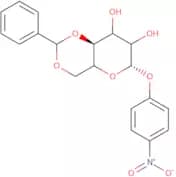
CAS :<p>4-Nitrophenyl 4,6-O-benzylidene-b-D-glucopyranoside is a fluorescent compound that is used in diagnostics and research. The compound is an enzyme substrate, a ligand for metal ions, and a chromogenic substrate. It can be used to test cultures of bacteria in culture media, as well as for food testing and environmental testing. 4-Nitrophenyl 4,6-O-benzylidene-b-D-glucopyranoside has high purity and quality due to its high fluorescence intensity. This product has been shown to be highly stable in various conditions and may be used in conjugates with other compounds.</p>Degré de pureté :Min. 95%Masse moléculaire :389.36 g/mol3-Indolyl b-D-glucuronide sodium salt
CAS :<p>3-Indolyl b-D-glucuronide sodium salt is a specialized enzyme substrate that features an indole moiety linked to a glucuronide group. This compound is commonly used in various biochemical assays to study the activity of glucuronidase enzymes, which play a crucial role in the metabolism and detoxification of xenobiotics and endogenous compounds. The sodium salt form of this substrate ensures enhanced solubility and stability in aqueous solutions, making it a valuable tool for researchers investigating the function and regulation of glucuronidase enzymes in biological systems. 3-Indolyl b-D-glucuronide sodium salt is also used for the detection of E. coli.</p>Degré de pureté :Min. 95%Couleur et forme :Off-White SolidMasse moléculaire :331.25 g/mol2-Bromo-4-nitrophenyl b-D-galactopyranoside
<p>2-Bromo-4-nitrophenyl b-D-galactopyranoside is a chemiluminescent substrate that is used for the detection of β-galactosidase activity in the biochemical reaction. It has been shown to be an excellent ligand for metal ions and can be used as a reagent in the determination of metal ions in biological systems. This product is manufactured with high purity and quality, which ensures its suitability for use in culture media, environmental testing, and diagnostics. 2-Bromo-4-nitrophenyl b-D-galactopyranoside has been tested as a fluorogenic substrate for β-galactosidase. It has also been used as a chromogenic substrate for β-galactosidase and an enzyme substrate for β-galactosidase. This product can be conjugated with other molecules such as biotin to enable rapid analysis of proteins or</p>Formule :C12H14BrNO8Degré de pureté :Min. 95%Masse moléculaire :380.15 g/mol4-Nitrophenyl 2,3-di-O-(2,3,4,6-tetra-O-acetyl-b-D-glucopyranosyl)-b-D-glucopyranoside
<p>4-Nitrophenyl 2,3-di-O-(2,3,4,6-tetra-O-acetyl-b-D-glucopyranosyl)-b-D-glucopyranoside is a fluorogenic substrate that is used in biochemistry as an enzyme substrate. It is a colorless solid that has high purity and high quality. This product is a ligand that binds to the enzyme beta glucosidase. The conjugate of this product with beta glucosidase can be used in diagnostics for the detection of glucose levels in culture media or food testing. This product also has chromogenic and chemiluminescent properties that are used in environmental testing and staining. CAS No.: 54323-05-8</p>Degré de pureté :Min. 95%Masse moléculaire :961.82 g/mol2-Chloro-4-nitrophenyl a-D-fucopyranoside
CAS :<p>2-Chloro-4-nitrophenyl a-D-fucopyranoside (CNPF) is a chromogenic enzyme substrate used primarily to detect fucosidase activity. CNPF is cleaved by the enzyme, which results in the release of a colored product that can be measured spectrophotometrically. Fucosidases are important enzymes that catalyze the hydrolysis of fucose-containing oligosaccharides, and CNPF is a commonly used substrate for the detection and quantification of these enzymes in various research studies.</p>Degré de pureté :Min. 95%Masse moléculaire :319.69 g/mol4-Nitrophenyl 2-azido-2-deoxy-a-D-galactopyranoside
CAS :<p>4-Nitrophenyl 2-azido-2-deoxy-a-D-galactopyranoside is a superior chromogenic substrate for the precise determination of alpha-D-galactosidase enzyme activity. This substrate features a unique 2-azido moiety providing enhanced sensitivity and specificity in biochemical assays. Upon enzymatic cleavage, it releases the highly fluorescent compound 4-nitrophenol, which simplifies quantification and tracking of enzyme activity in applications such as drug discovery, genetic studies, and enzyme inhibition assays.</p>Degré de pureté :Min. 95%Couleur et forme :White PowderMasse moléculaire :326.26 g/molAldol® 450 acetate, Biosynth Patent: EP 2427431 and US 8940909
CAS :<p>Aldol® 450 acetate is an enzyme substrate that is used in the detection of aldolase activity. Aldol® 450 acetate has been shown to be a useful alternative to the traditional bioluminescence and chemiluminescence methods for detecting aldolase activity. It has also been shown to be effective as a fluorogenic substrate for detecting aldolase activity in food products. Aldol® 450 acetate can be conjugated with other compounds, such as ligands and dyes, to enable it to detect different enzymes.<br>Aldol® 450 acetate has an absorption maximum at 450 nm and fluoresces blue-green under longwave UV light excitation. It is soluble in water and exhibits excellent stability at high temperatures (up to 50°C) and pH (1-14).</p>Formule :C27H19NO3Degré de pureté :Min. 95.0 Area-%Masse moléculaire :405.44 g/molBCM® Histamine-producing bacteria Broth
<p>Histamine (Scombrotoxin) fish poisoning is the most frequent cause of fish poisoning incidents today. Cymit Quimica's BCM®; Histamine-producingbacteria Broth (C-0450) is a growth medium for the detection of histamine-producing bacteria in food and water samples. The medium contains an indicator that turns orange to red due to metabolites released by histidine decarboxylase.</p>4-Nitrophenyl 2,3,4-tri-O-acetyl-6-O-trityl-a-D-glucopyranoside
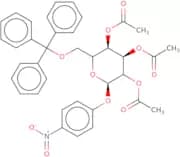
<p>4-Nitrophenyl 2,3,4-tri-O-acetyl-6-O-trityl-a-D-glucopyranoside is a substrate for chemiluminescent assays. It is a high quality chemical that can be used in environmental testing, staining, ligand binding and bioluminescence. 4NP2T6AODG is used as a chromogenic substrate or fluorogenic substrate to detect the presence of enzymes in diagnostics and food testing. This product has CAS No. 67794-14-0 and can be purchased at high purity.</p>Degré de pureté :Min. 95%Masse moléculaire :669.67 g/mol4-Nitrophenyl 4-O-(2,3,4,6-tetra-O-acetyl-b-D-galactopyranosyl)-2,3,6-tri-O-acetyl-b-D-thioglucopyranoside
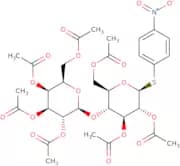
CAS :<p>4-Nitrophenyl 4-O-(2,3,4,6-tetra-O-acetyl-b-D-galactopyranosyl)-2,3,6-tri-O-acetyl-b-D-thioglucopyranoside is a superior chromogenic substrate for the detection of enzymes. Specifically designed for optimal performance, it provides exquisite sensitivity and definitive results in enzyme assays. Its exceptional properties make it a top choice among researchers and professionals in biochemistry, enabling accurate analysis and quantification of enzymatic activities.</p>Degré de pureté :Min. 95%Masse moléculaire :773.71 g/mol2,4-Dinitrophenyl 2-deoxy-2-fluoro-b-xylobioside
CAS :<p>2,4-Dinitrophenyl 2-deoxy-2-fluoro-beta-xylobioside, also known as DNFPX, is a substrate to study the activity of glycosidases. It is a derivative of xylobiose, which is a disaccharide composed of two xylose units. The 2-deoxy-2-fluoro modification on one of the xylose units makes the compound resistant to further hydrolysis by the enzyme, allowing it to be used as a reporter of enzyme activity. The 2,4-Dinitrophenyl group is used as a chromogenic group that enables rapid detection and measurement of the enzyme activity that can be quantitatively measured by monitoring the appearance of the yellow 2,4-dinitrophenyl group when cleavage of the glycosidic bond.</p>Degré de pureté :Min. 95%Masse moléculaire :450.33 g/molAldol® 515 propionate, Biosynth Patent: EP 2427431 and US 8940909
CAS :<p>Aldol® 515 propionate is a chromogenic substrate that is used as a reagent in food testing, diagnostics, and environmental testing. It reacts with an enzyme to form a fluorescent product that can be detected with a spectrophotometer. The substrate has been shown to have high purity and high quality.</p>Formule :C26H24N2O3Degré de pureté :Min. 95.0 Area-%Masse moléculaire :412.48 g/mol




![[2-Methoxy-4-(2-nitrovinyl)phenyl] b-D-glucopyranoside](/_next/image/?url=https%3A%2Fstatic.cymitquimica.com%2Fproducts%2F3D%2Fthumb-webp%2FEM06789.webp&w=3840&q=75)