AC-26834 - 14-dioxane-995-for-hplc | 123-91-1
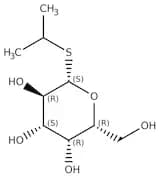
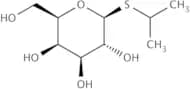
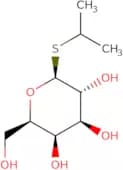
Isopropyl-β-D-thiogalactopyranoside (IPTG), Dioxane free, >99%, Ultrapure
CAS :Thermo Scientific Isopropyl-beta-D-thiogalactopyranoside (IPTG) Dioxane free Ultrapure
Formule :C9H18O5SDegré de pureté :99%Couleur et forme :White to pale cream, Powder or crystals or flakesMasse moléculaire :238.30Germanium(II) chloride dioxane adduct
CAS :Germanium(II) chloride dioxane adduct
Formule :C4H8Cl2GeO2Couleur et forme :white to off-white solidMasse moléculaire :231.65IPTG, 99.5%, dioxane free
CAS :Formule :C9H18O5SDegré de pureté :≥ 99.0%Couleur et forme :White crystalline powderMasse moléculaire :238.30Isopropyl ß-D-Thiogalactopyranoside, Dioxane Free
CAS :Applications A ß-Galactosidase inducer used also as an inducer for the activity of E. Coli lac operon.
References Cho, S. et al.: Biochem. Biophys. Res. Comm., 128, 1268 (1985), Sheffield, W.P., et al.: Biochem. Biophys. Res. Comm., 134, 21 (1986), Le Grice, S.F., et al.: Gene, 55, 95 (1987)Formule :C9H18O5SCouleur et forme :NeatMasse moléculaire :238.30Isopropyl-beta-D-thiogalactopyranoside, approx. 15.0% dioxane
CAS :A non-metabolizable allolactose analogue, widely used in molecular biology for overexpression of recombinant proteins from inducible systems under the control of lac promoter. IPTG binds to the LacI repressor and causes its release from the lac operator, allowing gene expression to take place. Present in vectors of pGEX, pGEM-T, pET, pRSET, pMAL class and others.Formule :C9H18O5SDegré de pureté :Min. 95%Couleur et forme :PowderMasse moléculaire :238.30 g/molIsopropyl-β-D-thiogalactopyranoside, <5ppm dioxane
CAS :IPTG is a gratuitous beta-D-galactosidase inducer. In Escherichia coli IPTG functions by binding to the lac repressor and altering its conformation. This inactivation prevents the repressor binding to the operator of the lac operon and thus the repression of the beta-galactosidase coding gene lacZ. IPTG is a commonly used reagent in cloning procedures that require induction of beta-galactosidase activity and is used in conjunction with X-Gal or Lapis-β-D-Gal in blue-white color selection of recombinant bacterial colonies.Formule :C9H18O5SDegré de pureté :Min. 99.0 Area-%Masse moléculaire :238.30 g/molIsopropyl-β-D-thiogalactopyranoside, approx. 15.0% dioxane
CAS :A non-metabolizable allolactose analogue, widely used in molecular biology for overexpression of recombinant proteins from inducible systems under the control of lac promoter. IPTG binds to the LacI repressor and causes its release from the lac operator, allowing gene expression to take place. Present in vectors of pGEX, pGEM-T, pET, pRSET, pMAL class and others.Formule :C9H18O5SMasse moléculaire :238.30 g/molRef: 3D-I-8050
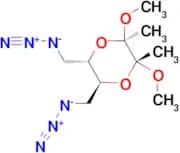
1kgÀ demander100gÀ demander250gÀ demander500gÀ demander2500gÀ demander-Unit-ggÀ demander(2R,3R,5S,6S)-5,6-bis(azidomethyl)-2,3-dimethoxy-2,3-dimethyl 1,4 dioxane
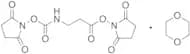
CAS :Formule :C10H18N6O4Degré de pureté :≥97%Masse moléculaire :286.292N-Succinimidoxycarbonyl-β-alanine N-Succinimidyl Ester 1,4- Dioxane complex
CAS :Produit contrôléApplications A short, amino reactive homobifunctional crosslinking reagent. Crosslinking distance 8.3 Å. It is useful in polymer coupling to proteins, because it may lead to a better selectivity among all the amino groups present in a protein, thus yielding less heterogeneous PEG-protein conjugates mixture because only the most nucleophilic and solvent exposed amines can react.
References Gross, H., et al.: Tetrahedron, 24, 6935 (1968), Clark, R., et al.: J. Biol. Chem., 271, 21969 (1996), Guiotto, A., et al.: Bioorg. Med. Chem., 12, 5031 (2004),Formule :C12H13N3O8·C4H8O2Couleur et forme :NeatMasse moléculaire :415.35Dioxane Bromonium Bromide
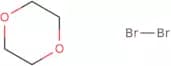
CAS :Produit contrôléDioxane Bromonium Bromide is a quinazolone derivative with inhibitory effects on the inflammatory process that is mediated by nitric oxide. Dioxane Bromonium Bromide inhibits the production of prostaglandins and leukotrienes, which are important mediators of inflammation. This drug has been shown to be effective in treating inflammatory bowel disease, autoimmune diseases, and cancer. The drug binds to the hydroxy group of tyrosine residues in proteins, which leads to inhibition of protein synthesis. It also reacts with chloride ions, forming pyridinium bromide. This reaction prevents the conversion of nitrite ions into reactive nitrogen species such as nitric oxide and peroxynitrite. This reaction product also inhibits neutrophil chemotaxis and degranulation, thereby reducing inflammation.Formule :C4H8Br2O2Degré de pureté :Min. 95%Masse moléculaire :247.91 g/mol2-[5-[(Acryloyloxy)methyl]-5-ethyl-1,3-dioxan-2-yl]-2-methylpropyl Acrylate (cis- and trans- mixture) (stabilized with MEHQ)
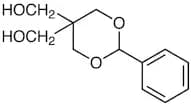
CAS :Formule :C17H26O6Degré de pureté :>95.0%(qNMR)Couleur et forme :Colorless to Light yellow clear liquidMasse moléculaire :326.395,5-Bis(hydroxymethyl)-2-phenyl-1,3-dioxane
CAS :Formule :C12H16O4Degré de pureté :>98.0%(GC)Couleur et forme :White to Almost white powder to crystalMasse moléculaire :224.26Bromine - 1,4-Dioxane Complex
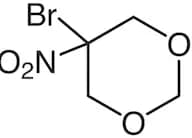
CAS :Formule :C4H8O2·Br2Degré de pureté :>95.0%(T)Couleur et forme :Light yellow to Brown powder to crystalMasse moléculaire :247.915-Bromo-5-nitro-1,3-dioxane
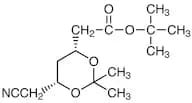
CAS :Formule :C4H6BrNO4Degré de pureté :>98.0%(GC)Couleur et forme :White to Almost white powder to crystalMasse moléculaire :212.00tert-Butyl (4R,6R)-6-Cyanomethyl-2,2-dimethyl-1,3-dioxane-4-acetate
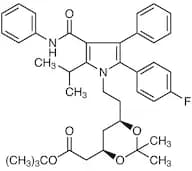
CAS :Formule :C14H23NO4Degré de pureté :>98.0%(GC)(N)Couleur et forme :White to Almost white powder to crystalMasse moléculaire :269.34tert-Butyl (4R,6R)-2-[6-[2-[2-(4-Fluorophenyl)-5-isopropyl-3-phenyl-4-(phenylcarbamoyl)pyrrol-1-yl]ethyl]-2,2-dimethyl-1,3-dioxan-4-yl]acetate
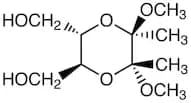
CAS :Formule :C40H47FN2O5Degré de pureté :>98.0%(HPLC)(N)Couleur et forme :White to Almost white powder to crystalMasse moléculaire :654.82(2R,3R,5S,6S)-5,6-Bis(hydroxymethyl)-2,3-dimethoxy-2,3-dimethyl-1,4-dioxane
CAS :Formule :C10H20O6Degré de pureté :>98.0%(GC)Couleur et forme :White to Almost white powder to crystalMasse moléculaire :236.265-Bromo-5-nitro-1,3-dioxane [for Biochemical Research]
CAS :Formule :C4H6BrNO4Degré de pureté :>98.0%(GC)Couleur et forme :White to Almost white powder to crystalineMasse moléculaire :212.00tert-Butyl (4R,6S)-6-(Hydroxymethyl)-2,2-dimethyl-1,3-dioxane-4-acetate
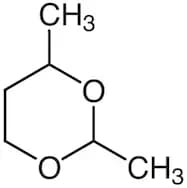
CAS :Formule :C13H24O5Degré de pureté :>98.0%(GC)Couleur et forme :Colorless to Light yellow to Light orange clear liquidMasse moléculaire :260.332,4-Dimethyl-1,3-dioxane
CAS :Formule :C6H12O2Degré de pureté :>98.0%(GC)Couleur et forme :Colorless to Almost colorless clear liquidMasse moléculaire :116.16







![2-[5-[(Acryloyloxy)methyl]-5-ethyl-1,3-dioxan-2-yl]-2-methylpropyl Acrylate (cis- and trans- mixtu…](/_next/image/?url=https%3A%2Fstatic.cymitquimica.com%2Fproducts%2F3B%2Fthumb-webp%2FA3441.webp&w=3840&q=75)


![5-Bromo-5-nitro-1,3-dioxane [for Biochemical Research]](/_next/image/?url=https%3A%2Fstatic.cymitquimica.com%2Fproducts%2F3B%2Fthumb-webp%2FB3769.webp&w=3840&q=75)