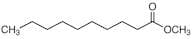
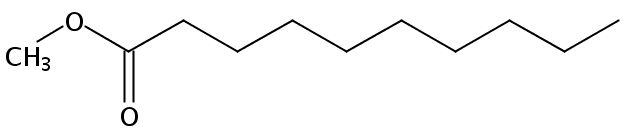
CAS 110-42-9
:Metil decanoato
Descrizione:
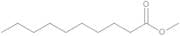
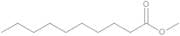
Metil decanoato, con il numero CAS 110-42-9, è un estere formato dalla reazione tra metanolo e acido decanoico. È caratterizzato dal suo piacevole odore fruttato, che lo rende utile nelle industrie dei sapori e delle fragranze. Questo composto è un liquido incolore o giallo pallido a temperatura ambiente e ha un punto di ebollizione relativamente basso, indicando che è volatile. Metil decanoato è solubile in solventi organici come etanolo ed etere, ma ha una solubilità limitata in acqua a causa della sua catena decanoato idrofobica. È comunemente usato come solvente e nella sintesi di altri composti chimici. Inoltre, presenta proprietà tipiche degli esteri, tra cui essere meno denso dell'acqua e avere una viscosità inferiore. Metil decanoato è anche riconosciuto per le sue potenziali applicazioni nella produzione di biodiesel e come composto modello negli studi sul metabolismo lipidico. I dati di sicurezza indicano che deve essere maneggiato con cura, poiché può essere un irritante per la pelle e gli occhi.
Formula:C11H22O2
InChI:InChI=1S/C11H22O2/c1-3-4-5-6-7-8-9-10-11(12)13-2/h3-10H2,1-2H3
InChI key:InChIKey=YRHYCMZPEVDGFQ-UHFFFAOYSA-N
SMILES:C(CCCCCCCC)C(OC)=O
Sinonimi:- C 1098
- Capric acid methyl ester
- Capric acid methyl ester~Decanoic acid methyl ester~Methyl decanoate
- Ce 1095
- Decanoate de methyle
- Decanoate, Methyl
- Decanoato De Metilo
- Decanoic acid methyl ester
- Estasol MD 10
- Metholene 2095
- Methyl caprinate
- Methyl decanoate
- Methyl n-caprate
- Methyl n-decanoate
- Methyldecanoat
- Methyle N-Caprinate
- Nsc 3713
- Pastell M 10
- Uniphat A 30
- Vedi altri sinonimi
Ordinare per
Purezza (%)
0
100
|
0
|
50
|
90
|
95
|
100
15 prodotti.
Methyl Decanoate [Standard Material for GC]
CAS:Formula:C11H22O2Purezza:>99.5%(GC)Colore e forma:Colorless clear liquidPeso molecolare:186.30Methyl Decanoate
CAS:Formula:C11H22O2Purezza:>98.0%(GC)Colore e forma:Colorless to Almost colorless clear liquidPeso molecolare:186.30Methyl decanoate, 98+%
CAS:It is employed as an intermediate for caproic acid, detergents, emulsifiers, wetting agents, stabilizers, resins, lubricants, plasticizers and flavoring. As a chemical intermediate for alkanolamides, fatty alcohols acids.This Thermo Scientific Chemicals brand product was originally part of the AlfaFormula:C11H22O2Purezza:98+%Colore e forma:Liquid, Clear colorless to pale yellowPeso molecolare:186.30Methyl Caprate
CAS:Saturated acyclic monocarboxylic acids and their anhydrides, halides, peroxides etc, nesoiFormula:C11H22O2Colore e forma:Clear Colorless LiquidPeso molecolare:186.3Methyl decanoate
CAS:Methyl decanoate (capric acid methyl ester) is an ester compound commonly used as an intermediate in organic synthesisFormula:C11H22O2Purezza:99.43%Colore e forma:SolidPeso molecolare:186.29Ref: 4Z-C-367004
5mgPrezzo su richiesta10mgPrezzo su richiesta25mgPrezzo su richiesta50mgPrezzo su richiesta100mgPrezzo su richiestaMethyl Decanoate(Methyl Caprate)
CAS:Applications Methyl Caprate, is an unsaturated biodiesel fuel surrogate. It can also be used as flavor and fragrance ingredients.
References Wang, W., et al.: Energy & Fuels, 27, 5527 (2013);Formula:C11H22O2Colore e forma:ColourlessPeso molecolare:186.29Capric Acid Methyl Ester (Methyl Decanoate) extrapure, 99%
CAS:Formula:C11H22O2Purezza:min. 99%Colore e forma:Clear, Colourless, LiquidPeso molecolare:186.29Methyl Decanoate
CAS:Methyl decanoate is a fatty acid that is used in the production of glycol ethers. It is produced by combining anhydrous sodium decanoate in a laminar flow reactor with methyl alcohol and water vapor. The mixture is heated to 180 °C, which causes the release of methyl alcohol and water vapor. The reaction mechanism for this process involves the oxidation of methyl alcohol, which creates a reactive intermediate. In the presence of oxygen and light, this intermediate reacts with the methyl decanoate to form methyl myristate and caproic acid. This process can also be carried out under constant pressure without using any solvent or catalyst. Methyl decanoate has been shown to react with fluorescence probes such as 8-hydroxyquinoline (8HQ). This reaction leads to changes in the fluorescence intensity, which can be detected using a spectrophotometer at wavelengths between 420 nm and 500 nm.Formula:C11H22O2Purezza:95%Min GcPeso molecolare:186.3 g/mol
![Methyl Decanoate [Standard Material for GC]](/_next/image/?url=https%3A%2Fstatic.cymitquimica.com%2Fproducts%2F3B%2Fthumb%2FS0308.jpg&w=3840&q=75)