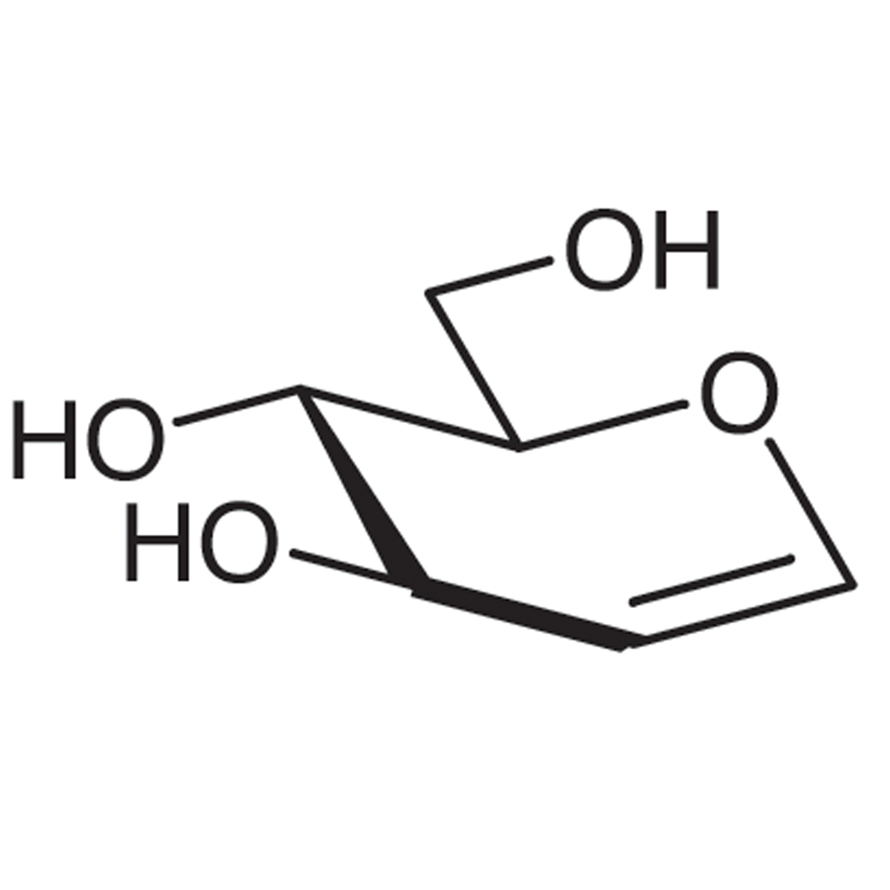
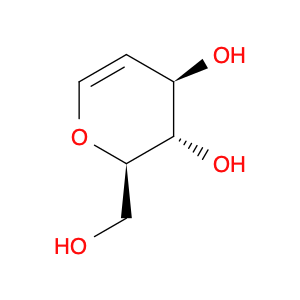
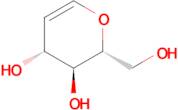
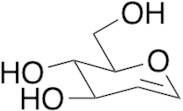
CAS 13265-84-4
:D-glucal
Descrizione:
D-glucal, con il numero CAS 13265-84-4, è un composto organico classificato come un aldoesoso ed è un derivato del glucosio. È caratterizzato dalla sua struttura a catena aperta, che presenta un gruppo carbonilico (aldeide) a un'estremità e più gruppi idrossilici lungo la catena di carbonio. D-glucal è tipicamente un solido bianco a bianco sporco ed è solubile in acqua grazie ai suoi gruppi funzionali polari. Questo composto è noto per la sua reattività, in particolare nelle reazioni di glicosilazione, rendendolo prezioso nella sintesi organica e nella chimica dei carboidrati. D-glucal può subire varie trasformazioni, inclusa ossidazione e riduzione, e può partecipare a reazioni di ciclopentano per formare glicosidi. Le sue caratteristiche strutturali contribuiscono alla sua importanza biologica, poiché può fungere da precursore per carboidrati più complessi. Inoltre, le proprietà di D-glucal lo rendono un soggetto di interesse nella ricerca relativa a glicoproteine e altre biomolecole.
Formula:C6H10O4
InChI:InChI=1/C6H10O4/c7-3-5-6(9)4(8)1-2-10-5/h1-2,4-9H,3H2/t4-,5-,6+/m1/s1
InChI key:InChIKey=YVECGMZCTULTIS-PBXRRBTRSA-N
SMILES:C(O)[C@@H]1[C@@H](O)[C@H](O)C=CO1
Sinonimi:- (4xi)-1,5-anhydro-2-deoxy-D-threo-hex-1-enitol
- 1,5-Anhydro-2-deoxy-<span class="text-smallcaps">D</span>-arabino-hex-1-enitol
- 1,5-Anhydro-2-deoxy-D-arabino-hex-1-enitol
- <span class="text-smallcaps">D</span>-(+)-Glucal
- <span class="text-smallcaps">D</span>-arabino-Hex-1-enitol, 1,5-anhydro-2-deoxy-
- <span class="text-smallcaps">D</span>-arabino-Hex-1-enopyranose, 1,2-dideoxy-
- D-arabino-Hex-1-enitol, 1,5-anhydro-2-deoxy-
- Glucal
- D-Glucal
- D-arabino-Hex-1-enopyranose, 1,2-dideoxy-
- (2R,3S,4R)-2-(hydroxymethyl)-3,4-dihydro-2H-pyran-3,4-diol
- (2R)-3β,4α-Dihydroxy-3,4-dihydro-2H-pyran-2α-methanol
- (2R)-3,4-Dihydro-2α-(hydroxymethyl)-2H-pyran-3β,4α-diol
- 1,2-Didehydro-1,2-dideoxy-D-glucopyranose
- P-GLUCAL
- 1,5-Anhydro-2-deoxy-D-arabino-hexa-1-enitol
- 1,5-anhydro-2-deoxy-d-arabino-hex-1-enito
- Vedi altri sinonimi
Filtra per
Percentuale di purezza
0
100
|
0
|
50
|
90
|
95
|
100
Trovati 9 prodotti.
- Prezzo più basso
- Prezzo più alto
- Purezza più bassa
- Purezza più alta
- Consegna più veloce
D-Glucal
CAS:Formula:C6H10O4Purezza:>97.0%(GC)Colore e forma:White to Almost white powder to crystalPeso molecolare:146.14D-Glucal
CAS:D-Glucal is an organic compound belonging to the family of aldohexoses, which are monosaccharides containing an aldehyde functional group. It features a six-carbon structure and is derived from glucose by oxidizing the primary alcohol group at carbon 1 to an aldehyde group. D-Glucal appears as a white crystalline solid, soluble in water, and has a sweet taste. It serves as a crucial intermediate in the chemical synthesis of various compounds, including pharmaceuticals, agrochemicals, and natural products. D-Glucal can be converted into other carbohydrate derivatives, such as glycosides, glycoconjugates, and amino sugars. Additionally, it plays a role in carbohydrate chemistry research and is used as a chiral component for synthesizing complex structures.Formula:C6H10O4Peso molecolare:146.1412D-Glucal
CAS:Formula:C6H10O4Purezza:≥ 98.0%Colore e forma:White to off-white or beige powderPeso molecolare:146.14D-Glucal
CAS:D-Glucal is a protonated d-glucal, which is a simple sugar. It reacts with the electron acceptor oxygen to form an oxidized product. This product can be reduced back to the original molecule by using a reducing agent, such as sodium borohydride or sodium dithionite. D-Glucal has been shown to inhibit the growth of tumor cells in mice that are resistant to other anticancer drugs. D-Glucal inhibits transcription and replication of DNA by binding to the DNA-dependent RNA polymerase and blocking its ability to transcribe messenger RNA (mRNA). The enzyme is also inhibited by glycosidic bond architectures that prevent it from binding to the DNA template strand. D-Glucal also has an effect on protein synthesis because it binds to proteins and prevents them from performing their normal functions. D-Glucal has been used as a model system for studying cellular processes in mammalian cells, such as oxidationFormula:C6H10O4Purezza:Min. 98 Area-%Colore e forma:White Off-White PowderPeso molecolare:146.14 g/mol(2R,3S,4R)-2-(Hydroxymethyl)-3,4-dihydro-2H-pyran-3,4-diol
CAS:Formula:C6H10O4Purezza:98%Colore e forma:SolidPeso molecolare:146.142D-Glucal
CAS:(2R,3S,4R)-2-(Hydroxymethyl)-3,4-dihydro-2H-pyran-3,4-diolFormula:C6H10O4Purezza:98%Peso molecolare:146.14D-Glucal
CAS:Prodotto controllatoApplications D-Glucal is an important building block for both solution- and solid-phase synthesis of oligosaccharides.
References Gilkes, N., et al.: J. Biol. Chem., 259, 10455 (1984), Street, I., et al.: Biochemistry, 31, 9970 (1992), Crout, D., et al.: Curr. Opin. Chem. Biol., 2, 98 (1998),Formula:C6H10O4Colore e forma:NeatPeso molecolare:146.14