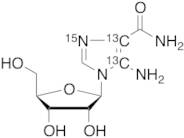
CAS 1609374-70-0
:Formula:C9H14N4O5
InChI:InChI=1S/C9H14N4O5/c10-7-4(8(11)17)12-2-13(7)9-6(16)5(15)3(1-14)18-9/h2-3,5-6,9,14-16H,1,10H2,(H2,11,17)/t3-,5-,6-,9-/m1/s1/i4+1,7+1,12+1
InChI key:RTRQQBHATOEIAF-CKEXIXISSA-N
SMILES:C1=[15N][13C](=[13C](N1[C@H]2[C@@H]([C@@H]([C@H](O2)CO)O)O)N)C(=O)N
Filtra per
Il filtro di purezza non è visibile perché i prodotti attuali non hanno dati di purezza associati per il filtraggio.
Trovati 2 prodotti.
- Prezzo più basso
- Prezzo più alto
- Purezza più bassa
- Purezza più alta
- Consegna più veloce
AICAR-13C2,15N
CAS:AICAR-13C2,15N is the isotopically labeled form of AICAR (T1477) with carbon-13 and nitrogen-15. AICAR (T1477) (Acadesine) acts as an adenosine analog and an AMPK activator, playing a role in glucose and lipid metabolism regulation, while inhibiting pro-inflammatory cytokines and iNOS production. Additionally, AICAR (T1477) functions as an inhibitor of autophagy, YAP, and mitochondrial autophagy.Formula:C9H14N4O5Peso molecolare:261.215-Aminoimidazole-4-carboxamide-1-beta-D-ribofuranoside-13C2,15N
CAS:Prodotto controllatoApplications A labelled nucleoside analogue that is able to enter nucleoside pools and is able to significantly increase levels of adenosine during periods of ATP breakdown. Adenosine-regulating agents (ARAs) have been recognized for therapeutic potential in myocardial ischemia. Cardioprotective.
References Mullane, K., et al.: Trends Cardiovasc Med., 3, 227 (1993), Browne, G.J., et al.: J. Biol. Chem., 279, 13, 12220 (2004)Formula:C2C7H1415NN3O5Colore e forma:NeatPeso molecolare:261.21