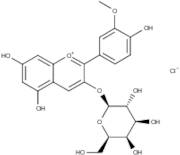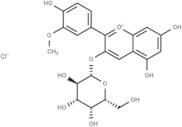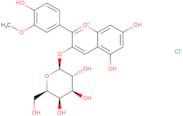
CAS 28148-89-2
:Formula:C22H23ClO11
InChI:InChI=1S/C22H22O11.ClH/c1-30-15-4-9(2-3-12(15)25)21-16(7-11-13(26)5-10(24)6-14(11)31-21)32-22-20(29)19(28)18(27)17(8-23)33-22;/h2-7,17-20,22-23,27-29H,8H2,1H3,(H2-,24,25,26);1H/t17-,18+,19+,20-,22-;/m1./s1
InChI key:VDTNZDSOEFSAIZ-HVOKISQTSA-N
SMILES:COC1=C(C=CC(=C1)C2=[O+]C3=CC(=CC(=C3C=C2O[C@H]4[C@@H]([C@H]([C@H]([C@H](O4)CO)O)O)O)O)O)O.[Cl-]
Filtra per
Percentuale di purezza
0
100
|
0
|
50
|
90
|
95
|
100
Trovati 7 prodotti.
- Prezzo più basso
- Prezzo più alto
- Purezza più bassa
- Purezza più alta
- Consegna più veloce
3-(Galactosyloxy)-4',5,7-trihydroxy-3'-methoxyflavylium chloride
CAS:3-(Galactosyloxy)-4',5,7-trihydroxy-3'-methoxyflavylium chlorideFormula:C22H23ClO11Purezza:≥95%Peso molecolare:498.86Peonidin-3-O-galactoside chloride (Standard)
CAS:Peonidin-3-O-galactoside chloride (Standard) is a reference standard for research and analysis in studies involving Peonidin-3-O-galactoside chloride. Peonidin-3-O-galactoside chloride has antioxidant activity.Formula:C22H23ClO11Peso molecolare:498.864Peonidin-3-O-galactoside chloride
CAS:Peonidin-3-O-galactoside chloride analytical standard provided with w/w absolute assay, to be used for quantitative titration.Formula:C22H23O11ClPurezza:(HPLC) ≥95%Colore e forma:PowderPeso molecolare:498.873-(Galactosyloxy)-4′,5,7-trihydroxy-3′-methoxyflavylium chloride
CAS:Formula:C22H23ClO11Purezza:93%Colore e forma:SolidPeso molecolare:498.8644Peonidin-3-O-galactoside chloride
CAS:Peonidin-3-O-galactoside chloride has antioxidant activity.Formula:C22H23ClO11Purezza:98%Colore e forma:SolidPeso molecolare:498.864Peonidin-3-O-galactoside chloride
CAS:Peonidin-3-O-galactoside chloride is a natural product that can be found in many plants, such as the genus Peonia, and is also commonly found in wine. It has been shown to inhibit pancreatic lipase in vitro and may have potential as a dietary supplement. The surface methodology used to study the interaction of protocatechuic acid with caco-2 cells was efficient and showed the ability of this compound to interact with fatty acids. This interaction could be related to its health effects, which have been studied using cell culture methods. The dietary intake of protocatechuic acid has been shown to reduce blood pressure in rats, but it is unclear if this effect would occur in humans because of the lack of a suitable animal model for human studies.Formula:C22H23O11·ClPurezza:Min. 95%Colore e forma:PowderPeso molecolare:498.86 g/mol