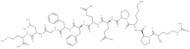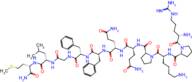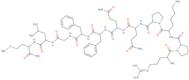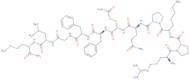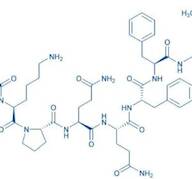
CAS 33507-63-0
:Sostanza P
Descrizione:
Sostanza P è un neuropeptide che funge principalmente da neurotrasmettitore e neuromodulatore nei sistemi nervoso centrale e periferico. È composto da undici aminoacidi ed è parte della famiglia dei peptidi tachichinina. Caratteristicamente, Sostanza P è coinvolto nella trasmissione dei segnali di dolore e gioca un ruolo significativo nelle risposte infiammatorie, nello stress e nell'ansia. Si lega al recettore della neurochinina-1 (NK1), che è ampiamente distribuito nel cervello e in altri tessuti, influenzando vari processi fisiologici. Oltre al suo ruolo nella percezione del dolore, Sostanza P è implicato nella regolazione dell'umore, dell'ansia e della risposta immunitaria. Il peptide si trova tipicamente in alte concentrazioni in aree del cervello associate alla regolazione del dolore e delle emozioni. A causa del suo coinvolgimento in varie condizioni patofisiologiche, Sostanza P è stato un obiettivo per interventi terapeutici nella gestione del dolore e nei disturbi psichiatrici. Il suo numero CAS, 33507-63-0, è utilizzato per l'identificazione in database chimici e contesti normativi.
Formula:C63H98N18O13S
InChI:InChI=1S/C63H98N18O13S/c1-37(2)33-45(57(89)74-41(53(68)85)27-32-95-3)73-52(84)36-72-54(86)46(34-38-15-6-4-7-16-38)78-58(90)47(35-39-17-8-5-9-18-39)79-56(88)42(23-25-50(66)82)75-55(87)43(24-26-51(67)83)76-59(91)49-22-14-31-81(49)62(94)44(20-10-11-28-64)77-60(92)48-21-13-30-80(48)61(93)40(65)19-12-29-71-63(69)70/h4-9,15-18,37,40-49H,10-14,19-36,64-65H2,1-3H3,(H2,66,82)(H2,67,83)(H2,68,85)(H,72,86)(H,73,84)(H,74,89)(H,75,87)(H,76,91)(H,77,92)(H,78,90)(H,79,88)(H4,69,70,71)/t40-,41-,42-,43-,44-,45-,46-,47-,48-,49-/m0/s1
InChI key:ADNPLDHMAVUMIW-CUZNLEPHSA-N
SMILES:CC(C)C[C@@H](C(=O)N[C@@H](CCSC)C(=O)N)NC(=O)CNC(=O)[C@H](CC1=CC=CC=C1)NC(=O)[C@H](CC2=CC=CC=C2)NC(=O)[C@H](CCC(=O)N)NC(=O)[C@H](CCC(=O)N)NC(=O)[C@@H]3CCCN3C(=O)[C@H](CCCCN)NC(=O)[C@@H]4CCCN4C(=O)[C@H](CCCN=C(N)N)N
Sinonimi:- 2: PN: JP2005049164 SEQID: 2 claimed protein
- 21: PN: WO0181408 SEQID: 44 claimed protein
- 36: PN: WO2007058336 SEQID: 36 claimed protein
- 44: PN: WO2005016244 PAGE: 68 claimed protein
- 690: PN: WO2004005342 PAGE: 46 claimed protein
- L-Methioninamide, L-arginyl-L-prolyl-L-lysyl-L-prolyl-L-glutaminyl-L-glutaminyl-L-phenylalanyl-L-phenylalanylglycyl-L-leucyl-
- Neurokinin P
- Substance P (1-11)
- Substance P (peptide)
- Substance P (smooth-muscle stimulant)
- Substanz P
- Vedi altri sinonimi
Filtra per
Percentuale di purezza
0
100
|
0
|
50
|
90
|
95
|
100
Trovati 7 prodotti.
- Prezzo più basso
- Prezzo più alto
- Purezza più bassa
- Purezza più alta
- Consegna più veloce
Substance P
CAS:For cellular and molecular biology applicationsFormula:C63H98N18O13SColore e forma:Lyophilized Powder, WhitePeso molecolare:1347.65Substance P
CAS:Substance P (Neurokinin P) (SP) is an undecapeptide (a peptide composed of a chain of 11 amino acid residues) member of the tachykinin neuropeptide family.Formula:C63H98N18O13SPurezza:98% - 99.51%Colore e forma:White SolidPeso molecolare:1347.63Substance P (Human, Bovine, Rat, Mouse)
CAS:Substance P is a member of the tachykinin neuropeptide family which is produced in the central nervous system (CNS) and acts through its specific receptor neurokinin 1 receptor (NK-1R). NK-1R is present in neurons and on glial cell types. Substance P is involved in: pain perceptions as a neurotransmitter; gut motility; increased inflammation in the lungs, gastrointestinal tract and the skin and neuroinflammation. Interestingly the levels of Substance P are raised in inflammatory bowel diseases and through its involvement in cytokine release, it contributes to asthma pathology. These diverse selection of functions makes substance P a target for therapeutic research. This product is available as a 0.5 mg vial.Formula:C63H98N18O13SPurezza:Min. 95%Peso molecolare:1,347.6 g/molSubstance P
CAS:Substance P is a protein that belongs to the tachykinin family of neuropeptides. It is a powerful activator of the inflammatory response, and also inhibits cell growth in cancer cells. There has been some evidence that Substance P may be useful in treating Alzheimer's disease, due to its ability to inhibit the proliferation of certain brain cells. The levels of substance P are increased in patients with Alzheimer's, and it has been hypothesized that this increase may be related to the progression of the disease.
Formula:C63H98N18O13SPurezza:Min. 95%Peso molecolare:1,347.63 g/molSubstance P
CAS:Substance P (SP), a neuropeptide discovered already in 1931, is closely related to neurokinin A. SP acts as neurotransmitter and as neuromodulator.Formula:C63H98N18O13SPurezza:≥ 98%Colore e forma:White LyophilisatePeso molecolare:1347.65