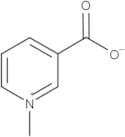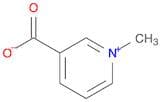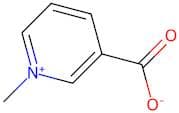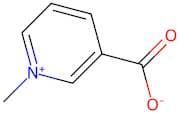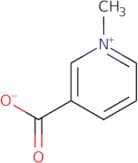
CAS 535-83-1
:Trigonellina
- 1-Methyl-1,2-Dihydropyridine-3-Carboxylic Acid
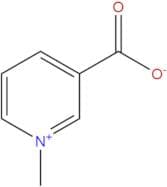
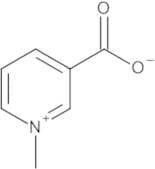
- 1-Methylpyridin-1-ium-3-carboxylate
- 1-Methylpyridinium-3-Carboxylate
- Betaine nicotinate
- Caffearine
- Coffearin
- Coffearine
- Gynesine
- N-Methylnicotinate
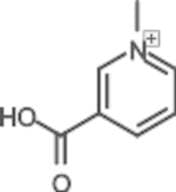
- N-Methylnicotinic acid
- Pyridinium, 3-carboxy-1-methyl-, hydroxide, inner salt
- Pyridinium, 3-carboxy-1-methyl-, inner salt
- Trigenolline
- Vedi altri sinonimi
Trigonelline
CAS:Trigonelline analytical standard provided with chromatographic purity, to be used as reference material for qualitative determination.Formula:C7H7NO2Purezza:(HPLC) ≥95%Colore e forma:PowderPeso molecolare:137.15Trigonelline
CAS:Other alkaloids,natural or reproduced by synthesis, and their salts, ethers,esters&other derivatives, nesoiFormula:C7H7NO2·H2OColore e forma:White PowderPeso molecolare:137.047681-Methylpyridinium-3-carboxylate
CAS:Formula:C7H7NO2Purezza:95%Colore e forma:SolidPeso molecolare:137.13601-Methylpyridin-1-Ium-3-Carboxylate
CAS:1-Methylpyridin-1-Ium-3-CarboxylatePurezza:99%Peso molecolare:137.14g/molTrigonelline
CAS:Trigonelline (Trigenolline), an alkaloid with potential antidiabetic activity, is present in considerable amounts in coffee.Formula:C7H7NO2Purezza:97.585% - 99.49%Colore e forma:Prisms Aqueous From Alcohol + Water SolidPeso molecolare:137.14Ref: 4Z-N-0677
5mgPrezzo su richiesta10mgPrezzo su richiesta25mgPrezzo su richiesta50mgPrezzo su richiesta100mgPrezzo su richiestaRef: 4Z-N-0669
5mgPrezzo su richiesta10mgPrezzo su richiesta25mgPrezzo su richiesta50mgPrezzo su richiesta100mgPrezzo su richiestaTrigonelline
CAS:Prodotto controllatoApplications Trigonelline is an alkaloid present in coffee and fenugreek presenting phytoestrogenic activity.
References Folwarczna, J. et al.: Mol. Nutr. Food Res., 58, 1457 (2014);Formula:C7H7NO2Colore e forma:White To Light BeigePeso molecolare:137.14Trigonelline-D3 Hydrate
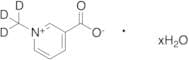
CAS:Prodotto controllatoApplications Trigonelline-D3 is an intermediate used in the synthesis of Trigonelline-d3 HCl (N-methyl-d3) (T794052), which is deuterium labelled Trigonelline HCl. Trigonelline HCl has utility in developing site-specific system that delivers drugs to the brain. It has also been suggested as a potential anti-Alzheimer disease agent.
References Bodor, N., et al.: J. Med. Chem 26, 313 (1983); Makowska, J., et al.: J. Chromatogr. B 968, 101 (2014)Formula:C7H4D3NO2•xH2OColore e forma:NeatPeso molecolare:140.151802Trigonelline
CAS:Trigonelline is a natural compound found in plants belonging to the family of Fabaceae. It has been shown to be a potent activator of Toll-like receptor 4 (TLR4) and induces an inflammatory response in biological samples, such as macrophage cells. Trigonelline also has anti-inflammatory properties and has been shown to inhibit neuronal death. The hypoglycemic effect of trigonelline may be due to its inhibition of glucose uptake by cells. Furthermore, trigonelline has been shown to act as an antioxidant and regulate energy metabolism through the action of mitochondria. Trigonelline also acts as a matrix metalloproteinase inhibitor, which may provide therapeutic benefits for osteoarthritis and other diseases resulting from joint degradation. Trigonelline can be extracted from plants by chromatographic analysis or purified from plant material using analytical methods such as high performance liquid chromatography (HPLC).
Formula:C7H7NO2Purezza:Min. 98 Area-%Colore e forma:White Off-White PowderPeso molecolare:137.14 g/mol