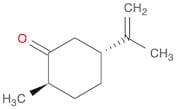
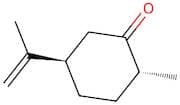
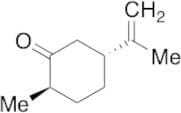
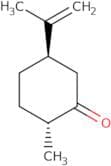
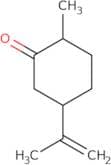
CAS 5524-05-0
:(+)-Diidrocarvone
Descrizione:
(+)-Diidrocarvone è una chetone monoterpenoide chirale, conosciuta principalmente per il suo aroma di menta, che la rende un composto prezioso nell'industria dei sapori e delle fragranze. È un liquido incolore o giallo pallido a temperatura ambiente e si caratterizza per il suo piacevole profumo di menta. Il composto ha una formula molecolare di C10H16O e presenta un anello di cicloesene con un gruppo carbonilico, contribuendo alla sua reattività e potenziali applicazioni nella sintesi organica. (+)-Diidrocarvone è solubile in solventi organici come etanolo ed etere, ma ha una solubilità limitata in acqua. La sua attività ottica è notevole, poiché esiste in due forme enantiomeriche, con la forma (+) che è la variante naturalmente occorrente. Questo composto è spesso utilizzato nella formulazione di profumi, cosmetici e prodotti alimentari, e può anche mostrare attività biologiche, comprese proprietà antimicrobiche. I dati di sicurezza indicano che deve essere maneggiato con cura, poiché può causare irritazione al contatto con la pelle o gli occhi.
Formula:C10H16O
InChI:InChI=1S/C10H16O/c1-7(2)9-5-4-8(3)10(11)6-9/h8-9H,1,4-6H2,2-3H3/t8-,9-/m1/s1
InChI key:InChIKey=AZOCECCLWFDTAP-RKDXNWHRSA-N
SMILES:C(C)(=C)[C@H]1CC(=O)[C@H](C)CC1
Sinonimi:- (+)-Dihydrocarvone, mixture of isomers
- (+)-trans-Dihydrocarvone
- (1R,4R)-(+)-Dihydrocarvone
- (2R,5R)-(+)-Dihydrocarvone
- (2R,5R)-2-Methyl-5-(1-methylethenyl)cyclohexanone
- (2R,5R)-2-Methyl-5-(prop-1-en-2-yl)cyclohexan-1-one
- (2R,5R)-2-methyl-5-(prop-1-en-2-yl)cyclohexanone
- (2R,5R)-5-Isopropenyl-2-methylcyclohexanone
- (2S,5R)-2-methyl-5-(prop-1-en-2-yl)cyclohexanone
- 8-p-Menthen-2-one
- Cyclohexanone, 2-methyl-5-(1-methylethenyl)-, (2R,5R)-
- Cyclohexanone, 2-methyl-5-(1-methylethenyl)-, (2R-trans)-
- d-Dihydrocarvone
- p-Menth-8(9)-en-2-one
- p-Menth-8-en-2-one, (+)-
- (+)-Dihydrocarvone
- Cyclohexanone,2-methyl-5-(1-methylethenyl)-,trans-
- p-Menth-8-en-2-one,trans-
- (2R-trans)-2-methyl-5-(1-methylvinyl)cyclohexan-1-one
- (+)-dihydrocarvone,mixtureofisomers
- (2R)-2α-Methyl-5β-(1-methylethenyl)cyclohexanone
- Cyclohexanone,2-methyl-5-(1-methylethenyl)-,(2R,5R)-rel-
- DIHYDROCARVONE/2-METHYL-5-(1-METHYLETHENYL)-,(2R-TRANS)-CYCLOHEXANONE
- (2R)-2α-Methyl-5β-isopropenylcyclohexanone
- (2theta-trans)-cyclohexanon
- 2-methyl-5-(1-methylethenyl)-,(2R-trans)-Cyclohexanone
- (2R,5R)-2-Methyl-5-isopropenylcyclohexanone
- Vedi altri sinonimi
Ordinare per
Purezza (%)
0
100
|
0
|
50
|
90
|
95
|
100
7 prodotti.
(+)-DIHYDROCARVONE MIXTURE OF ISOMERS
CAS:Formula:C10H16OPurezza:98%Colore e forma:LiquidPeso molecolare:152.2334(2R,5R)-2-Methyl-5-(Prop-1-En-2-Yl)Cyclohexanone
CAS:(2R,5R)-2-Methyl-5-(Prop-1-En-2-Yl)CyclohexanonePurezza:98%, stabilized with TBCPeso molecolare:152.23g/mol(+)-Dihydrocarvone (Mixture of (2S)/(2R) isomers)
CAS:Formula:C10H16OColore e forma:NeatPeso molecolare:152.23D-Dihydrocarvone
CAS:D-Dihydrocarvone is a compound that has shown promising effects in the treatment of epileptic encephalopathy. It has been found to interact with the 5-HT2C receptor, which plays a role in regulating serotonin levels in the brain. This interaction may contribute to its antiepileptic properties. Additionally, D-Dihydrocarvone has been studied for its potential cardiovascular benefits. It has been shown to have myocardial protective effects and may help improve cardiac function in certain conditions. Furthermore, D-Dihydrocarvone has demonstrated sodium-dependent glucose transporter inhibitory activity, suggesting potential applications in managing diabetes. Overall, this compound holds promise for various therapeutic applications and warrants further research.Formula:C10H16OPurezza:Min. 97 Area-%Peso molecolare:152.23 g/mol(2R,5R)-2-Methyl-5-(prop-1-en-2-yl)cyclohexanone
CAS:Formula:C10H16OPurezza:95%Colore e forma:LiquidPeso molecolare:152.237(2R,5R)-2-Methyl-5-(prop-1-en-2-yl)cyclohexan-1-one
CAS:(2R,5R)-2-Methyl-5-(prop-1-en-2-yl)cyclohexan-1-one is an enantiomer of (2S,5S)-2-methyl-5-(prop-1-en-2-yl)cyclohexan -1 -one. It belongs to the class of saponins and has been shown to have a synergistic effect with glutamic acid in the synthesis of deionized water. It can be used as a test drug for the detection of staphylococcus bacteria.Formula:C10H16OPurezza:Min. 95%Peso molecolare:152.23 g/mol