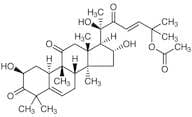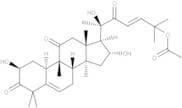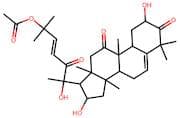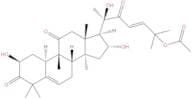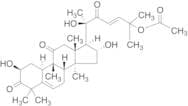
CAS 6199-67-3
:(+)-Cucurbitacina B
Descrizione:
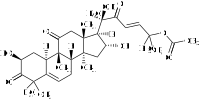
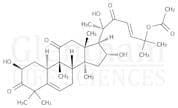
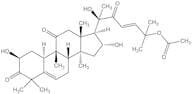
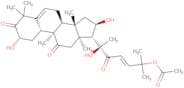
(+)-Cucurbitacina B è un composto triterpenoide appartenente alla famiglia dei cucurbitacini, che deriva principalmente da varie piante della famiglia Cucurbitaceae, come cetrioli e zucche. Questo composto è caratterizzato dalla sua complessa struttura tetraciclica, che contribuisce alla sua attività biologica. È noto per il suo sapore amaro ed è stato studiato per le sue potenziali proprietà farmacologiche, inclusi effetti antitumorali, antinfiammatori e antidiabetici. (+)-Cucurbitacina B mostra citotossicità contro varie linee cellulari tumorali, rendendolo un argomento di interesse nella ricerca sul cancro. Inoltre, è stato dimostrato che influenza diverse vie di segnalazione, comprese quelle relative all'apoptosi e alla proliferazione cellulare. Il composto si trova tipicamente in basse concentrazioni negli estratti vegetali e può essere isolato attraverso varie tecniche di estrazione e purificazione. La sua struttura unica e le attività biologiche lo rendono un composto prezioso per ulteriori ricerche in chimica medicinale e farmacologia. Tuttavia, a causa dei suoi effetti potenti, si consiglia cautela nel suo uso e manipolazione.
Formula:C32H46O8
InChI:InChI=1S/C32H46O8/c1-17(33)40-27(2,3)13-12-23(36)32(9,39)25-21(35)15-29(6)22-11-10-18-19(14-20(34)26(38)28(18,4)5)31(22,8)24(37)16-30(25,29)7/h10,12-13,19-22,25,34-35,39H,11,14-16H2,1-9H3/b13-12+/t19-,20+,21-,22+,25+,29+,30-,31+,32+/m1/s1
InChI key:InChIKey=IXQKXEUSCPEQRD-DKRGWESNSA-N
SMILES:C[C@]12[C@@](C)([C@@]([C@@](C(/C=C/C(OC(C)=O)(C)C)=O)(C)O)([C@H](O)C1)[H])CC(=O)[C@]3(C)[C@]2(CC=C4[C@]3(C[C@H](O)C(=O)C4(C)C)[H])[H]
Sinonimi:- (23E)-2,16,20-trihydroxy-9,10,14-trimethyl-1,11,22-trioxo-4,9-cyclo-9,10-secocholesta-5,23-dien-25-yl acetate
- (2S,4R,9beta,16alpha)-2,16,20-trihydroxy-9,10,14-trimethyl-1,11,22-trioxo-4,9-cyclo-9,10-secocholesta-5,23-dien-25-yl acetate
- (2S,4R,9beta,16alpha,17xi,23E)-2,16,20-trihydroxy-9,10,14-trimethyl-1,11,22-trioxo-4,9-cyclo-9,10-secocholesta-5,23-dien-25-yl acetate
- (2S,4R,9beta,16alpha,23E)-2,16,20-trihydroxy-9,10,14-trimethyl-1,11,22-trioxo-4,9-cyclo-9,10-secocholesta-5,23-dien-25-yl acetate
- (2β,9β,10α,16α,23E)-25-(Acetyloxy)-2,16,20-trihydroxy-9-methyl-19-norlanosta-5,23-diene-3,11,22-trione
- 19-Nor-9β,10α-lanosta-5,23-diene-3,11,22-trione, 2β,16α,20,25-tetrahydroxy-9-methyl-, 25-acetate
- 19-Norlanosta-5,23-diene-3,11,22-trione, 25-(acetyloxy)-2,16,20-trihydroxy-9-methyl-, (2β,9β,10α,16α,23E)-
- Amarine
- Cucurbitacine B
- Hy-N 0416
- NSC 144154
- NSC 49451
- Vedi altri sinonimi
Ordinare per
Purezza (%)
0
100
|
0
|
50
|
90
|
95
|
100
10 prodotti.
Cucurbitacin B
CAS:Formula:C32H46O8Purezza:>98.0%(HPLC)Colore e forma:White to Light yellow powder to crystalPeso molecolare:558.71Cucurbitacin B
CAS:Cucurbitacin B analytical standard provided with w/w absolute assay, to be used for quantitative titration.Formula:C32H46O8Purezza:(HPLC) ≥95%Colore e forma:PowderPeso molecolare:558.72Cucurbitacin B
CAS:Cucurbitacin B (cucB) is a triterpenoid constituent of Cucurbitaceae vegetables and a promising phytochemical for cancer prevention, cucB induces G(2) arrest and apoptosis through a STAT3-independent but ROS-dependent mechanism in SW480 cells.Formula:C32H46O8Purezza:95%~99%Colore e forma:White powderPeso molecolare:558.712Cucurbitacin B
CAS:Cucurbitacin B (Cuc B) has profound in vitro and in vivo antiproliferative effects against human pancreatic Y cells.Formula:C32H46O8Purezza:97.1% - 99.33%Colore e forma:SolidPeso molecolare:558.70Ref: 4Z-C-266004
5mgPrezzo su richiesta10mgPrezzo su richiesta25mgPrezzo su richiesta50mgPrezzo su richiesta100mgPrezzo su richiestaCucurbitacin B
CAS:Formula:C32H46O8Purezza:≥ 98.0%Colore e forma:White to off-white powderPeso molecolare:558.71Cucurbitacin b
CAS:Carboxylic acid with additional oxygen functionsFormula:C32H46O8Purezza:≥ 90.0 % (HPLC)Colore e forma:PowderPeso molecolare:558.71Cucurbitacin B
CAS:Prodotto controllatoCucurbitacin B is a triterpenoid compound, which is derived from plants primarily within the Cucurbitaceae family. This compound exhibits its mode of action through the inhibition of the JAK-STAT signaling pathway, effectively disrupting processes that are critical for cell survival and proliferation. As a result, Cucurbitacin B is being extensively studied for its antiproliferative and pro-apoptotic properties, especially in the context of cancer research.Formula:C32H46O8Purezza:Min. 95%Colore e forma:White PowderPeso molecolare:558.7 g/molCucurbitacin B
CAS:Prodotto controllatoApplications Cucurbitacin B is a tetracyclic triterpenoid, which can induce apoptosis in human hepatoma cells. It can also induce DNA damage and autophagy in MCF-7 breast cancer cells.In the wild, watermelons, cucumbers, and muskmelons produce bitter Cucurbitacins to defend against preditors. Humans have bred these fruits to eliminate these compounds thereby yielding fruits that are more appealing to our palate.
Not a dangerous good if item is equal to or less than 1g/ml and there is less than 100g/ml in the package
References Sun, Y., et al.: Eur. J. Pharmacol. 768, 28 (2015); Ren, G., et al.: J. Nat. Med. 69, 522 (2015); C&E News p. 10, Dec. 5, 2016jFormula:C32H46O8Colore e forma:NeatPeso molecolare:558.7