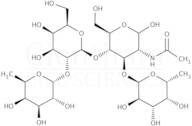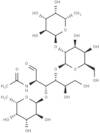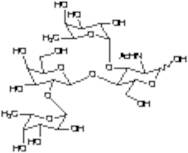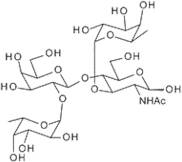
CAS 82993-43-9
:Formula:C26H45NO19
InChI:InChI=1S/C26H45NO19/c1-7-13(33)16(36)19(39)24(41-7)44-21(10(4-28)27-9(3)31)22(11(32)5-29)45-26-23(18(38)15(35)12(6-30)43-26)46-25-20(40)17(37)14(34)8(2)42-25/h4,7-8,10-26,29-30,32-40H,5-6H2,1-3H3,(H,27,31)/t7-,8-,10-,11+,12+,13+,14+,15-,16+,17+,18-,19-,20-,21+,22+,23+,24-,25-,26-/m0/s1
InChI key:APQKPNYMOAYHPL-ILVDQUQFSA-N
SMILES:C[C@H]1[C@H]([C@H]([C@@H]([C@@H](O1)O[C@@H]2[C@H]([C@H]([C@H](O[C@H]2O[C@H]([C@@H](CO)O)[C@@H]([C@H](C=O)NC(=O)C)O[C@H]3[C@H]([C@@H]([C@@H]([C@@H](O3)C)O)O)O)CO)O)O)O)O)O
Filtra per
Percentuale di purezza
0
100
|
0
|
50
|
90
|
95
|
100
Trovati 6 prodotti.
- Prezzo più basso
- Prezzo più alto
- Purezza più bassa
- Purezza più alta
- Consegna più veloce
Lewis y Tetrasaccharide
CAS:Lewis y TetrasaccharideFormula:C26H45NO19Purezza:99%Peso molecolare:675.63Lewis y tetrasaccharide
CAS:Lewis Y tetrasaccharide, a derivative of Lewis X, is an antigen linked to ovarian cancer metastasis and bad prognosis.Formula:C26H45NO19Colore e forma:SolidPeso molecolare:675.6308Lewis y tetrasaccharide
CAS:Formula:C26H45NO19Purezza:99%Colore e forma:SolidPeso molecolare:675.6308Lewis Y Tetrasaccharide
CAS:Prodotto controllatoApplications Lewis Y Tetrasaccharide (cas# 82993-43-9) is a compound useful in organic synthesis.
Formula:C26H45NO19Colore e forma:NeatPeso molecolare:675.63Lewis Y tetrasaccharide
CAS:Lewis Y tetrasaccharide is a type of antigen that is used as a pharmacological agent. It has been shown to be effective in treating carcinoma cell lines and primary sclerosing cholangitis. Lewis Y tetrasaccharide has also been shown to be an antigen for the mouse monoclonal antibody, which is used in cancer research. The Lewis Y tetrasaccharide stimulates the immune system by interacting with certain cells called dendritic cells and macrophages, which are responsible for activating T-cells. This interaction promotes the production of chemoattractant proteins, which are proteins that attract white blood cells to fight infection and promote healing. Lewis Y tetrasaccharide has also been shown to cause cancer cell death by lysing cells through apoptosis or necrosis depending on the tissue type.Formula:C26H45NO19Purezza:(%) Min. 95%Colore e forma:PowderPeso molecolare:675.64 g/mol