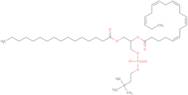
CAS 99296-77-2
:Formula:C44H78NO8P
InChI:InChI=1S/C44H78NO8P/c1-6-8-10-12-14-16-18-20-21-22-23-25-27-29-31-33-35-37-44(47)53-42(41-52-54(48,49)51-39-38-45(3,4)5)40-50-43(46)36-34-32-30-28-26-24-19-17-15-13-11-9-7-2/h8,10,14,16,20-21,23,25,29,31,42H,6-7,9,11-13,15,17-19,22,24,26-28,30,32-41H2,1-5H3/b10-8-,16-14-,21-20-,25-23-,31-29-/t42-/m1/s1
InChI key:KLTHQSWIRFFBRI-CPFPVJFHSA-N
SMILES:CCCCCCCCCCCCCCCC(=O)OC[C@H](COP(=O)([O-])OCC[N+](C)(C)C)OC(=O)CCC/C=C\C/C=C\C/C=C\C/C=C\C/C=C\CC
Filtra per
Percentuale di purezza
0
100
|
0
|
50
|
90
|
95
|
100
Trovati 2 prodotti.
- Prezzo più basso
- Prezzo più alto
- Purezza più bassa
- Purezza più alta
- Consegna più veloce
1-Palmitoyl-2-Eicosapentaenoyl-sn-Glycero-3-Phosphatidylcholine
CAS:Formula:C44H78NO8PPurezza:>99%Peso molecolare:780.07Palmitoyleicosapentaenoyl phosphatidylcholine
CAS:Palmitoyleicosapentaenoic acid (PAPA) is a long-chain polyunsaturated fatty acid that can be found in the cell membranes of cells. Palmitoyleicosapentaenoyl phosphatidylcholine (PAPPC) is a derivative of PAPA that can be used in biomedical research and as a dietary supplement. PAPPC was synthesized by esterification of palmitoyl-CoA with phosphatidylcholine. It has been shown to have potential as an anti-cancer agent, an inhibitor of HIV infection, and for the treatment of neurological disorders such as Alzheimer's disease. The experimental result showed that PAPPC had a higher degree of fluidity than other types of phospholipids. This could be due to its high degree of unsaturation, which may make it more susceptible to radiation or reactive oxygen species (ROS).Formula:C44H78NO8PPurezza:(%) Min. 95%Colore e forma:Yellow PowderPeso molecolare:780.07 g/mol